%44%6f%6e%67%2d%48%77%61%20%53%65%6f
-
 Development of Dream Battery Material: Air-Stable and Fast-Charging All-Solid-State Battery
<(Bottom row, from left) Dr. Jae-Seung Kim (Seoul National University), Prof. Dong-Hwa Seo (KAIST), Researcher Heeju Park (KAIST), Researcher Jiwon Seo, Researcher Jinyeong Choe.
(Top row, from left) Researcher Hae-Yong Kim (Dongguk University), Prof. Eunryeol Lee (Chungbuk National University), Prof. Kyung-Wan Nam (Dongguk University), Prof. Yoon Seok Jung (Yonsei University)>
Expectations are rising for all-solid-state batteries—the "dream battery" with low fire risk—not only for electric vehicles but also for various fields such as robotics and Urban Air Mobility (UAM). A research team at our university has presented a new design principle that simultaneously overcomes the limitations of solid electrolytes, which were previously vulnerable to air exposure and suffered from low performance. This technology is gaining significant attention as it can enhance both battery safety and charging speeds, demonstrating the feasibility of commercializing next-generation all-solid-state batteries.
KAIST announced on April 16th that a research team led by Professor Dong-Hwa Seo from the Department of Materials Science and Engineering, through joint research with teams from Dongguk University (President Jae-Woong Yoon), Yonsei University (President Dong-Sup Yoon), and Chungbuk National University (Acting President Yu-Sik Park), has developed a design technology for solid electrolytes used in all-solid-state batteries. This technology maintains structural stability even when exposed to air while dramatically increasing ionic conductivity.
Unlike conventional lithium-ion batteries that use liquid electrolytes, all-solid-state batteries are spotlighted as next-generation batteries due to their low fire risk. Among these, halide-based solid electrolytes—which contain halogen elements such as chlorine (Cl) and bromine (Br)—are advantageous in terms of performance due to their high ionic conductivity. However, they are known to be difficult materials to manufacture and handle because they are highly vulnerable to moisture in the air, which easily degrades their performance.
To solve this problem, the research team introduced a new structure called "Oxygen Anchoring." This method involves stably bonding oxygen inside the electrolyte to strengthen its structural intergrity, a process in which the element Tungsten plays a key role.
< Research image on tungsten-based oxygen fixation strategy >
As a result, it was confirmed that the electrolyte maintains a stable structure without collapsing, even in air-exposed environments.
Furthermore, the research team improved battery performance in addition to stability. The changes in the internal structure of the electrolyte widened the pathways for lithium ions, allowing them to move more smoothly and increasing the ion migration speed. It was confirmed that the oxygen-incorporated material exhibited an ionic conductivity approximately 2.7 times higher than that of conventional zirconium (Zr)-based halide solid electrolytes.
Another feature of this technology is that it is not limited to a specific material. The research team applied the same strategy to various halide solid electrolytes, including those based on zirconium (Zr), indium (In), yttrium (Y), and erbium (Er), and confirmed similar effects. This demonstrates that it is a "universal design principle" applicable to a wide range of battery materials.
< Research image (AI-generated image) >
The research team expects this technology to contribute to the development of solid electrolytes that possess both air stability and high performance.
Professor Dong-Hwa Seo stated, "This study presents a new material design principle that optimizes multiple performances through a structural design strategy that simultaneously improves air stability and ionic conductivity. It will serve as a key indicator for future all-solid-state battery research and process development."
This study involved Jae-Seung Kim (formerly KAIST, now SNU), Heeju Park, and Hae-Yong Kim as joint first authors. The research included contributions from Eunryeol Lee, Heewon Kim, Soeul Lee, Jinyeong Choe, Jiwon Seo, Hyeon-Jong Lee, Hojoon Kim, Jemin Yeon, and Yoon Seok Jung. The findings were published on March 6, 2026, in the international academic journal Advanced Energy Materials.
Paper Title: Universal Oxychlorination Strategy in Halide Solid Electrolytes for All-Solid-State Batteries
DOI: https://doi.org/10.1002/aenm.202506744
This research was conducted with support from the Samsung Electronics Future Technology Promotion Center and the Nano and Materials Technology Development Program of the National Research Foundation of Korea. Computational studies were performed using the resources of the National Supercomputing Center.
2026.04.16 View 702
Development of Dream Battery Material: Air-Stable and Fast-Charging All-Solid-State Battery
<(Bottom row, from left) Dr. Jae-Seung Kim (Seoul National University), Prof. Dong-Hwa Seo (KAIST), Researcher Heeju Park (KAIST), Researcher Jiwon Seo, Researcher Jinyeong Choe.
(Top row, from left) Researcher Hae-Yong Kim (Dongguk University), Prof. Eunryeol Lee (Chungbuk National University), Prof. Kyung-Wan Nam (Dongguk University), Prof. Yoon Seok Jung (Yonsei University)>
Expectations are rising for all-solid-state batteries—the "dream battery" with low fire risk—not only for electric vehicles but also for various fields such as robotics and Urban Air Mobility (UAM). A research team at our university has presented a new design principle that simultaneously overcomes the limitations of solid electrolytes, which were previously vulnerable to air exposure and suffered from low performance. This technology is gaining significant attention as it can enhance both battery safety and charging speeds, demonstrating the feasibility of commercializing next-generation all-solid-state batteries.
KAIST announced on April 16th that a research team led by Professor Dong-Hwa Seo from the Department of Materials Science and Engineering, through joint research with teams from Dongguk University (President Jae-Woong Yoon), Yonsei University (President Dong-Sup Yoon), and Chungbuk National University (Acting President Yu-Sik Park), has developed a design technology for solid electrolytes used in all-solid-state batteries. This technology maintains structural stability even when exposed to air while dramatically increasing ionic conductivity.
Unlike conventional lithium-ion batteries that use liquid electrolytes, all-solid-state batteries are spotlighted as next-generation batteries due to their low fire risk. Among these, halide-based solid electrolytes—which contain halogen elements such as chlorine (Cl) and bromine (Br)—are advantageous in terms of performance due to their high ionic conductivity. However, they are known to be difficult materials to manufacture and handle because they are highly vulnerable to moisture in the air, which easily degrades their performance.
To solve this problem, the research team introduced a new structure called "Oxygen Anchoring." This method involves stably bonding oxygen inside the electrolyte to strengthen its structural intergrity, a process in which the element Tungsten plays a key role.
< Research image on tungsten-based oxygen fixation strategy >
As a result, it was confirmed that the electrolyte maintains a stable structure without collapsing, even in air-exposed environments.
Furthermore, the research team improved battery performance in addition to stability. The changes in the internal structure of the electrolyte widened the pathways for lithium ions, allowing them to move more smoothly and increasing the ion migration speed. It was confirmed that the oxygen-incorporated material exhibited an ionic conductivity approximately 2.7 times higher than that of conventional zirconium (Zr)-based halide solid electrolytes.
Another feature of this technology is that it is not limited to a specific material. The research team applied the same strategy to various halide solid electrolytes, including those based on zirconium (Zr), indium (In), yttrium (Y), and erbium (Er), and confirmed similar effects. This demonstrates that it is a "universal design principle" applicable to a wide range of battery materials.
< Research image (AI-generated image) >
The research team expects this technology to contribute to the development of solid electrolytes that possess both air stability and high performance.
Professor Dong-Hwa Seo stated, "This study presents a new material design principle that optimizes multiple performances through a structural design strategy that simultaneously improves air stability and ionic conductivity. It will serve as a key indicator for future all-solid-state battery research and process development."
This study involved Jae-Seung Kim (formerly KAIST, now SNU), Heeju Park, and Hae-Yong Kim as joint first authors. The research included contributions from Eunryeol Lee, Heewon Kim, Soeul Lee, Jinyeong Choe, Jiwon Seo, Hyeon-Jong Lee, Hojoon Kim, Jemin Yeon, and Yoon Seok Jung. The findings were published on March 6, 2026, in the international academic journal Advanced Energy Materials.
Paper Title: Universal Oxychlorination Strategy in Halide Solid Electrolytes for All-Solid-State Batteries
DOI: https://doi.org/10.1002/aenm.202506744
This research was conducted with support from the Samsung Electronics Future Technology Promotion Center and the Nano and Materials Technology Development Program of the National Research Foundation of Korea. Computational studies were performed using the resources of the National Supercomputing Center.
2026.04.16 View 702 -
 Breaking Performance Barriers of All Solid State Batteries
< (Bottom, from left) Professor Dong-Hwa Seo, Researcher Jae-Seung Kim, (Top, from left) Professor Kyung-Wan Nam, Professor Sung-Kyun Jung, Professor Youn-Seok Jung >
Batteries are an essential technology in modern society, powering smartphones and electric vehicles, yet they face limitations such as fire explosion risks and high costs. While all-solid-state batteries have garnered attention as a viable alternative, it has been difficult to simultaneously satisfy safety, performance, and cost. Recently, a Korean research team successfully improved the performance of all-solid-state batteries simply through structural design—without adding expensive metals.
KAIST announced on January 7th that a research team led by Professor Dong-Hwa Seo from the Department of Materials Science and Engineering, in collaboration with teams led by Professor Sung-Kyun Jung (Seoul National University), Professor Youn-Suk Jung (Yonsei University), and Professor Kyung-Wan Nam (Dongguk University), has developed a design method for core materials for all-solid-state batteries that uses low-cost raw materials while ensuring high performance and low risk of fire or explosion.
Conventional batteries rely on lithium ions moving through a liquid electrolyte. In contrast, all-solid-state batteries use a solid electrolyte. While this makes them safer, achieving rapid lithium-ion movement within a solid has typically required expensive metals or complex manufacturing processes.
To create efficient pathways for lithium-ion transport within the solid electrolyte, the research team focused on "divalent anions" such as oxygen and sulfur . Divalent anions play a crucial role in altering the crystal structure by integrating into the basic framework of the electrolyte.
The team developed a technology to precisely control the internal structure of low-cost zirconium (Zr)-based halide solid electrolytes by introducing these divalent anions. This design principle, termed the "Framework Regulation Mechanism," widens the pathways for lithium ions and lowers the energy barriers they encounter during transport. By adjusting the bonding environment and crystal structure around the lithium ions, the team enabled faster and easier movement.
To verify these structural changes, the researchers utilized various high-precision analysis techniques, including:
High-energy Synchrontron X-ray diffraction(Synchrotron XRD)
Pair Distribution Function (PDF) analysis
X-ray Absorption Spectroscopy (XAS)
Density Functional Theory (DFT) modeling for electronic structure and diffusion.
The results showed that electrolytes incorporating oxygen or sulfur improved lithium-ion mobility by 2 to 4 times compared to conventional zirconium-based electrolytes. This signifies that performance levels suitable for practical all-solid-state battery applications can be achieved using inexpensive materials.
Specifically, the ionic conductivity at room temperature was measured at approximately 1.78 mS/cm for the oxygen-doped electrolyte and 1.01 mS/cm for the sulfur-doped electrolyte. Ionic conductivity indicates how quickly and smoothly lithium ions move; a value above 1 mS/cm is generally considered sufficient for practical battery applications at room temperature.
< Structural Regulation Mechanism of Zr-based Halide Electrolytes via Divalent Anion Introduction >
< Atomic Rearrangement of Solid Electrolyte for All-Solid-State Batteries (AI-generated image) >
Professor Dong-Hwa Seo stated, "Through this research, we have presented a design principle that can simultaneously improve the cost and performance of all-solid-state batteries using cheap raw materials. Its potential for industrial application is very high." Lead author Jae-Seung Kim added that the study shifts the focus from "what materials to use" to "how to design them" in the development of battery materials.
This study, with Jae-Seung Kim (KAIST) and Da-Seul Han (Dongguk University) as co-first authors, was published in the international journal Nature Communications on November 27, 2025.
Paper Title: Divalent anion-driven framework regulation in Zr-based halide solid electrolytes for all-solid-state batteries
DOI: https://www.nature.com/articles/s41467-025-65702-2
This research was supported by the Samsung Electronics Future Technology Promotion Center, the National Research Foundation of Korea, and the National Supercomputing Center.
2026.01.07 View 5020
Breaking Performance Barriers of All Solid State Batteries
< (Bottom, from left) Professor Dong-Hwa Seo, Researcher Jae-Seung Kim, (Top, from left) Professor Kyung-Wan Nam, Professor Sung-Kyun Jung, Professor Youn-Seok Jung >
Batteries are an essential technology in modern society, powering smartphones and electric vehicles, yet they face limitations such as fire explosion risks and high costs. While all-solid-state batteries have garnered attention as a viable alternative, it has been difficult to simultaneously satisfy safety, performance, and cost. Recently, a Korean research team successfully improved the performance of all-solid-state batteries simply through structural design—without adding expensive metals.
KAIST announced on January 7th that a research team led by Professor Dong-Hwa Seo from the Department of Materials Science and Engineering, in collaboration with teams led by Professor Sung-Kyun Jung (Seoul National University), Professor Youn-Suk Jung (Yonsei University), and Professor Kyung-Wan Nam (Dongguk University), has developed a design method for core materials for all-solid-state batteries that uses low-cost raw materials while ensuring high performance and low risk of fire or explosion.
Conventional batteries rely on lithium ions moving through a liquid electrolyte. In contrast, all-solid-state batteries use a solid electrolyte. While this makes them safer, achieving rapid lithium-ion movement within a solid has typically required expensive metals or complex manufacturing processes.
To create efficient pathways for lithium-ion transport within the solid electrolyte, the research team focused on "divalent anions" such as oxygen and sulfur . Divalent anions play a crucial role in altering the crystal structure by integrating into the basic framework of the electrolyte.
The team developed a technology to precisely control the internal structure of low-cost zirconium (Zr)-based halide solid electrolytes by introducing these divalent anions. This design principle, termed the "Framework Regulation Mechanism," widens the pathways for lithium ions and lowers the energy barriers they encounter during transport. By adjusting the bonding environment and crystal structure around the lithium ions, the team enabled faster and easier movement.
To verify these structural changes, the researchers utilized various high-precision analysis techniques, including:
High-energy Synchrontron X-ray diffraction(Synchrotron XRD)
Pair Distribution Function (PDF) analysis
X-ray Absorption Spectroscopy (XAS)
Density Functional Theory (DFT) modeling for electronic structure and diffusion.
The results showed that electrolytes incorporating oxygen or sulfur improved lithium-ion mobility by 2 to 4 times compared to conventional zirconium-based electrolytes. This signifies that performance levels suitable for practical all-solid-state battery applications can be achieved using inexpensive materials.
Specifically, the ionic conductivity at room temperature was measured at approximately 1.78 mS/cm for the oxygen-doped electrolyte and 1.01 mS/cm for the sulfur-doped electrolyte. Ionic conductivity indicates how quickly and smoothly lithium ions move; a value above 1 mS/cm is generally considered sufficient for practical battery applications at room temperature.
< Structural Regulation Mechanism of Zr-based Halide Electrolytes via Divalent Anion Introduction >
< Atomic Rearrangement of Solid Electrolyte for All-Solid-State Batteries (AI-generated image) >
Professor Dong-Hwa Seo stated, "Through this research, we have presented a design principle that can simultaneously improve the cost and performance of all-solid-state batteries using cheap raw materials. Its potential for industrial application is very high." Lead author Jae-Seung Kim added that the study shifts the focus from "what materials to use" to "how to design them" in the development of battery materials.
This study, with Jae-Seung Kim (KAIST) and Da-Seul Han (Dongguk University) as co-first authors, was published in the international journal Nature Communications on November 27, 2025.
Paper Title: Divalent anion-driven framework regulation in Zr-based halide solid electrolytes for all-solid-state batteries
DOI: https://www.nature.com/articles/s41467-025-65702-2
This research was supported by the Samsung Electronics Future Technology Promotion Center, the National Research Foundation of Korea, and the National Supercomputing Center.
2026.01.07 View 5020 -
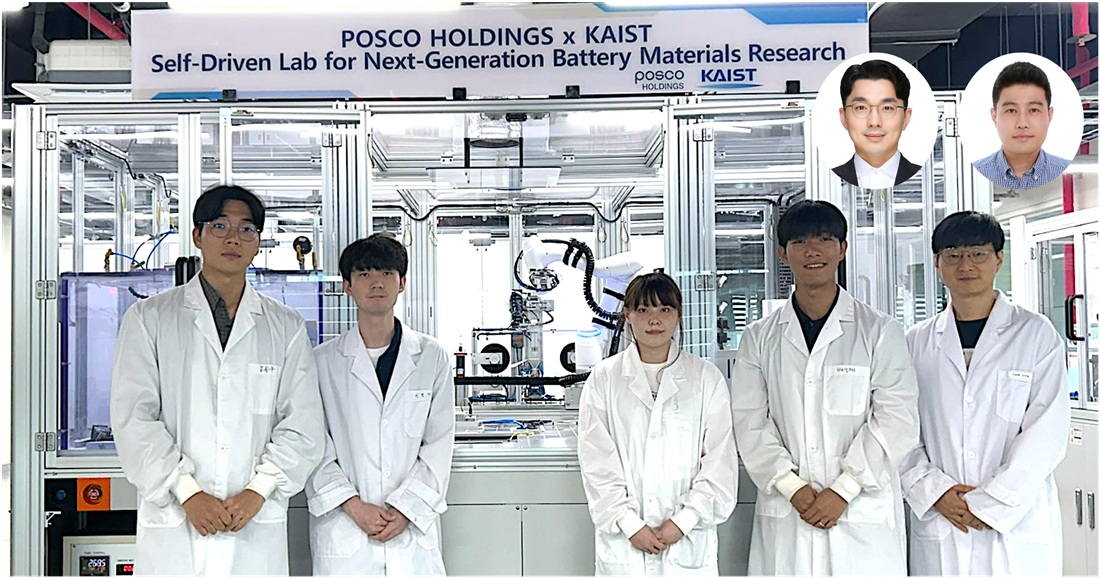 Material Innovation Realized with Robotic Arms and AI, Without Human Researchers
<(From Left) M.S candidate Dongwoo Kim from KAIST, Ph.D candidate Hyun-Gi Lee from KAIST, Intern Yeham Kang from KAIST, M.S candidate Seongjae Bae from KAIST, Professor Dong-Hwa Seo from KAIST, (From top right, from left) Senior Researcher Inchul Park from POSCO Holdings, Senior Researcher Jung Woo Park, senior researcher from POSCO Holdings>
A joint research team from industry and academia in Korea has successfully developed an autonomous lab that uses AI and automation to create new cathode materials for secondary batteries. This system operates without human intervention, drastically reducing researcher labor and cutting the material discovery period by 93%.
* Autonomous Lab: A platform that autonomously designs, conducts, and analyzes experiments to find the optimal material.
KAIST (President Kwang Hyung Lee) announced on the 3rd of August that the research team led by Professor Dong-Hwa Seo of the Department of Materials Science and Engineering, in collaboration with the team of LIB Materials Research Center in Energy Materials R&D Laboratories at POSCO Holdings' POSCO N.EX.T Hub (Director Ki Soo Kim), built the lab to explore cathode materials using AI and automation technology.
Developing secondary battery cathode materials is a labor-intensive and time-consuming process for skilled researchers. It involves extensive exploration of various compositions and experimental variables through weighing, transporting, mixing, sintering*, and analyzing samples.
* Sintering: A process in which powder particles are heated to form a single solid mass through thermal activation.
The research team's autonomous lab combines an automated system with an AI model. The system handles all experimental steps—weighing, mixing, pelletizing, sintering, and analysis—without human interference. The AI model then interprets the data, learns from it, and selects the best candidates for the next experiment.
<Figure 1. Outline of the Anode Material Autonomous Exploration Laboratory>
To increase efficiency, the team designed the automation system with separate modules for each process, which are managed by a central robotic arm. This modular approach reduces the system's reliance on the robotic arm.
The team also significantly improved the synthesis speed by using a new high-speed sintering method, which is 50 times faster than the conventional low-speed method. This allows the autonomous lab to acquire 12 times more material data compared to traditional, researcher-led experiments.
<Figure 2. Synthesis of Cathode Material Using a High-Speed Sintering Device>
The vast amount of data collected is automatically interpreted by the AI model to extract information such as synthesized phases and impurity ratios. This data is systematically stored to create a high-quality database, which then serves as training data for an optimization AI model. This creates a closed-loop experimental system that recommends the next cathode composition and synthesis conditions for the automated system.
* Closed-loop experimental system: A system that independently performs all experimental processes without researcher intervention.
Operating this intelligent automation system 24 hours a day can secure more than 12 times the experimental data and shorten material discovery time by 93%. For a project requiring 500 experiments, the system can complete the work in about 6 days, whereas a traditional researcher-led approach would take 84 days.
During development, POSCO Holdings team managed the overall project planning, reviewed the platform design, and co-developed the partial module design and AI-based experimental model. The KAIST team, led by Professor Dong-hwa Seo, was responsible for the actual system implementation and operation, including platform design, module fabrication, algorithm creation, and system verification and improvement.
Professor Dong-Hwa Seo of KAIST stated that this system is a solution to the decrease in research personnel due to the low birth rate in Korea. He expects it will enhance global competitiveness by accelerating secondary battery material development through the acquisition of high-quality data.
<Figure 3. Exterior View (Side) of the Cathode Material Autonomous Exploration Laboratory>
POSCO N.EX.T Hub plans to apply an upgraded version of this autonomous lab to its own research facilities after 2026 to dramatically speed up next-generation secondary battery material development. They are planning further developments to enhance the system's stability and scalability, and hope this industry-academia collaboration will serve as a model for using innovative technology in real-world R&D.
<Figure 4. Exterior View (Front) of the Cathode Material Autonomous Exploration Laboratory>
The research was spearheaded by Ph.D. student Hyun-Gi Lee, along with master's students Seongjae Bae and Dongwoo Kim from Professor Dong-Hwa Seo’s lab at KAIST. Senior researchers Jung Woo Park and Inchul Park from LIB Materials Research Center of POSCO N.EX.T Hub's Energy Materials R&D Laboratories (Director Jeongjin Hong) also participated.
2025.08.06 View 6259
Material Innovation Realized with Robotic Arms and AI, Without Human Researchers
<(From Left) M.S candidate Dongwoo Kim from KAIST, Ph.D candidate Hyun-Gi Lee from KAIST, Intern Yeham Kang from KAIST, M.S candidate Seongjae Bae from KAIST, Professor Dong-Hwa Seo from KAIST, (From top right, from left) Senior Researcher Inchul Park from POSCO Holdings, Senior Researcher Jung Woo Park, senior researcher from POSCO Holdings>
A joint research team from industry and academia in Korea has successfully developed an autonomous lab that uses AI and automation to create new cathode materials for secondary batteries. This system operates without human intervention, drastically reducing researcher labor and cutting the material discovery period by 93%.
* Autonomous Lab: A platform that autonomously designs, conducts, and analyzes experiments to find the optimal material.
KAIST (President Kwang Hyung Lee) announced on the 3rd of August that the research team led by Professor Dong-Hwa Seo of the Department of Materials Science and Engineering, in collaboration with the team of LIB Materials Research Center in Energy Materials R&D Laboratories at POSCO Holdings' POSCO N.EX.T Hub (Director Ki Soo Kim), built the lab to explore cathode materials using AI and automation technology.
Developing secondary battery cathode materials is a labor-intensive and time-consuming process for skilled researchers. It involves extensive exploration of various compositions and experimental variables through weighing, transporting, mixing, sintering*, and analyzing samples.
* Sintering: A process in which powder particles are heated to form a single solid mass through thermal activation.
The research team's autonomous lab combines an automated system with an AI model. The system handles all experimental steps—weighing, mixing, pelletizing, sintering, and analysis—without human interference. The AI model then interprets the data, learns from it, and selects the best candidates for the next experiment.
<Figure 1. Outline of the Anode Material Autonomous Exploration Laboratory>
To increase efficiency, the team designed the automation system with separate modules for each process, which are managed by a central robotic arm. This modular approach reduces the system's reliance on the robotic arm.
The team also significantly improved the synthesis speed by using a new high-speed sintering method, which is 50 times faster than the conventional low-speed method. This allows the autonomous lab to acquire 12 times more material data compared to traditional, researcher-led experiments.
<Figure 2. Synthesis of Cathode Material Using a High-Speed Sintering Device>
The vast amount of data collected is automatically interpreted by the AI model to extract information such as synthesized phases and impurity ratios. This data is systematically stored to create a high-quality database, which then serves as training data for an optimization AI model. This creates a closed-loop experimental system that recommends the next cathode composition and synthesis conditions for the automated system.
* Closed-loop experimental system: A system that independently performs all experimental processes without researcher intervention.
Operating this intelligent automation system 24 hours a day can secure more than 12 times the experimental data and shorten material discovery time by 93%. For a project requiring 500 experiments, the system can complete the work in about 6 days, whereas a traditional researcher-led approach would take 84 days.
During development, POSCO Holdings team managed the overall project planning, reviewed the platform design, and co-developed the partial module design and AI-based experimental model. The KAIST team, led by Professor Dong-hwa Seo, was responsible for the actual system implementation and operation, including platform design, module fabrication, algorithm creation, and system verification and improvement.
Professor Dong-Hwa Seo of KAIST stated that this system is a solution to the decrease in research personnel due to the low birth rate in Korea. He expects it will enhance global competitiveness by accelerating secondary battery material development through the acquisition of high-quality data.
<Figure 3. Exterior View (Side) of the Cathode Material Autonomous Exploration Laboratory>
POSCO N.EX.T Hub plans to apply an upgraded version of this autonomous lab to its own research facilities after 2026 to dramatically speed up next-generation secondary battery material development. They are planning further developments to enhance the system's stability and scalability, and hope this industry-academia collaboration will serve as a model for using innovative technology in real-world R&D.
<Figure 4. Exterior View (Front) of the Cathode Material Autonomous Exploration Laboratory>
The research was spearheaded by Ph.D. student Hyun-Gi Lee, along with master's students Seongjae Bae and Dongwoo Kim from Professor Dong-Hwa Seo’s lab at KAIST. Senior researchers Jung Woo Park and Inchul Park from LIB Materials Research Center of POSCO N.EX.T Hub's Energy Materials R&D Laboratories (Director Jeongjin Hong) also participated.
2025.08.06 View 6259