research
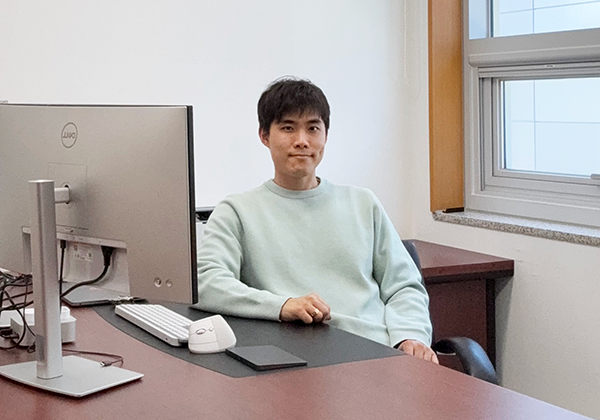
< Professor Iksung Kang, KAIST >
Observing the depths of a living brain with clarity has traditionally required expensive, high-end equipment. However, a KAIST research team has advanced neuroscience research by developing a physics-based AI computational algorithm that restores blurred images into sharp ones without the need for additional optical measurement hardware.
KAIST (President Kwang Hyung Lee) announced on April 21st that Professor Iksung Kang (School of Electrical Engineering), in collaboration with Professor Na Ji's research team at UC Berkeley, has developed a technology that accurately corrects image aberrations in microscopes used for live biological imaging. Notably, the experimental design and algorithm development – the core components of this technology – were led by Professor Kang during his postdoctoral fellowship in Professor Na Ji’s group. This breakthrough was achieved using Neural Fields — a neural network-based technology that continuously represents 3D spatial structures to simultaneously reconstruct clear images and volumetric forms.
The research team utilized Two-Photon Fluorescence Microscopy, a core technology for observing deep within living biological tissues by using two low-energy photons simultaneously to selectively illuminate specific points. However, as light passes through thick tissue, it bends and scatters, causing the image to become blurred — much like how objects appear distorted underwater. This phenomenon is known as optical aberration.
Previously, correcting these distortions required adding complex and costly hardware, such as wavefront sensors, which measure exactly how much the light path has deviated.
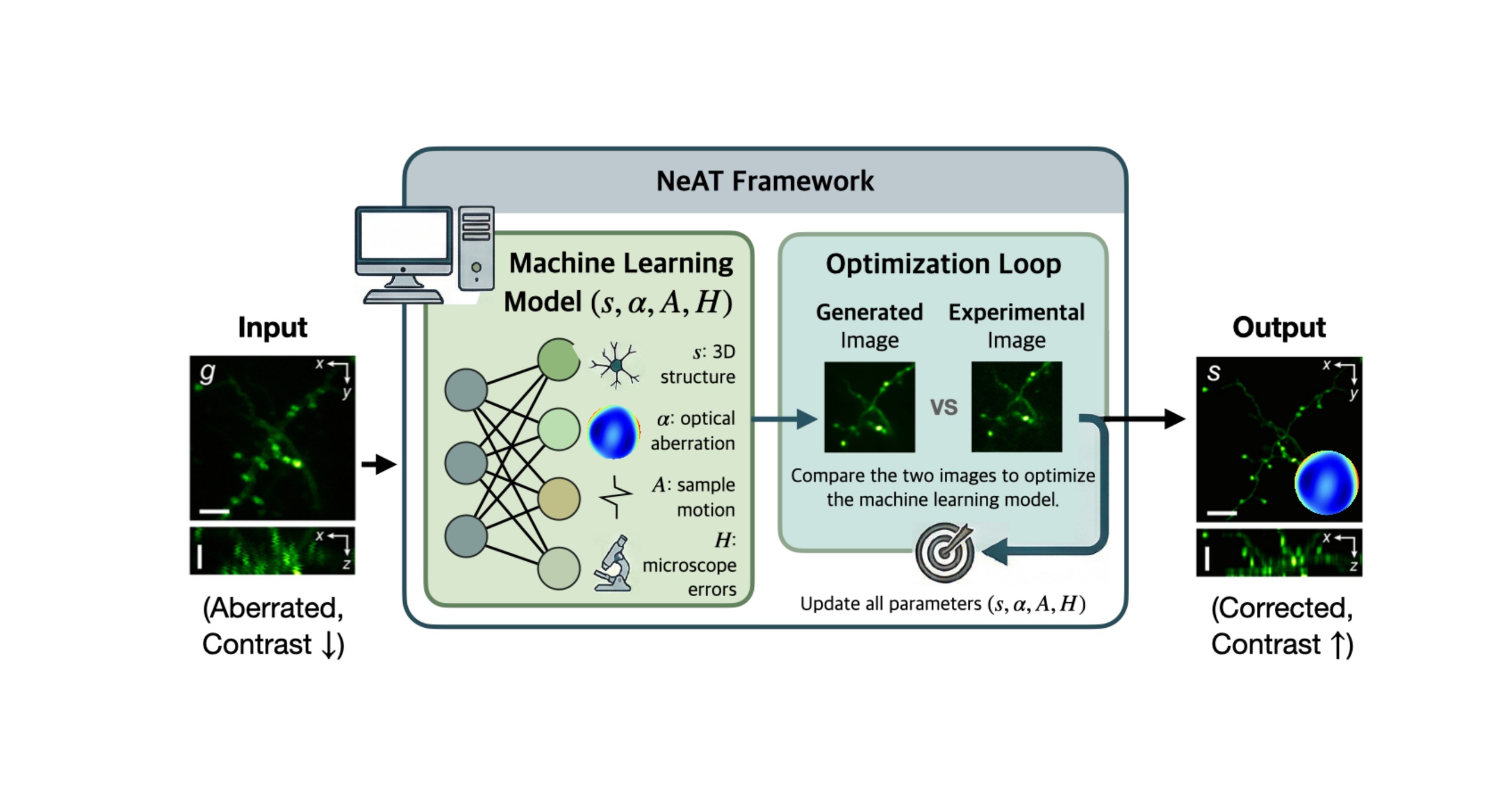
< Framework for Integrated Distortion Correction in Two-Photon Fluorescence Microscopy >
In contrast, the research team developed an algorithm that inversely calculates how light was distorted using only the captured image data and corrects it. In other words, it is a method of restoring image clarity by analyzing blurred photos, without relying on any additional equipment.
The core of this technology is a machine learning algorithm based on the Neural Fields model. This algorithm tracks the distortion process that occurs as light travels, implementing an integrated technology that compensates not only for optical aberrations caused by biological tissue but also for microscopic movements of the living specimen and alignment errors of the microscope itself.
As a result, the team successfully and reliably obtained high-resolution, high-contrast images from deep within biological tissues, without any separate aberration measurement or correction devices.
This research is particularly significant because it overcomes the conventional limitation that “better images require more expensive equipment” by solving the problem through a software-based approach. This is expected to lower the burden of research equipment costs and allow more researchers to perform precise brain observations.
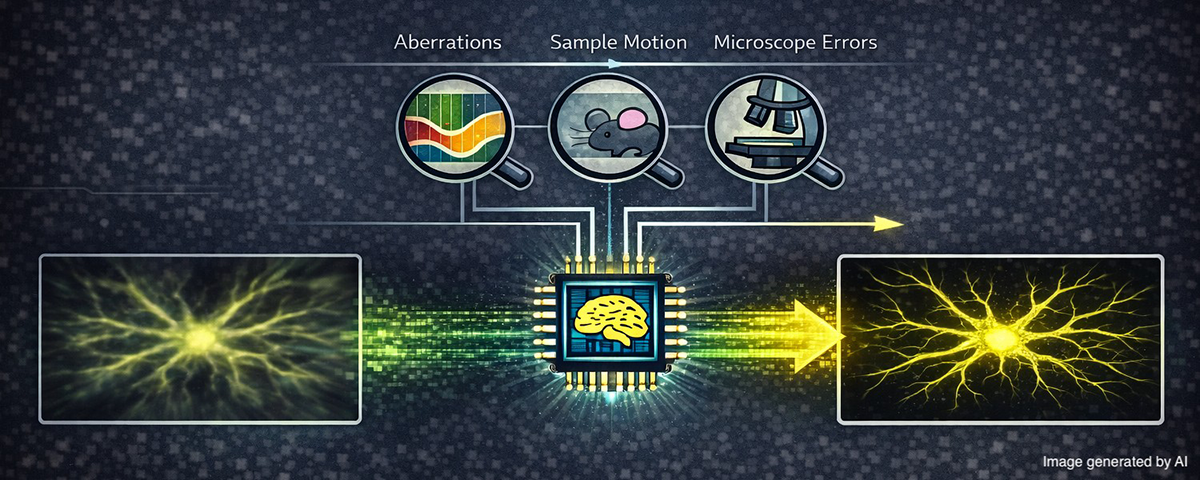
< Comparison of images using a framework that integrates correction for optical aberrations, sample motion, and microscope errors (AI-generated image) >
Professor Iksung Kang stated, “This research opens the way to see more accurately inside living organisms by combining optics and artificial intelligence technology. Moving forward, we plan to develop this into an intelligent optical imaging system where the microscope itself finds the optimal image.”
This study was published on April 13th in Nature Methods, a leading methodology journal in the field of life sciences.
- Paper Title: Adaptive optical correction for in vivo two-photon fluorescence microscopy with neural fields
- DOI: 10.1038/s41592-026-03053-6
- Authors: Iksung Kang (KAIST, Co-corresponding & First Author), Hyeonggeon Kim, Ryan Natan, Qinrong Zhang, Stella X. Yu, & Na Ji (UC Berkeley, Co-corresponding Author)
-
research KAIST Develops New Catalyst Design Technology to Improve Battery and Hydrogen Fuel Cell Performance
<(From Left) Professor Seung Jun Hwang, Professor Jaeyune Ryu> Korean researchers have developed a new catalyst design technology that can improve the performance of batteries and hydrogen fuel cells while reducing energy loss. KAISTannounced on the 1st of June that a research team led by Professor Seung Jun Hwang of the Department of Chemistry, through joint research with Professor Jaeyune Ryu’s team from the Department of Chemical and Biological Engineering at Seoul National
2026-06-01 -
research KAIST Produces Eco-Friendly Core Nylon Precursors Used from Clothing to Automobiles with Microbes
<(From Left) Dr. Da-Hee Ahn, Distinguished Professor Sang Yup Lee> Nylon is a representative plastic material used throughout our daily lives, from clothing to automobiles. However, most of its raw materials have been produced through petrochemical processes, resulting in large carbon emissions. KAIST researchers have developed a technology that can produce key nylon precursors in an eco-friendly way using microbes. KAIST (President Kwang Hyung Lee) announced on the 31st of May that a
2026-06-01 -
research "Development of 'ADvisor', an AI that Predicts Instagram Advertising Performance in Advance"
<(Bottom from left) M.S candidate Gyurim Hwang, M.S candidate Yeongho Kim, Ph.D. candidate Kyungho Kim, Ph.D.candidate Jongha Lee, M.S candidate Yeonje Choi (Top from left) Undergraduate student Sejin Chung, Researcher Hongseok Lee, Researcher Myeong Ho Song, Ph.D. candidate Sunwoo Kim, M.S candidate Juyeon Kim, Professor Kijung Shin> Social media advertising usually requires running multiple ad drafts in practice before determining which ad is effective. Because of this, testing adver
2026-06-01 -
research Development of a Virtual AI Testbed Capable of Performance Verification Before Building Massive AI Servers
< From left: Professor Jongse Park , M.S candidate Jaehong Cho, M.S candidate Hyunmin Choi, Professor Brandon Reagen ISPASS > Operating Large Language Model (LLM) services like ChatGPT requires a server infrastructure on the scale of tens of thousands of units. However, constructing actual equipment every time a new AI semiconductor or system architecture needs to be verified incurs massive costs and time. A research team at our university has developed a ‘virtual testbed’
2026-05-29 -
research Clearing the Expressway for Bubble Blockages to Achieve High-Efficiency Green Hydrogen Production
< (From left) Ph.D candidate Jaeho Byeon, Ph.D candidate Minkyeong Ban, Professor Jinwoo Lee, Dr. Sungjun Kim, Professor Jang Yong Lee> As the global transition toward carbon neutrality accelerates, "water electrolysis"—a technology that splits water electrically to produce clean hydrogen—is drawing significant attention. However, a major limitation has been the decline in efficiency caused by bubbles formed during the electrolysis process that block the pathways. A domestic
2026-05-28