research

<(From left) Professor Dong-Wook Kim of Uijeongbu Eulji University Hospital Hematologic Malignancy Center, Professor Hongtae Kim of UNIST, Professor Chunghun Lim of KAIST, and Dr. Jumin Park of KAIST>
The real reason why anticancer drugs kill cancer cells has been revealed. KAIST research team has identified that targeted anticancer therapies do not simply block cancer proteins, but rather shut down the "protein factories" inside the cells, forcing them to undergo self-destruction. Consequently, the "two-faced protein" that plays a key role in this process is gaining attention as a breakthrough for treating patients with drug resistance.
KAIST announced on April 23rd that a joint research team—consisting of Professor Chunghun Lim from the Department of Biological Sciences at KAIST, Professor Dong-Wook Kim from the Hematologic Malignancy Center at Uijeongbu Eulji University Hospital, and Professor Hongtae Kim from UNIST —has identified a new molecular mechanism that regulates the response to anticancer drugs for Chronic Myeloid Leukemia (CML).
Chronic Myeloid Leukemia occurs when genetic abnormalities in hematopoietic stem cells produce an abnormal protein. This protein is known to be the primary cause of cancer cell proliferation by sending continuous growth signals to the cells. While targeted anticancer drugs that inhibit this protein are currently used as the standard treatment, there have been limitations, such as drug resistance or low treatment response in some patients.
The research team focused on the impact of anticancer drugs on the protein production process within the cell. As a result, they confirmed that when anticancer drugs are administered, the flow of ribosomes—the machines that create proteins—becomes tangled, leading to "ribosome collisions." This process induces intense stress inside the cell, ultimately leading the cancer cell to its death.
In particular, the research team identified the ZAK protein as the key sensor that detects these ribosome collisions and discovered that ZAK possesses "two faces" depending on the situation. Under normal conditions, it acts as an assistant, binding with AKT signals* to help cancer cells grow. However, once targeted anticancer treatment begins, it transforms into a sentinel that monitors ribosome collisions and triggers the death of the cancer cell. This marks the world's first proof that the same protein can perform diametrically opposite roles during cancer progression versus cancer treatment. *A key intracellular signaling pathway that regulates cell survival, growth, proliferation, metabolism, and migration.
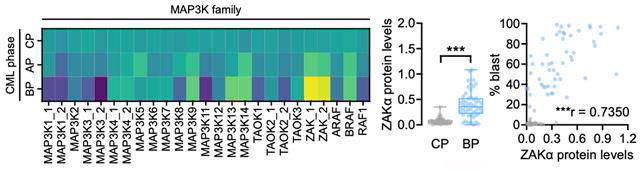
<Clinical correlation between disease stage and ZAK expression in a Chronic Myeloid Leukemia patient cohort>
The research team verified this mechanism by analyzing cancer cells derived from actual leukemia patients. When drugs that increase ribosome collisions were used in combination, the anticancer effect improved significantly. Conversely, when ZAK function was impaired, the responsiveness to the anticancer drug decreased.
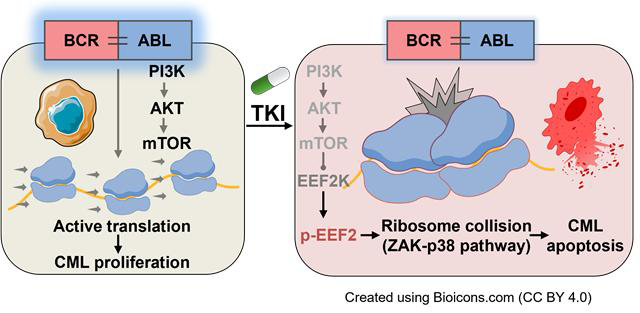
<Mechanism of ribosome collision and ZAK-dependent cancer cell death induced by Targeted Kinase Inhibitors (TKIs) in Chronic Myeloid Leukemia>
In other words, according to this study, drug-resistant patients are predicted to have decreased ZAK function or an insufficient ribosome stress response. This suggests that it is possible to predict treatment responses based on an individual patient's ZAK activation status and design customized combination therapy strategies.
This study is a significant achievement that presents the importance of the ribosome stress signaling pathway in the treatment of Chronic Myeloid Leukemia. It is expected to lead to the development of new combination therapies and enhance the effectiveness of targeted anticancer drugs. In particular, it offers new possibilities for patients struggling with drug resistance.
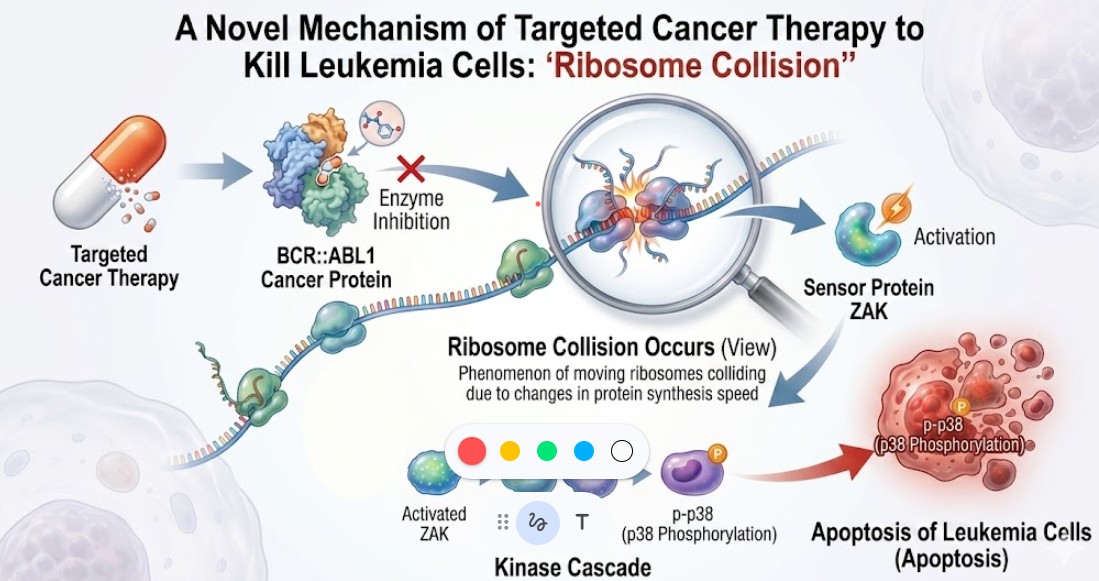
<Research Image (AI-generated)>
Professor Chunghun Lim stated, "This study shows how critical the process of the cell detecting abnormal protein synthesis and converting it into a death signal is for treatment." Dr. Jumin Park, the lead author, noted, "As we have confirmed that ribosome collision is a key switch determining cancer cell death, we plan to expand this research to various other types of cancer."
The results of this study, featuring Jumin Park of KAIST as the first author, were published online on March 30th in Leukemia, one of the most prestigious academic journals in the field of hematology.
- Paper Title: BCR::ABL1 tyrosine kinase inhibitors induce ribosome collisions to activate ZAK-dependent ribotoxic stress and apoptosis in chronic myeloid leukemia
- Authors: Jumin Park, Soo-Hyun Kim, Jongmin Park, Heeju Park, Hongtae Kim, Dong-Wook Kim & Chunghun Lim
- DOI: https://doi.org/10.1038/s41375-026-02916-3
This research was conducted with support from the Suh Kyungbae Foundation, the Mid-career Researcher Support Program of the National Research Foundation of Korea, the Basic Research Lab Support Program, and the KAIST Settlement Project.
-
research KAIST Develops New Catalyst Design Technology to Improve Battery and Hydrogen Fuel Cell Performance
<(From Left) Professor Seung Jun Hwang, Professor Jaeyune Ryu> Korean researchers have developed a new catalyst design technology that can improve the performance of batteries and hydrogen fuel cells while reducing energy loss. KAISTannounced on the 1st of June that a research team led by Professor Seung Jun Hwang of the Department of Chemistry, through joint research with Professor Jaeyune Ryu’s team from the Department of Chemical and Biological Engineering at Seoul National
2026-06-01 -
research KAIST Produces Eco-Friendly Core Nylon Precursors Used from Clothing to Automobiles with Microbes
<(From Left) Dr. Da-Hee Ahn, Distinguished Professor Sang Yup Lee> Nylon is a representative plastic material used throughout our daily lives, from clothing to automobiles. However, most of its raw materials have been produced through petrochemical processes, resulting in large carbon emissions. KAIST researchers have developed a technology that can produce key nylon precursors in an eco-friendly way using microbes. KAIST (President Kwang Hyung Lee) announced on the 31st of May that a
2026-06-01 -
research "Development of 'ADvisor', an AI that Predicts Instagram Advertising Performance in Advance"
<(Bottom from left) M.S candidate Gyurim Hwang, M.S candidate Yeongho Kim, Ph.D. candidate Kyungho Kim, Ph.D.candidate Jongha Lee, M.S candidate Yeonje Choi (Top from left) Undergraduate student Sejin Chung, Researcher Hongseok Lee, Researcher Myeong Ho Song, Ph.D. candidate Sunwoo Kim, M.S candidate Juyeon Kim, Professor Kijung Shin> Social media advertising usually requires running multiple ad drafts in practice before determining which ad is effective. Because of this, testing adver
2026-06-01 -
research Development of a Virtual AI Testbed Capable of Performance Verification Before Building Massive AI Servers
< From left: Professor Jongse Park , M.S candidate Jaehong Cho, M.S candidate Hyunmin Choi, Professor Brandon Reagen ISPASS > Operating Large Language Model (LLM) services like ChatGPT requires a server infrastructure on the scale of tens of thousands of units. However, constructing actual equipment every time a new AI semiconductor or system architecture needs to be verified incurs massive costs and time. A research team at our university has developed a ‘virtual testbed’
2026-05-29 -
research Clearing the Expressway for Bubble Blockages to Achieve High-Efficiency Green Hydrogen Production
< (From left) Ph.D candidate Jaeho Byeon, Ph.D candidate Minkyeong Ban, Professor Jinwoo Lee, Dr. Sungjun Kim, Professor Jang Yong Lee> As the global transition toward carbon neutrality accelerates, "water electrolysis"—a technology that splits water electrically to produce clean hydrogen—is drawing significant attention. However, a major limitation has been the decline in efficiency caused by bubbles formed during the electrolysis process that block the pathways. A domestic
2026-05-28