research
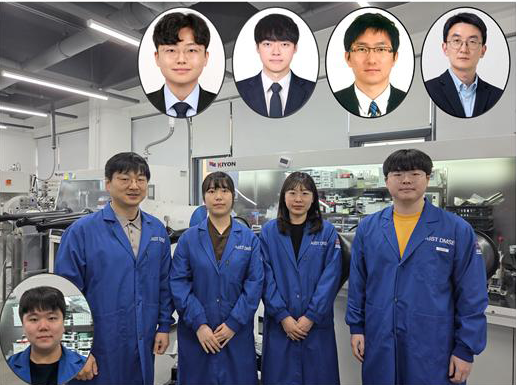
<(Bottom row, from left) Dr. Jae-Seung Kim (Seoul National University), Prof. Dong-Hwa Seo (KAIST), Researcher Heeju Park (KAIST), Researcher Jiwon Seo, Researcher Jinyeong Choe.
(Top row, from left) Researcher Hae-Yong Kim (Dongguk University), Prof. Eunryeol Lee (Chungbuk National University), Prof. Kyung-Wan Nam (Dongguk University), Prof. Yoon Seok Jung (Yonsei University)>
Expectations are rising for all-solid-state batteries—the "dream battery" with low fire risk—not only for electric vehicles but also for various fields such as robotics and Urban Air Mobility (UAM). A research team at our university has presented a new design principle that simultaneously overcomes the limitations of solid electrolytes, which were previously vulnerable to air exposure and suffered from low performance. This technology is gaining significant attention as it can enhance both battery safety and charging speeds, demonstrating the feasibility of commercializing next-generation all-solid-state batteries.
KAIST announced on April 16th that a research team led by Professor Dong-Hwa Seo from the Department of Materials Science and Engineering, through joint research with teams from Dongguk University (President Jae-Woong Yoon), Yonsei University (President Dong-Sup Yoon), and Chungbuk National University (Acting President Yu-Sik Park), has developed a design technology for solid electrolytes used in all-solid-state batteries. This technology maintains structural stability even when exposed to air while dramatically increasing ionic conductivity.
Unlike conventional lithium-ion batteries that use liquid electrolytes, all-solid-state batteries are spotlighted as next-generation batteries due to their low fire risk. Among these, halide-based solid electrolytes—which contain halogen elements such as chlorine (Cl) and bromine (Br)—are advantageous in terms of performance due to their high ionic conductivity. However, they are known to be difficult materials to manufacture and handle because they are highly vulnerable to moisture in the air, which easily degrades their performance.
To solve this problem, the research team introduced a new structure called "Oxygen Anchoring." This method involves stably bonding oxygen inside the electrolyte to strengthen its structural intergrity, a process in which the element Tungsten plays a key role.
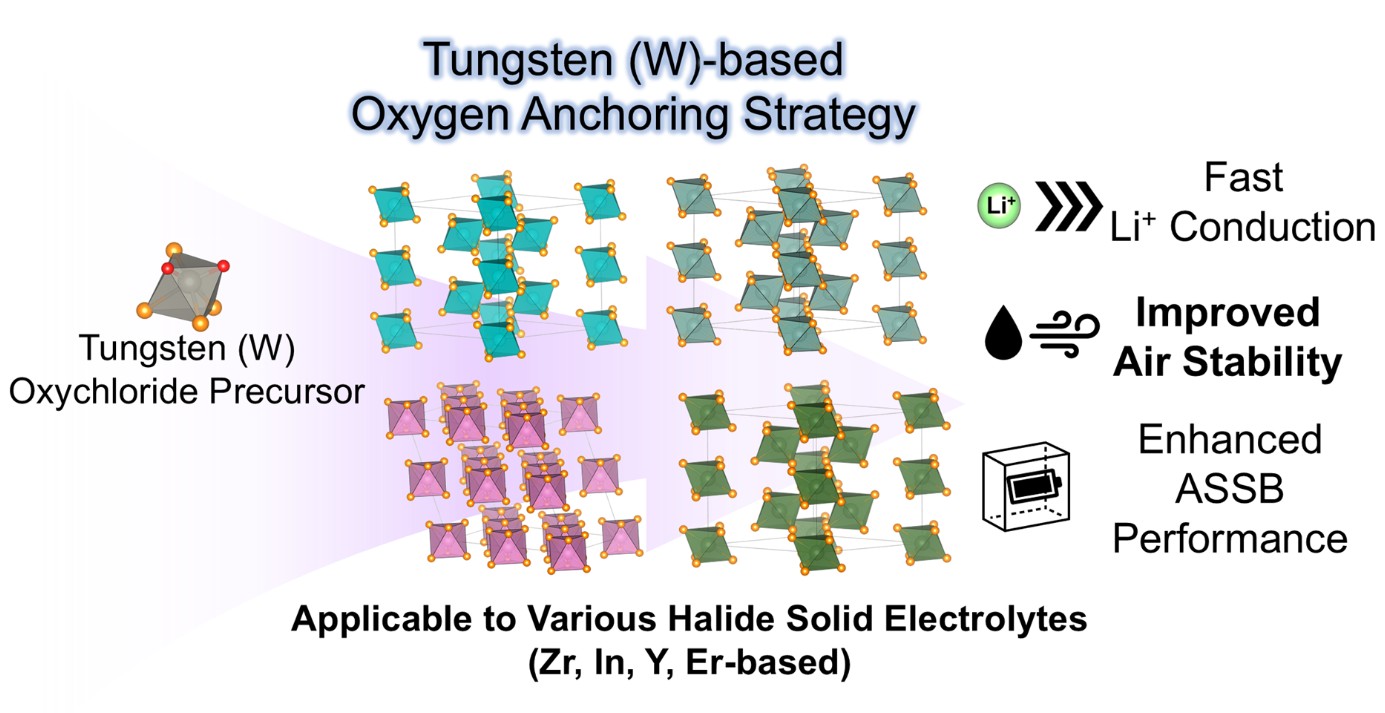
< Research image on tungsten-based oxygen fixation strategy >
As a result, it was confirmed that the electrolyte maintains a stable structure without collapsing, even in air-exposed environments.
Furthermore, the research team improved battery performance in addition to stability. The changes in the internal structure of the electrolyte widened the pathways for lithium ions, allowing them to move more smoothly and increasing the ion migration speed. It was confirmed that the oxygen-incorporated material exhibited an ionic conductivity approximately 2.7 times higher than that of conventional zirconium (Zr)-based halide solid electrolytes.
Another feature of this technology is that it is not limited to a specific material. The research team applied the same strategy to various halide solid electrolytes, including those based on zirconium (Zr), indium (In), yttrium (Y), and erbium (Er), and confirmed similar effects. This demonstrates that it is a "universal design principle" applicable to a wide range of battery materials.
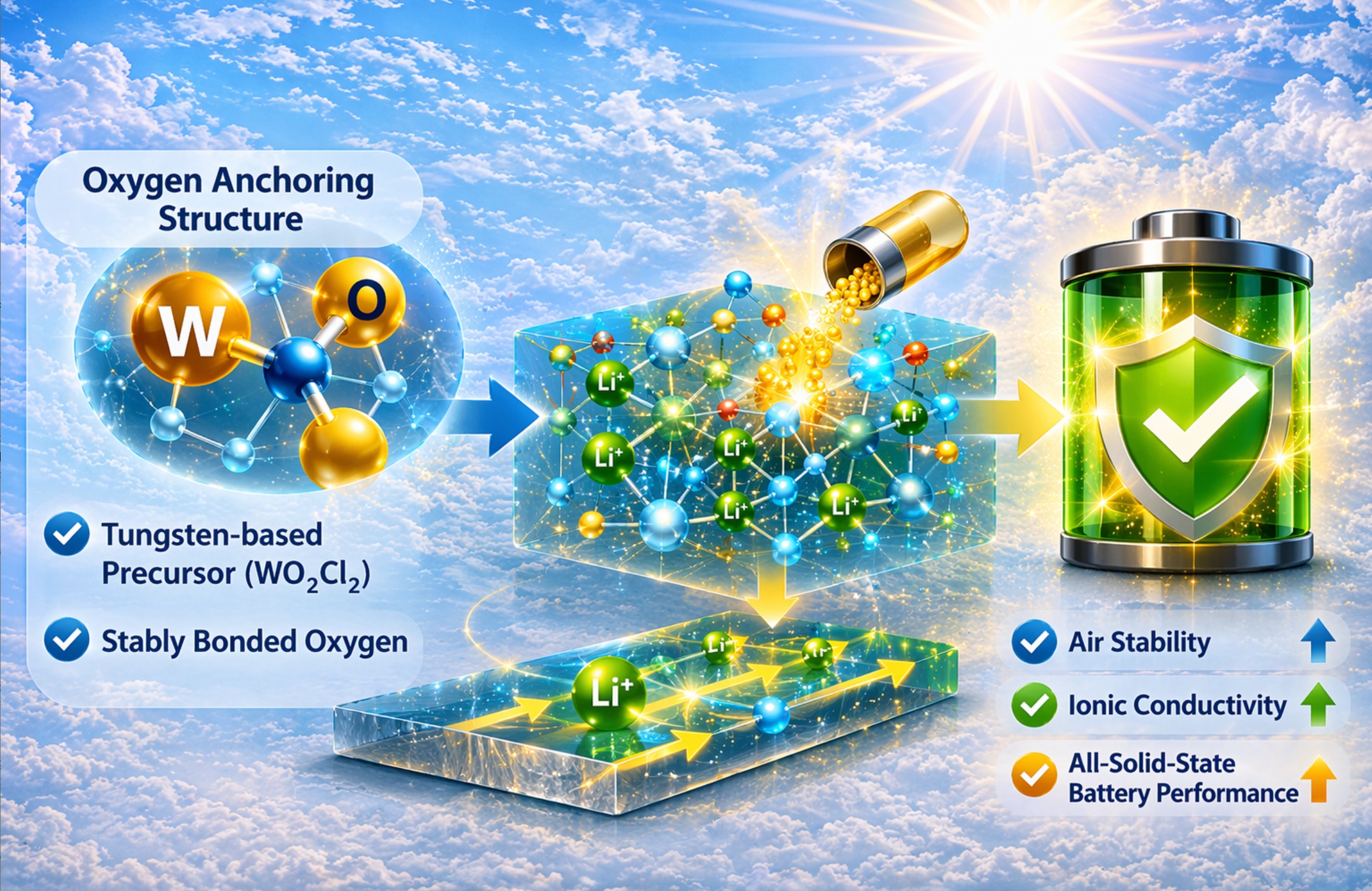
< Research image (AI-generated image) >
The research team expects this technology to contribute to the development of solid electrolytes that possess both air stability and high performance.
Professor Dong-Hwa Seo stated, "This study presents a new material design principle that optimizes multiple performances through a structural design strategy that simultaneously improves air stability and ionic conductivity. It will serve as a key indicator for future all-solid-state battery research and process development."
This study involved Jae-Seung Kim (formerly KAIST, now SNU), Heeju Park, and Hae-Yong Kim as joint first authors. The research included contributions from Eunryeol Lee, Heewon Kim, Soeul Lee, Jinyeong Choe, Jiwon Seo, Hyeon-Jong Lee, Hojoon Kim, Jemin Yeon, and Yoon Seok Jung. The findings were published on March 6, 2026, in the international academic journal Advanced Energy Materials.
- Paper Title: Universal Oxychlorination Strategy in Halide Solid Electrolytes for All-Solid-State Batteries
- DOI: https://doi.org/10.1002/aenm.202506744
This research was conducted with support from the Samsung Electronics Future Technology Promotion Center and the Nano and Materials Technology Development Program of the National Research Foundation of Korea. Computational studies were performed using the resources of the National Supercomputing Center.
-
research KAIST Develops New Catalyst Design Technology to Improve Battery and Hydrogen Fuel Cell Performance
<(From Left) Professor Seung Jun Hwang, Professor Jaeyune Ryu> Korean researchers have developed a new catalyst design technology that can improve the performance of batteries and hydrogen fuel cells while reducing energy loss. KAISTannounced on the 1st of June that a research team led by Professor Seung Jun Hwang of the Department of Chemistry, through joint research with Professor Jaeyune Ryu’s team from the Department of Chemical and Biological Engineering at Seoul National
2026-06-01 -
research KAIST Produces Eco-Friendly Core Nylon Precursors Used from Clothing to Automobiles with Microbes
<(From Left) Dr. Da-Hee Ahn, Distinguished Professor Sang Yup Lee> Nylon is a representative plastic material used throughout our daily lives, from clothing to automobiles. However, most of its raw materials have been produced through petrochemical processes, resulting in large carbon emissions. KAIST researchers have developed a technology that can produce key nylon precursors in an eco-friendly way using microbes. KAIST (President Kwang Hyung Lee) announced on the 31st of May that a
2026-06-01 -
research "Development of 'ADvisor', an AI that Predicts Instagram Advertising Performance in Advance"
<(Bottom from left) M.S candidate Gyurim Hwang, M.S candidate Yeongho Kim, Ph.D. candidate Kyungho Kim, Ph.D.candidate Jongha Lee, M.S candidate Yeonje Choi (Top from left) Undergraduate student Sejin Chung, Researcher Hongseok Lee, Researcher Myeong Ho Song, Ph.D. candidate Sunwoo Kim, M.S candidate Juyeon Kim, Professor Kijung Shin> Social media advertising usually requires running multiple ad drafts in practice before determining which ad is effective. Because of this, testing adver
2026-06-01 -
research Development of a Virtual AI Testbed Capable of Performance Verification Before Building Massive AI Servers
< From left: Professor Jongse Park , M.S candidate Jaehong Cho, M.S candidate Hyunmin Choi, Professor Brandon Reagen ISPASS > Operating Large Language Model (LLM) services like ChatGPT requires a server infrastructure on the scale of tens of thousands of units. However, constructing actual equipment every time a new AI semiconductor or system architecture needs to be verified incurs massive costs and time. A research team at our university has developed a ‘virtual testbed’
2026-05-29 -
research Clearing the Expressway for Bubble Blockages to Achieve High-Efficiency Green Hydrogen Production
< (From left) Ph.D candidate Jaeho Byeon, Ph.D candidate Minkyeong Ban, Professor Jinwoo Lee, Dr. Sungjun Kim, Professor Jang Yong Lee> As the global transition toward carbon neutrality accelerates, "water electrolysis"—a technology that splits water electrically to produce clean hydrogen—is drawing significant attention. However, a major limitation has been the decline in efficiency caused by bubbles formed during the electrolysis process that block the pathways. A domestic
2026-05-28