research
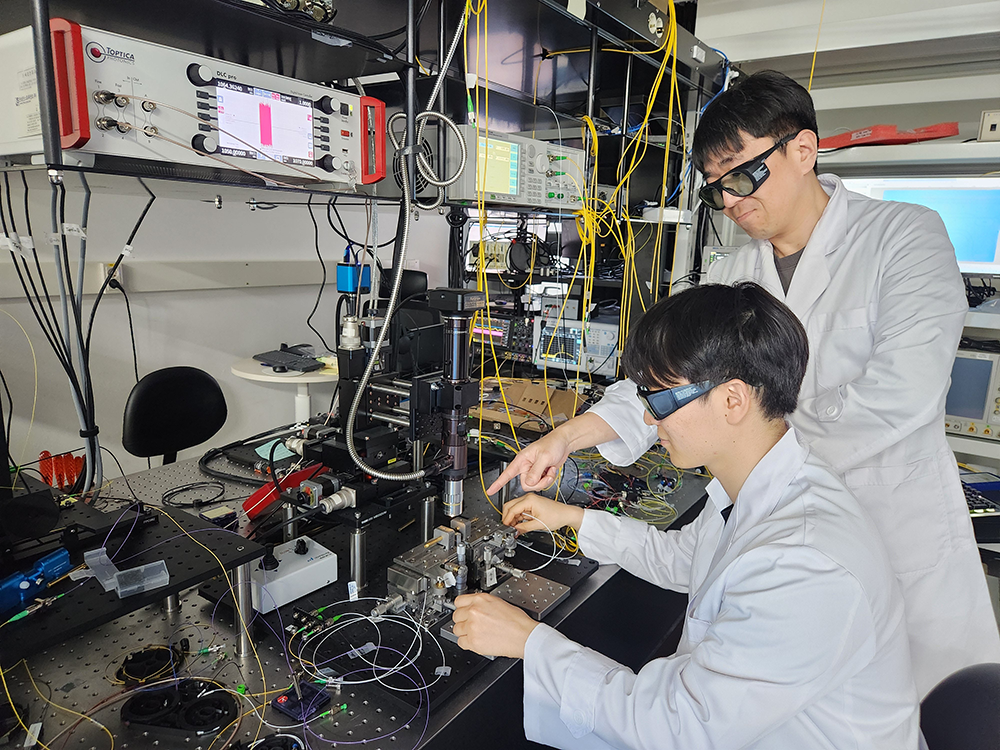
< (From left) Undergraduate researcher Taewon Kim and Professor Sangsik Kim >
A new technology has been developed that allows light to be "designed" into desired forms, potentially making Artificial Intelligence (AI) and communication technologies faster and more accurate. A KAIST research team has developed an "integrated photonic resonator"—a core component of next-generation optical integrated circuits that process data using light. The research is particularly significant as it was led by an undergraduate student. This technology is expected to serve as a key foundation for next-generation security technologies such as high-speed data processing and quantum communication.
KAIST announced on the 15th that a research team led by Professor Sangsik Kim from the School of Electrical Engineering, in collaboration with Professor Jae Woong Yoon’s team from the Department of Physics at Hanyang University (President Kigeong Lee), has developed a new integrated photonic resonator structure capable of freely controlling optical signals by utilizing light interference (the phenomenon where two light waves meet and influence each other).
Photonic Integrated Circuits (PICs) process data at ultra-high speeds and with low power consumption using light. They are garnering significant attention as a fundamental platform technology for next-generation fields such as AI, data centers, and quantum information processing.
The core of this technology lies in the precision with which light can be controlled. Specifically, the ability to freely adjust the spectrum (color or wavelength distribution) and phase response (timing or wave position) of optical signals is essential for implementing high-performance optical communication and computing. However, conventional methods have faced fundamental limitations.
The integrated photonic resonator (optical resonator) focused on by the research team is a key optical device that traps light in a specific space to amplify it or select specific colors (wavelengths), similar to how the body of a musical instrument amplifies sound. However, existing single-bus resonators have had limitations in precisely adjusting the phase and spectrum of optical signals.
To overcome these challenges, the research team introduced a "dual-bus" structure. This design allows light that has passed through the resonator to recombine with light that has not, enabling precise control over interference. This allows for the free design of optical signals into desired forms, making it possible to control various types of light signals that were previously difficult to implement.
By applying this technology, the research team secured new characteristics for more precise control of wavelength properties and presented new possibilities for non-linear frequency conversion research (changing the color of light). Utilizing this technology enables faster and more accurate data processing, which is expected to provide the groundwork for performance enhancements in future high-speed data centers, AI accelerators, and quantum communication systems.
This research is especially meaningful as it was led by an undergraduate student. Taewon Kim, an undergraduate student who conducted the study through the KAIST Undergraduate Research Program (URP), stated, "I was able to develop the resonator principles I learned in the Introduction to Integrated Optics class into actual device designs and a published paper."
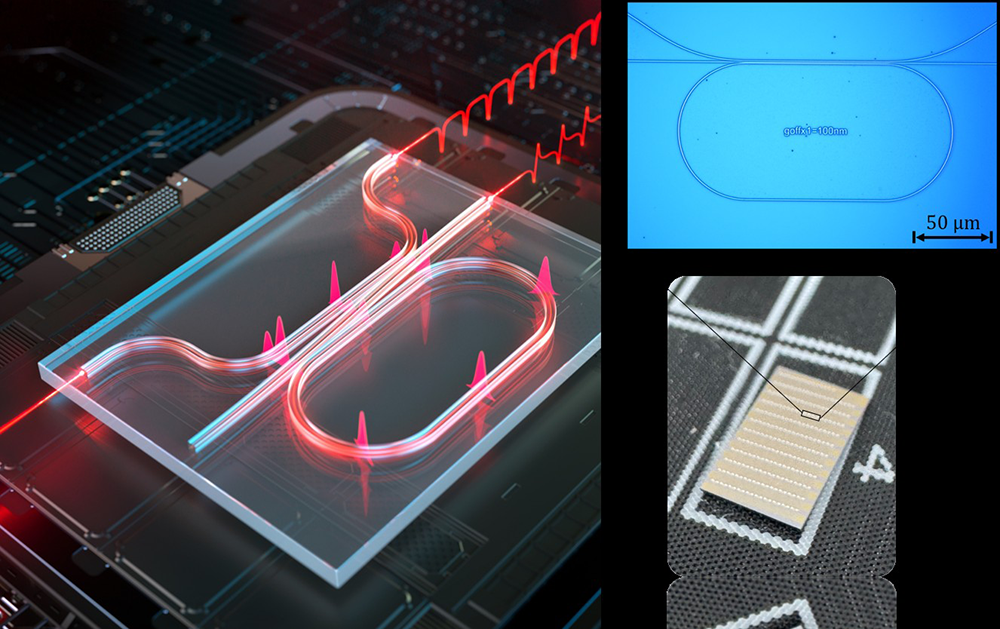
< Research Image of the Dual-bus Resonator >
Professor Sangsik Kim remarked, "This study goes beyond proposing a new device; it demonstrates that by precisely analyzing previously overlooked optical characteristics, physical limitations can be overcome. We expect this to contribute broadly to the development of optics-based AI accelerators and optical communication technologies."
KAIST undergraduate student Taewon Kim participated as the lead author of this study, and the results were published on March 6th in the international optics journal, Laser & Photonics Reviews.
Paper Title: Dual-bus resonator for multi-port spectral engineering DOI: 10.1002/lpor.202502935 Authors: Taewon Kim, Mehedi Hasan, Yu Sung Choi, Jae Woong Yoon, and Sangsik Kim
This research was supported by the KAIST URP Program, the Institute of Information & Communications Technology Planning & Evaluation (IITP), the U.S. Asian Office of Aerospace Research and Development (AOARD), and the National Research Foundation of Korea (NRF).
-
research KAIST Develops AI Technology That Automatically Generates Sounds as If a “Jurassic Park” Dinosaur Were Actually Walking Toward You
<(From Left) Hyun-Bin Oh, Takida Yuhta, Uesaka Toshimitsu, Tae-Hyun Oh, Mitsufuji Yuki> When people watch a scene in the film Jurassic Park where a giant dinosaur walks toward them, they naturally imagine a heavy, rumbling sound, as if the ground were shaking. This is because humans predict sound by considering not only the shape of an object, but also physical properties such as its size, weight, and speed of movement. However, existing video-to-audio generation AI mainly generates sou
2026-05-27 -
event Welcome to South Korea's Hosting of the 'Global AI Hub'
KAIST announced on May 22nd that the entire faculty of the Graduate School of AI welcomes South Korea's hosting of the 'Global AI Hub.' The faculty determined that hosting this will serve as a crucial momentum builder for South Korea to earnestly contribute to international cooperation and the responsible use of technology in the artificial intelligence (AI) era. In a joint statement, the faculty of the KAIST Graduate School of AI expressed, "Hosting the Global AI Hub goes beyond simply attr
2026-05-22 -
event “Entrepreneurial Mutual Growth Fair 2026” to be Held... KAIST Super Star Companies Gather for AI Solopreneurship, Tech Commercialization, Investment, and Youth Job Fair
KAIST announced that it will host the ‘AI Agent-Based Solopreneurship Program Information Session’ and the ‘Entrepreneurial Mutual Growth Fair 2026’ for two days from May 18th to 19th. In this event, KAIST’s new AI-based solopreneurship model, which utilizes AI not merely as an operational tool but as a ‘Co-founder,’ will be introduced in depth. The university will hold an information session for the ‘AI Solopreneur Support Project,’ whic
2026-05-13 -
event Professor Yiyun Kang Selected as TED 2026 Main Stage Speaker
< Professor Yiyun Kang (Photo Credit: Ryan Lash / TED) > KAIST announced on April 17th that Professor Yiyun Kang of the Department of Industrial Design has been selected as a speaker for the Main Stage at TED 2026, the world-renowned knowledge conference. Founded in 1984 under the motto "Ideas Worth Spreading," TED is an American non-profit knowledge platform where scholars, innovators, and artists from around the globe gather annually to lead global discourse. Previous Korean speakers
2026-04-18 -
event AI, Humanoid Robots, and Space Rovers to Gather: Experience Future Technologies at the Science Festival
<(From left) Photos of the KAIST Science Festival exhibition hall and booths from the previous year> KAIST announced on April 10th that KAIST will participate in the ‘2026 Korea Science and Technology Festival,’ the largest science festival in the country, to mark Science Month in April. KAIST will operate ‘KAIST Play World,’ an interactive exhibition hall showcasing the pinnacle of AI and robotics. This year’s festival will be held in two parts: ‘20
2026-04-13