-
 KAIST: AI Learns to Say “I’m Not Sure” … Reducing Overconfidence and Improving Reliability
<Professor Se-Bum Paik, (Upper Right) M.S candidate Jeonghwan Cheon>
“AI should be able to say ‘I’m Not Sure’ on its own.”
A new approach has been proposed to address the problem of “overconfidence”—one of the most critical risks of artificial intelligence (AI) in areas such as autonomous driving and medical diagnosis, where AI shows high confidence in incorrect predictions. A KAIST research team has developed a training method that enables AI to recognize situations involving unfamiliar or unseen knowledge, laying the foundation for reducing overconfidence and improving reliability.
KAIST (President Kwang Hyung Lee) announced on the 27th of April that a research team led by Distinguished Professor Se-Bum Paik from the Department of Brain and Cognitive Sciences has identified that random initialization—widely used in deep learning (an AI technique that learns from data using artificial neural networks)—may be a fundamental cause of overconfidence in AI.
To address this, the research team proposed a “warm-up” strategy in which the neural network is briefly trained using random noise (meaningless arbitrary input data) before learning from real data.
<AI-generated images comparing a model with reliability calibration through pretraining and one without it>
The research team found that AI overconfidence already appears at the initialization stage, which can propagate and cause significant errors during subsequent training. In fact, when random data were input into a randomly initialized neural network, the model exhibited high confidence despite not having learned anything. This characteristic can lead to hallucination in generative AI, where false information is produced in a plausible manner.
The research team found clues for solving this issue in the biological brain. The human brain forms neural circuits through “spontaneous neural activity”—brain signals generated without external input—even before birth.
Applying this concept to artificial neural networks, the researchers introduced a “warm-up phase” in which the network undergoes brief pre-training with random noise inputs before actual learning. This corresponds to a process in which AI adjusts its own uncertainty before starting data learning. After the warm-up process, the AI model’s initial confidence is aligned to a low level close to chance, significantly reducing the overconfidence bias observed in conventional initialization.
In other words, before learning from real data, the model first learns the state of “I don’t know anything yet.”
As a result, the model’s accuracy (how often predictions are correct) and confidence (how strongly the model believes its predictions) naturally become aligned.
<A reliability test comparing the accuracy of responses and the model’s confidence levels in an artificial neural network>
A notable difference was also observed in responses to unseen data. While conventional models tend to give incorrect answers with high confidence even for data they have not encountered during training, models with warm-up training showed a clear improvement in their ability to lower confidence and recognize that they “do not know.”
This also led to strong performance in out-of-distribution detection, which refers to identifying data that differ from the training distribution.
<Random noise warm-up training that mimics the brain’s developmental process>
This study suggests the possibility that AI can go beyond simply producing correct answers and develop the ability to distinguish “what it knows” from “what it does not know”—that is, meta-cognition, the ability to recognize its own cognitive state.
Professor Se-Bum Paik stated, “This study demonstrates that by incorporating key principles of brain development, AI can recognize its own knowledge state in a way that is more similar to humans,” adding, “This is important because it helps AI understand when it is uncertain or might be mistaken, not just improve how often it gives the right answer.”
This technology is expected to be applied not only to fields requiring high reliability, such as autonomous driving, medical AI, and generative AI, but also to the initialization methods of nearly all deep learning models, making it a key technology for improving overall AI reliability.
This study, with Jeonghwan Cheon, a master’s student in the Department of Brain and Cognitive Sciences at KAIST (currently serving as a Private in the Republic of Korea Army), as the first author, was published online on April 9, 2026, in the international journal Nature Machine Intelligence, and was selected as a notable paper and featured in News & Views.
※ Paper title: “Brain-inspired warm-up training with random noise for uncertainty calibration,” DOI: 10.1038/s42256-026-01215-x
※ News & Views article: Learning to be uncertain before learning from data, DOI: 10.1038/s42256-026-01205-z
This research was supported by the Basic Science Research Program of the National Research Foundation of Korea and the KAIST Singularity Professor Research Program.
2026.04.30 View 959
KAIST: AI Learns to Say “I’m Not Sure” … Reducing Overconfidence and Improving Reliability
<Professor Se-Bum Paik, (Upper Right) M.S candidate Jeonghwan Cheon>
“AI should be able to say ‘I’m Not Sure’ on its own.”
A new approach has been proposed to address the problem of “overconfidence”—one of the most critical risks of artificial intelligence (AI) in areas such as autonomous driving and medical diagnosis, where AI shows high confidence in incorrect predictions. A KAIST research team has developed a training method that enables AI to recognize situations involving unfamiliar or unseen knowledge, laying the foundation for reducing overconfidence and improving reliability.
KAIST (President Kwang Hyung Lee) announced on the 27th of April that a research team led by Distinguished Professor Se-Bum Paik from the Department of Brain and Cognitive Sciences has identified that random initialization—widely used in deep learning (an AI technique that learns from data using artificial neural networks)—may be a fundamental cause of overconfidence in AI.
To address this, the research team proposed a “warm-up” strategy in which the neural network is briefly trained using random noise (meaningless arbitrary input data) before learning from real data.
<AI-generated images comparing a model with reliability calibration through pretraining and one without it>
The research team found that AI overconfidence already appears at the initialization stage, which can propagate and cause significant errors during subsequent training. In fact, when random data were input into a randomly initialized neural network, the model exhibited high confidence despite not having learned anything. This characteristic can lead to hallucination in generative AI, where false information is produced in a plausible manner.
The research team found clues for solving this issue in the biological brain. The human brain forms neural circuits through “spontaneous neural activity”—brain signals generated without external input—even before birth.
Applying this concept to artificial neural networks, the researchers introduced a “warm-up phase” in which the network undergoes brief pre-training with random noise inputs before actual learning. This corresponds to a process in which AI adjusts its own uncertainty before starting data learning. After the warm-up process, the AI model’s initial confidence is aligned to a low level close to chance, significantly reducing the overconfidence bias observed in conventional initialization.
In other words, before learning from real data, the model first learns the state of “I don’t know anything yet.”
As a result, the model’s accuracy (how often predictions are correct) and confidence (how strongly the model believes its predictions) naturally become aligned.
<A reliability test comparing the accuracy of responses and the model’s confidence levels in an artificial neural network>
A notable difference was also observed in responses to unseen data. While conventional models tend to give incorrect answers with high confidence even for data they have not encountered during training, models with warm-up training showed a clear improvement in their ability to lower confidence and recognize that they “do not know.”
This also led to strong performance in out-of-distribution detection, which refers to identifying data that differ from the training distribution.
<Random noise warm-up training that mimics the brain’s developmental process>
This study suggests the possibility that AI can go beyond simply producing correct answers and develop the ability to distinguish “what it knows” from “what it does not know”—that is, meta-cognition, the ability to recognize its own cognitive state.
Professor Se-Bum Paik stated, “This study demonstrates that by incorporating key principles of brain development, AI can recognize its own knowledge state in a way that is more similar to humans,” adding, “This is important because it helps AI understand when it is uncertain or might be mistaken, not just improve how often it gives the right answer.”
This technology is expected to be applied not only to fields requiring high reliability, such as autonomous driving, medical AI, and generative AI, but also to the initialization methods of nearly all deep learning models, making it a key technology for improving overall AI reliability.
This study, with Jeonghwan Cheon, a master’s student in the Department of Brain and Cognitive Sciences at KAIST (currently serving as a Private in the Republic of Korea Army), as the first author, was published online on April 9, 2026, in the international journal Nature Machine Intelligence, and was selected as a notable paper and featured in News & Views.
※ Paper title: “Brain-inspired warm-up training with random noise for uncertainty calibration,” DOI: 10.1038/s42256-026-01215-x
※ News & Views article: Learning to be uncertain before learning from data, DOI: 10.1038/s42256-026-01205-z
This research was supported by the Basic Science Research Program of the National Research Foundation of Korea and the KAIST Singularity Professor Research Program.
2026.04.30 View 959 -
 AI Computation Enables Clearer Views of the Deep Brain, Bypassing the Need for Expensive Equipment
< Professor Iksung Kang, KAIST >
Observing the depths of a living brain with clarity has traditionally required expensive, high-end equipment. However, a KAIST research team has advanced neuroscience research by developing a physics-based AI computational algorithm that restores blurred images into sharp ones without the need for additional optical measurement hardware.
KAIST (President Kwang Hyung Lee) announced on April 21st that Professor Iksung Kang (School of Electrical Engineering), in collaboration with Professor Na Ji's research team at UC Berkeley, has developed a technology that accurately corrects image aberrations in microscopes used for live biological imaging. Notably, the experimental design and algorithm development – the core components of this technology – were led by Professor Kang during his postdoctoral fellowship in Professor Na Ji’s group. This breakthrough was achieved using Neural Fields — a neural network-based technology that continuously represents 3D spatial structures to simultaneously reconstruct clear images and volumetric forms.
The research team utilized Two-Photon Fluorescence Microscopy, a core technology for observing deep within living biological tissues by using two low-energy photons simultaneously to selectively illuminate specific points. However, as light passes through thick tissue, it bends and scatters, causing the image to become blurred — much like how objects appear distorted underwater. This phenomenon is known as optical aberration.
Previously, correcting these distortions required adding complex and costly hardware, such as wavefront sensors, which measure exactly how much the light path has deviated.
< Framework for Integrated Distortion Correction in Two-Photon Fluorescence Microscopy >
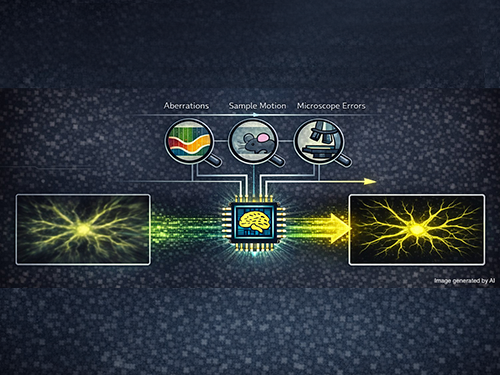
In contrast, the research team developed an algorithm that inversely calculates how light was distorted using only the captured image data and corrects it. In other words, it is a method of restoring image clarity by analyzing blurred photos, without relying on any additional equipment.
The core of this technology is a machine learning algorithm based on the Neural Fields model. This algorithm tracks the distortion process that occurs as light travels, implementing an integrated technology that compensates not only for optical aberrations caused by biological tissue but also for microscopic movements of the living specimen and alignment errors of the microscope itself.
As a result, the team successfully and reliably obtained high-resolution, high-contrast images from deep within biological tissues, without any separate aberration measurement or correction devices.
This research is particularly significant because it overcomes the conventional limitation that “better images require more expensive equipment” by solving the problem through a software-based approach. This is expected to lower the burden of research equipment costs and allow more researchers to perform precise brain observations.
< Comparison of images using a framework that integrates correction for optical aberrations, sample motion, and microscope errors (AI-generated image) >
Professor Iksung Kang stated, “This research opens the way to see more accurately inside living organisms by combining optics and artificial intelligence technology. Moving forward, we plan to develop this into an intelligent optical imaging system where the microscope itself finds the optimal image.”
This study was published on April 13th in Nature Methods, a leading methodology journal in the field of life sciences.
Paper Title: Adaptive optical correction for in vivo two-photon fluorescence microscopy with neural fields
DOI: 10.1038/s41592-026-03053-6
Authors: Iksung Kang (KAIST, Co-corresponding & First Author), Hyeonggeon Kim, Ryan Natan, Qinrong Zhang, Stella X. Yu, & Na Ji (UC Berkeley, Co-corresponding Author)
2026.04.29 View 459
AI Computation Enables Clearer Views of the Deep Brain, Bypassing the Need for Expensive Equipment
< Professor Iksung Kang, KAIST >
Observing the depths of a living brain with clarity has traditionally required expensive, high-end equipment. However, a KAIST research team has advanced neuroscience research by developing a physics-based AI computational algorithm that restores blurred images into sharp ones without the need for additional optical measurement hardware.
KAIST (President Kwang Hyung Lee) announced on April 21st that Professor Iksung Kang (School of Electrical Engineering), in collaboration with Professor Na Ji's research team at UC Berkeley, has developed a technology that accurately corrects image aberrations in microscopes used for live biological imaging. Notably, the experimental design and algorithm development – the core components of this technology – were led by Professor Kang during his postdoctoral fellowship in Professor Na Ji’s group. This breakthrough was achieved using Neural Fields — a neural network-based technology that continuously represents 3D spatial structures to simultaneously reconstruct clear images and volumetric forms.
The research team utilized Two-Photon Fluorescence Microscopy, a core technology for observing deep within living biological tissues by using two low-energy photons simultaneously to selectively illuminate specific points. However, as light passes through thick tissue, it bends and scatters, causing the image to become blurred — much like how objects appear distorted underwater. This phenomenon is known as optical aberration.
Previously, correcting these distortions required adding complex and costly hardware, such as wavefront sensors, which measure exactly how much the light path has deviated.
< Framework for Integrated Distortion Correction in Two-Photon Fluorescence Microscopy >
In contrast, the research team developed an algorithm that inversely calculates how light was distorted using only the captured image data and corrects it. In other words, it is a method of restoring image clarity by analyzing blurred photos, without relying on any additional equipment.
The core of this technology is a machine learning algorithm based on the Neural Fields model. This algorithm tracks the distortion process that occurs as light travels, implementing an integrated technology that compensates not only for optical aberrations caused by biological tissue but also for microscopic movements of the living specimen and alignment errors of the microscope itself.
As a result, the team successfully and reliably obtained high-resolution, high-contrast images from deep within biological tissues, without any separate aberration measurement or correction devices.
This research is particularly significant because it overcomes the conventional limitation that “better images require more expensive equipment” by solving the problem through a software-based approach. This is expected to lower the burden of research equipment costs and allow more researchers to perform precise brain observations.
< Comparison of images using a framework that integrates correction for optical aberrations, sample motion, and microscope errors (AI-generated image) >
Professor Iksung Kang stated, “This research opens the way to see more accurately inside living organisms by combining optics and artificial intelligence technology. Moving forward, we plan to develop this into an intelligent optical imaging system where the microscope itself finds the optimal image.”
This study was published on April 13th in Nature Methods, a leading methodology journal in the field of life sciences.
Paper Title: Adaptive optical correction for in vivo two-photon fluorescence microscopy with neural fields
DOI: 10.1038/s41592-026-03053-6
Authors: Iksung Kang (KAIST, Co-corresponding & First Author), Hyeonggeon Kim, Ryan Natan, Qinrong Zhang, Stella X. Yu, & Na Ji (UC Berkeley, Co-corresponding Author)
2026.04.29 View 459 -
 3D Stem Cell Culture Technology to Shift the Paradigm of Regenerative Medicine
< (From left) KAIST Dr. Changjin Seo, Professor Sangyong Jon >
A breakthrough technology has been developed to overcome the limitation where stem cells fail to survive for long periods in the body, even when administered in large quantities. Stem cells are vital for regenerating damaged tissues or recovering injured areas. A KAIST research team has successfully enhanced both the survival rate and therapeutic efficacy of these cells by developing a 3D culture technology that precisely designs the cellular microenvironment. This achievement is expected to transcend the current limits of stem cell therapy and reshape the landscape of regenerative medicine.
On April 29th, the research team—led by Professor Sangyong Jon from the Department of Biological Sciences and featuring researchers Changjin Seo, Dohyeon Kim, Junhyuk Song, Sun-Young Kim, Youngju Son, and Afia Tasnim Rahman—announced the development of a novel culture technology to grow healthier stem cells. The team implemented a 3D platform by applying a polymer matrix (an artificial structure coating the culture substrate) to an "artificial floor" that mimics the natural in vivo environment. On this platform, they cultured human adipose-derived stem cells (hADSCs) in three dimensions, confirming a dramatic improvement in cellular function and therapeutic impact.
Human adipose-derived stem cells have been favored for clinical use due to their ease of harvest, high proliferation, and low immune rejection. However, traditional 2D (planar) culture methods cause cells to age and lose function over time. Previous 3D methods, such as forming cell aggregates (spheroids), also faced hurdles in maintaining long-term survival and functionality within the body.
To solve this, the research team developed a densely cross-linked synthetic polymer material composed of siloxane (a biocompatible polymer of silicon and oxygen), named "poly-Z."
This material modifies the physicochemical properties of the culture substrate to promote the adsorption of albumin proteins found in the culture medium. As a result, cells do not adhere to the floor but instead self-assemble into 3D spheroid structures. These spheroids showed increased production of the extracellular matrix (ECM), creating an environment highly similar to the human body and demonstrating performance far superior to conventional methods.
Experimental results showed that stem cells cultured on the poly-Z platform exhibited enhanced differentiation potential and immunomodulatory functions, with a significantly increased survival time inside the body.
< Schematic of hADSC Spheroid Formation on the Synthetic Polymer Matrix, Poly-Z >
Notably, in animal models of acute colitis and acute liver injury, this method showed significantly higher therapeutic efficacy than conventional methods. This suggests that even with the same dosage, the cells live longer and act more vigorously. The team confirmed that the activation of integrin and FAK signaling pathways—the mechanisms through which cells sense and respond to their environment—strengthened the stem cells' functions, allowing them to better perceive their surroundings and perform more effectively after transplantation.
Professor Sangyong Jon stated, "This research proves that a precisely engineered synthetic polymer-based 3D environment can simultaneously enhance the function and therapeutic efficacy of stem cells. We expect this to be widely utilized in developing next-generation cell therapies for various incurable diseases, including inflammatory conditions."
The study, with Dr. Changjin Seo from the KAIST InnoCORE AI-Drug Discovery Center as the lead author, was published online on March 31 in the international journal Advanced Science (Impact Factor: 14.1).
Paper Title: Polymer Matrix-Based 3D Culture Significantly Enhances the Differentiation and Immunomodulatory Functions of Human Adipose-Derived Stem Cells
DOI: https://doi.org/10.1002/advs.202518704
This research was supported by the Korea Multi-Ministry Regenerative Medicine Project, the KAIST InnoCORE Program, and the Leader Research Grant of the National Research Foundation of Korea.
2026.04.29 View 383
3D Stem Cell Culture Technology to Shift the Paradigm of Regenerative Medicine
< (From left) KAIST Dr. Changjin Seo, Professor Sangyong Jon >
A breakthrough technology has been developed to overcome the limitation where stem cells fail to survive for long periods in the body, even when administered in large quantities. Stem cells are vital for regenerating damaged tissues or recovering injured areas. A KAIST research team has successfully enhanced both the survival rate and therapeutic efficacy of these cells by developing a 3D culture technology that precisely designs the cellular microenvironment. This achievement is expected to transcend the current limits of stem cell therapy and reshape the landscape of regenerative medicine.
On April 29th, the research team—led by Professor Sangyong Jon from the Department of Biological Sciences and featuring researchers Changjin Seo, Dohyeon Kim, Junhyuk Song, Sun-Young Kim, Youngju Son, and Afia Tasnim Rahman—announced the development of a novel culture technology to grow healthier stem cells. The team implemented a 3D platform by applying a polymer matrix (an artificial structure coating the culture substrate) to an "artificial floor" that mimics the natural in vivo environment. On this platform, they cultured human adipose-derived stem cells (hADSCs) in three dimensions, confirming a dramatic improvement in cellular function and therapeutic impact.
Human adipose-derived stem cells have been favored for clinical use due to their ease of harvest, high proliferation, and low immune rejection. However, traditional 2D (planar) culture methods cause cells to age and lose function over time. Previous 3D methods, such as forming cell aggregates (spheroids), also faced hurdles in maintaining long-term survival and functionality within the body.
To solve this, the research team developed a densely cross-linked synthetic polymer material composed of siloxane (a biocompatible polymer of silicon and oxygen), named "poly-Z."
This material modifies the physicochemical properties of the culture substrate to promote the adsorption of albumin proteins found in the culture medium. As a result, cells do not adhere to the floor but instead self-assemble into 3D spheroid structures. These spheroids showed increased production of the extracellular matrix (ECM), creating an environment highly similar to the human body and demonstrating performance far superior to conventional methods.
Experimental results showed that stem cells cultured on the poly-Z platform exhibited enhanced differentiation potential and immunomodulatory functions, with a significantly increased survival time inside the body.
< Schematic of hADSC Spheroid Formation on the Synthetic Polymer Matrix, Poly-Z >
Notably, in animal models of acute colitis and acute liver injury, this method showed significantly higher therapeutic efficacy than conventional methods. This suggests that even with the same dosage, the cells live longer and act more vigorously. The team confirmed that the activation of integrin and FAK signaling pathways—the mechanisms through which cells sense and respond to their environment—strengthened the stem cells' functions, allowing them to better perceive their surroundings and perform more effectively after transplantation.
Professor Sangyong Jon stated, "This research proves that a precisely engineered synthetic polymer-based 3D environment can simultaneously enhance the function and therapeutic efficacy of stem cells. We expect this to be widely utilized in developing next-generation cell therapies for various incurable diseases, including inflammatory conditions."
The study, with Dr. Changjin Seo from the KAIST InnoCORE AI-Drug Discovery Center as the lead author, was published online on March 31 in the international journal Advanced Science (Impact Factor: 14.1).
Paper Title: Polymer Matrix-Based 3D Culture Significantly Enhances the Differentiation and Immunomodulatory Functions of Human Adipose-Derived Stem Cells
DOI: https://doi.org/10.1002/advs.202518704
This research was supported by the Korea Multi-Ministry Regenerative Medicine Project, the KAIST InnoCORE Program, and the Leader Research Grant of the National Research Foundation of Korea.
2026.04.29 View 383 -
 Implementation of a DNA Molecular Computer Smaller Than 2nm Semiconductors… High Expectations for Bio-computing Applications
< (From left) KAIST Professor Yeongjae Choi, GIST MS/PhD Student Woojin Kim, KAIST Researcher Taehoon Kim, Researcher Sangeun Jeong, Researcher Sion Kim, GIST Master's Student Junho Sim >
Until now, molecular-level DNA circuits have mainly been used for simple tasks, such as detecting the presence of cancer-related substances. However, these systems have faced a key limitation: once a reaction occurs, the circuits cannot be reused. Overcoming this challenge, the research team has developed a DNA-based molecular computer that operates at a much smaller scale than conventional semiconductor devices, enabling both computation and memory within the same system. This advancement opens up new possibilities for future computing technologies in bio and medical applications, including disease diagnosis.
KAIST announced on April 22 that a research team led by Professor Yeongjae Choi from the Graduate School of Engineering Biology has developed a DNA-based bio-transistor—a molecular analogue of a key semiconductor component that receives signals and performs computations—and used it to implement a new molecular circuit capable of both information processing and storage.
As semiconductor technology approaches the 2-nanometer (nm) scale, widely considered to be nearing its physical limits, researchers are increasingly exploring alternative computing paradigms that operate beyond traditional silicon-based systems. DNA has emerged as a promising candidate due to its unique properties. By leveraging complementary base pairing, DNA can be precisely programmed to respond to specific inputs. Moreover, the distance between adjacent bases is only 0.34 nanometers, making DNA an attractive material for ultra-high-density information processing.
Despite this potential, conventional DNA circuits have been limited by their “one-time use” nature. Once a reaction occurs, the system is consumed, making it difficult to perform continuous or complex information processing.
To address this issue, the research team designed DNA molecules that change their binding configurations in response to input signals while maintaining those configurations over time. In this system, the resulting molecular configuration effectively stores information and influences subsequent operations. In other words, the researchers implemented a reset-free circuit capable of real-time information processing without requiring an external initialization step, while preserving previously processed information.
< Illustration of a DNA-based nanoscale bio-memory circuit capable of low-power operation >
This study is significant in that it demonstrates transistor-like functionality—the fundamental building block of semiconductor devices—at the level of DNA molecules. It provides a foundation for programmable molecular systems in which molecules can both process and store information, moving beyond simple chemical reactions.
Professor Yeongjae Choi stated, “This research advances the feasibility of implementing molecular computers using DNA,” adding, “It has the potential to open new directions in both bio-computing and medical technologies.”In this study, Professor Sung Sun Yim, Researcher Taehoon Kim, Researcher Sangeun Jeong, and Researcher Sion Kim from the KAIST Graduate School of Engineering Biology, and MS/PhD integrated student Woojin Kim and Master's student Junho Sim from GIST participated as co-authors, and Professor Yeongjae Choi served as the corresponding author.
Professor Sung Sun Yim, Researcher Taehoon Kim, Researcher Sangeun Jeong, and Researcher Sion Kim from the KAIST Graduate School of Engineering Biology, and MS/PhD integrated student Woojin Kim and Master's student Junho Sim from GIST participated as co-authors, and Professor Yeongjae Choi served as the corresponding author. The research results were published in the international academic journal ‘Science Advances’ on April 1, 2026.
※ Paper Title: Reset-free DNA logic circuits for real-time input processing and memory. DOI: 10.1126/sciadv.aeb1699
This research was conducted with support from the Future Promising Convergence Technology Pioneer Program supported by the Ministry of Science and ICT, the Basic Research Program supported by the Ministry of Education, and the KAIST Quantum+X Convergence R&D Project.
2026.04.26 View 752
Implementation of a DNA Molecular Computer Smaller Than 2nm Semiconductors… High Expectations for Bio-computing Applications
< (From left) KAIST Professor Yeongjae Choi, GIST MS/PhD Student Woojin Kim, KAIST Researcher Taehoon Kim, Researcher Sangeun Jeong, Researcher Sion Kim, GIST Master's Student Junho Sim >
Until now, molecular-level DNA circuits have mainly been used for simple tasks, such as detecting the presence of cancer-related substances. However, these systems have faced a key limitation: once a reaction occurs, the circuits cannot be reused. Overcoming this challenge, the research team has developed a DNA-based molecular computer that operates at a much smaller scale than conventional semiconductor devices, enabling both computation and memory within the same system. This advancement opens up new possibilities for future computing technologies in bio and medical applications, including disease diagnosis.
KAIST announced on April 22 that a research team led by Professor Yeongjae Choi from the Graduate School of Engineering Biology has developed a DNA-based bio-transistor—a molecular analogue of a key semiconductor component that receives signals and performs computations—and used it to implement a new molecular circuit capable of both information processing and storage.
As semiconductor technology approaches the 2-nanometer (nm) scale, widely considered to be nearing its physical limits, researchers are increasingly exploring alternative computing paradigms that operate beyond traditional silicon-based systems. DNA has emerged as a promising candidate due to its unique properties. By leveraging complementary base pairing, DNA can be precisely programmed to respond to specific inputs. Moreover, the distance between adjacent bases is only 0.34 nanometers, making DNA an attractive material for ultra-high-density information processing.
Despite this potential, conventional DNA circuits have been limited by their “one-time use” nature. Once a reaction occurs, the system is consumed, making it difficult to perform continuous or complex information processing.
To address this issue, the research team designed DNA molecules that change their binding configurations in response to input signals while maintaining those configurations over time. In this system, the resulting molecular configuration effectively stores information and influences subsequent operations. In other words, the researchers implemented a reset-free circuit capable of real-time information processing without requiring an external initialization step, while preserving previously processed information.
< Illustration of a DNA-based nanoscale bio-memory circuit capable of low-power operation >
This study is significant in that it demonstrates transistor-like functionality—the fundamental building block of semiconductor devices—at the level of DNA molecules. It provides a foundation for programmable molecular systems in which molecules can both process and store information, moving beyond simple chemical reactions.
Professor Yeongjae Choi stated, “This research advances the feasibility of implementing molecular computers using DNA,” adding, “It has the potential to open new directions in both bio-computing and medical technologies.”In this study, Professor Sung Sun Yim, Researcher Taehoon Kim, Researcher Sangeun Jeong, and Researcher Sion Kim from the KAIST Graduate School of Engineering Biology, and MS/PhD integrated student Woojin Kim and Master's student Junho Sim from GIST participated as co-authors, and Professor Yeongjae Choi served as the corresponding author.
Professor Sung Sun Yim, Researcher Taehoon Kim, Researcher Sangeun Jeong, and Researcher Sion Kim from the KAIST Graduate School of Engineering Biology, and MS/PhD integrated student Woojin Kim and Master's student Junho Sim from GIST participated as co-authors, and Professor Yeongjae Choi served as the corresponding author. The research results were published in the international academic journal ‘Science Advances’ on April 1, 2026.
※ Paper Title: Reset-free DNA logic circuits for real-time input processing and memory. DOI: 10.1126/sciadv.aeb1699
This research was conducted with support from the Future Promising Convergence Technology Pioneer Program supported by the Ministry of Science and ICT, the Basic Research Program supported by the Ministry of Education, and the KAIST Quantum+X Convergence R&D Project.
2026.04.26 View 752 -
 Discovery of the Two-Faced Protein in Leukemia Treatment: A Clue to Overcoming Drug Resistance
<(From left) Professor Dong-Wook Kim of Uijeongbu Eulji University Hospital Hematologic Malignancy Center, Professor Hongtae Kim of UNIST, Professor Chunghun Lim of KAIST, and Dr. Jumin Park of KAIST>
The real reason why anticancer drugs kill cancer cells has been revealed. KAIST research team has identified that targeted anticancer therapies do not simply block cancer proteins, but rather shut down the "protein factories" inside the cells, forcing them to undergo self-destruction. Consequently, the "two-faced protein" that plays a key role in this process is gaining attention as a breakthrough for treating patients with drug resistance.
KAIST announced on April 23rd that a joint research team—consisting of Professor Chunghun Lim from the Department of Biological Sciences at KAIST, Professor Dong-Wook Kim from the Hematologic Malignancy Center at Uijeongbu Eulji University Hospital, and Professor Hongtae Kim from UNIST —has identified a new molecular mechanism that regulates the response to anticancer drugs for Chronic Myeloid Leukemia (CML).
Chronic Myeloid Leukemia occurs when genetic abnormalities in hematopoietic stem cells produce an abnormal protein. This protein is known to be the primary cause of cancer cell proliferation by sending continuous growth signals to the cells. While targeted anticancer drugs that inhibit this protein are currently used as the standard treatment, there have been limitations, such as drug resistance or low treatment response in some patients.
The research team focused on the impact of anticancer drugs on the protein production process within the cell. As a result, they confirmed that when anticancer drugs are administered, the flow of ribosomes—the machines that create proteins—becomes tangled, leading to "ribosome collisions." This process induces intense stress inside the cell, ultimately leading the cancer cell to its death.
In particular, the research team identified the ZAK protein as the key sensor that detects these ribosome collisions and discovered that ZAK possesses "two faces" depending on the situation. Under normal conditions, it acts as an assistant, binding with AKT signals* to help cancer cells grow. However, once targeted anticancer treatment begins, it transforms into a sentinel that monitors ribosome collisions and triggers the death of the cancer cell. This marks the world's first proof that the same protein can perform diametrically opposite roles during cancer progression versus cancer treatment. *A key intracellular signaling pathway that regulates cell survival, growth, proliferation, metabolism, and migration.
<Clinical correlation between disease stage and ZAK expression in a Chronic Myeloid Leukemia patient cohort>
The research team verified this mechanism by analyzing cancer cells derived from actual leukemia patients. When drugs that increase ribosome collisions were used in combination, the anticancer effect improved significantly. Conversely, when ZAK function was impaired, the responsiveness to the anticancer drug decreased.
<Mechanism of ribosome collision and ZAK-dependent cancer cell death induced by Targeted Kinase Inhibitors (TKIs) in Chronic Myeloid Leukemia>
In other words, according to this study, drug-resistant patients are predicted to have decreased ZAK function or an insufficient ribosome stress response. This suggests that it is possible to predict treatment responses based on an individual patient's ZAK activation status and design customized combination therapy strategies.
This study is a significant achievement that presents the importance of the ribosome stress signaling pathway in the treatment of Chronic Myeloid Leukemia. It is expected to lead to the development of new combination therapies and enhance the effectiveness of targeted anticancer drugs. In particular, it offers new possibilities for patients struggling with drug resistance.
<Research Image (AI-generated)>
Professor Chunghun Lim stated, "This study shows how critical the process of the cell detecting abnormal protein synthesis and converting it into a death signal is for treatment." Dr. Jumin Park, the lead author, noted, "As we have confirmed that ribosome collision is a key switch determining cancer cell death, we plan to expand this research to various other types of cancer."
The results of this study, featuring Jumin Park of KAIST as the first author, were published online on March 30th in Leukemia, one of the most prestigious academic journals in the field of hematology.
Paper Title: BCR::ABL1 tyrosine kinase inhibitors induce ribosome collisions to activate ZAK-dependent ribotoxic stress and apoptosis in chronic myeloid leukemia
Authors: Jumin Park, Soo-Hyun Kim, Jongmin Park, Heeju Park, Hongtae Kim, Dong-Wook Kim & Chunghun Lim
DOI: https://doi.org/10.1038/s41375-026-02916-3
This research was conducted with support from the Suh Kyungbae Foundation, the Mid-career Researcher Support Program of the National Research Foundation of Korea, the Basic Research Lab Support Program, and the KAIST Settlement Project.
2026.04.23 View 492
Discovery of the Two-Faced Protein in Leukemia Treatment: A Clue to Overcoming Drug Resistance
<(From left) Professor Dong-Wook Kim of Uijeongbu Eulji University Hospital Hematologic Malignancy Center, Professor Hongtae Kim of UNIST, Professor Chunghun Lim of KAIST, and Dr. Jumin Park of KAIST>
The real reason why anticancer drugs kill cancer cells has been revealed. KAIST research team has identified that targeted anticancer therapies do not simply block cancer proteins, but rather shut down the "protein factories" inside the cells, forcing them to undergo self-destruction. Consequently, the "two-faced protein" that plays a key role in this process is gaining attention as a breakthrough for treating patients with drug resistance.
KAIST announced on April 23rd that a joint research team—consisting of Professor Chunghun Lim from the Department of Biological Sciences at KAIST, Professor Dong-Wook Kim from the Hematologic Malignancy Center at Uijeongbu Eulji University Hospital, and Professor Hongtae Kim from UNIST —has identified a new molecular mechanism that regulates the response to anticancer drugs for Chronic Myeloid Leukemia (CML).
Chronic Myeloid Leukemia occurs when genetic abnormalities in hematopoietic stem cells produce an abnormal protein. This protein is known to be the primary cause of cancer cell proliferation by sending continuous growth signals to the cells. While targeted anticancer drugs that inhibit this protein are currently used as the standard treatment, there have been limitations, such as drug resistance or low treatment response in some patients.
The research team focused on the impact of anticancer drugs on the protein production process within the cell. As a result, they confirmed that when anticancer drugs are administered, the flow of ribosomes—the machines that create proteins—becomes tangled, leading to "ribosome collisions." This process induces intense stress inside the cell, ultimately leading the cancer cell to its death.
In particular, the research team identified the ZAK protein as the key sensor that detects these ribosome collisions and discovered that ZAK possesses "two faces" depending on the situation. Under normal conditions, it acts as an assistant, binding with AKT signals* to help cancer cells grow. However, once targeted anticancer treatment begins, it transforms into a sentinel that monitors ribosome collisions and triggers the death of the cancer cell. This marks the world's first proof that the same protein can perform diametrically opposite roles during cancer progression versus cancer treatment. *A key intracellular signaling pathway that regulates cell survival, growth, proliferation, metabolism, and migration.
<Clinical correlation between disease stage and ZAK expression in a Chronic Myeloid Leukemia patient cohort>
The research team verified this mechanism by analyzing cancer cells derived from actual leukemia patients. When drugs that increase ribosome collisions were used in combination, the anticancer effect improved significantly. Conversely, when ZAK function was impaired, the responsiveness to the anticancer drug decreased.
<Mechanism of ribosome collision and ZAK-dependent cancer cell death induced by Targeted Kinase Inhibitors (TKIs) in Chronic Myeloid Leukemia>
In other words, according to this study, drug-resistant patients are predicted to have decreased ZAK function or an insufficient ribosome stress response. This suggests that it is possible to predict treatment responses based on an individual patient's ZAK activation status and design customized combination therapy strategies.
This study is a significant achievement that presents the importance of the ribosome stress signaling pathway in the treatment of Chronic Myeloid Leukemia. It is expected to lead to the development of new combination therapies and enhance the effectiveness of targeted anticancer drugs. In particular, it offers new possibilities for patients struggling with drug resistance.
<Research Image (AI-generated)>
Professor Chunghun Lim stated, "This study shows how critical the process of the cell detecting abnormal protein synthesis and converting it into a death signal is for treatment." Dr. Jumin Park, the lead author, noted, "As we have confirmed that ribosome collision is a key switch determining cancer cell death, we plan to expand this research to various other types of cancer."
The results of this study, featuring Jumin Park of KAIST as the first author, were published online on March 30th in Leukemia, one of the most prestigious academic journals in the field of hematology.
Paper Title: BCR::ABL1 tyrosine kinase inhibitors induce ribosome collisions to activate ZAK-dependent ribotoxic stress and apoptosis in chronic myeloid leukemia
Authors: Jumin Park, Soo-Hyun Kim, Jongmin Park, Heeju Park, Hongtae Kim, Dong-Wook Kim & Chunghun Lim
DOI: https://doi.org/10.1038/s41375-026-02916-3
This research was conducted with support from the Suh Kyungbae Foundation, the Mid-career Researcher Support Program of the National Research Foundation of Korea, the Basic Research Lab Support Program, and the KAIST Settlement Project.
2026.04.23 View 492 -
 Zero-Crease Foldable Technology to Shift the Paradigm of Next-Generation Displays
< Professor Phil-Seung Lee (center), Master’s graduate Jun-han Bae (top left) >
The "crease," long considered the biggest weakness of foldable smartphones, has been pointed out as a major obstacle to market expansion, causing screen distortion and reduced durability over repeated use. A research team at KAIST has presented a solution to this problem, marking a turning point for foldables to leap forward as the standard for next-generation smartphones. Furthermore, the technology is expected to establish itself as a core component of the future mobile industry, expanding into various devices such as laptops.
KAIST announced on April 20th that a research team led by Professor Phil-Seung Lee of the Department of Mechanical Engineering has developed an original technology capable of fundamentally solving the crease issue that occurs at the folding area of foldable smartphone displays and has registered a patent for it. The team has secured global technological competitiveness by filing patent applications in the United States, China, and the European Union (EU), in addition to South Korea.
While global smartphone companies have attempted to solve this issue through massive R&D investments for years, they have yet to achieve the complete removal of the crease. Consequently, the industry has identified the crease problem as the single greatest barrier to the widespread adoption of the foldable smartphone market.
The research team began their study to resolve the inconveniences they personally experienced while using mobile foldable phones. After disassembling dozens of used foldable phones and repeating various experiments, they derived a solution by innovatively redesigning the "adhesive area" between the display and the supporting plate. The core of the design is ensuring that deformation is not concentrated in a specific folding area but is instead distributed to the surrounding sections. Through this, they perfectly demonstrated the feasibility of a "crease-free foldable" while maintaining normal smartphone functionality.
To verify performance, the team shone a straight-line LED light onto the screen. Unlike commercial products where the light refracts and the straight line appears curved at the fold, the prototype maintained a sharp, straight reflection without any distortion. Notably, no visual distortion appeared even under conditions sensitive enough to detect minute curves with a crease depth of less than 0.1mm.
< Display surface reflecting a straight-line LED lamp >
This technology presents a new design paradigm that surpasses the limitations faced by the current industry. It not only fundamentally suppresses the formation of creases but also ensures superior durability by minimizing deformation even after tens of thousands of folding cycles.
Furthermore, because the structure is intuitive and simple, it can be easily integrated into existing manufacturing processes. It is expected to have high industrial utility, as it can be expanded beyond smartphones to various foldable display devices, including tablets and laptops.
< Core idea of the invention: (a) Adhesive and non-adhesive areas of a conventional foldable smartphone, (b) Adhesive and non-adhesive areas in this invention, (c) Stress distribution in a conventional foldable smartphone display, (d) Stress distribution in a foldable smartphone display applying this technology >
Industry experts anticipate that the commercialization of this technology will encourage global companies—which have been hesitant to enter the market due to crease issues—to participate. This is projected to significantly improve consumer satisfaction and accelerate the growth of the stagnating foldable market.
Professor Phil-Seung Lee stated, "We have solved a challenge that global giants could not resolve, using a relatively simple and clear method. We expect this technology to spread across next-generation displays, including laptops and tablets, further strengthening Korea's technological competitiveness."
Meanwhile, this research was conducted with support from the "2022 Daedeok Innopolis Campus Project," and the patent for the related original technology was registered on September 9, 2025.
2026.04.21 View 1071
Zero-Crease Foldable Technology to Shift the Paradigm of Next-Generation Displays
< Professor Phil-Seung Lee (center), Master’s graduate Jun-han Bae (top left) >
The "crease," long considered the biggest weakness of foldable smartphones, has been pointed out as a major obstacle to market expansion, causing screen distortion and reduced durability over repeated use. A research team at KAIST has presented a solution to this problem, marking a turning point for foldables to leap forward as the standard for next-generation smartphones. Furthermore, the technology is expected to establish itself as a core component of the future mobile industry, expanding into various devices such as laptops.
KAIST announced on April 20th that a research team led by Professor Phil-Seung Lee of the Department of Mechanical Engineering has developed an original technology capable of fundamentally solving the crease issue that occurs at the folding area of foldable smartphone displays and has registered a patent for it. The team has secured global technological competitiveness by filing patent applications in the United States, China, and the European Union (EU), in addition to South Korea.
While global smartphone companies have attempted to solve this issue through massive R&D investments for years, they have yet to achieve the complete removal of the crease. Consequently, the industry has identified the crease problem as the single greatest barrier to the widespread adoption of the foldable smartphone market.
The research team began their study to resolve the inconveniences they personally experienced while using mobile foldable phones. After disassembling dozens of used foldable phones and repeating various experiments, they derived a solution by innovatively redesigning the "adhesive area" between the display and the supporting plate. The core of the design is ensuring that deformation is not concentrated in a specific folding area but is instead distributed to the surrounding sections. Through this, they perfectly demonstrated the feasibility of a "crease-free foldable" while maintaining normal smartphone functionality.
To verify performance, the team shone a straight-line LED light onto the screen. Unlike commercial products where the light refracts and the straight line appears curved at the fold, the prototype maintained a sharp, straight reflection without any distortion. Notably, no visual distortion appeared even under conditions sensitive enough to detect minute curves with a crease depth of less than 0.1mm.
< Display surface reflecting a straight-line LED lamp >
This technology presents a new design paradigm that surpasses the limitations faced by the current industry. It not only fundamentally suppresses the formation of creases but also ensures superior durability by minimizing deformation even after tens of thousands of folding cycles.
Furthermore, because the structure is intuitive and simple, it can be easily integrated into existing manufacturing processes. It is expected to have high industrial utility, as it can be expanded beyond smartphones to various foldable display devices, including tablets and laptops.
< Core idea of the invention: (a) Adhesive and non-adhesive areas of a conventional foldable smartphone, (b) Adhesive and non-adhesive areas in this invention, (c) Stress distribution in a conventional foldable smartphone display, (d) Stress distribution in a foldable smartphone display applying this technology >
Industry experts anticipate that the commercialization of this technology will encourage global companies—which have been hesitant to enter the market due to crease issues—to participate. This is projected to significantly improve consumer satisfaction and accelerate the growth of the stagnating foldable market.
Professor Phil-Seung Lee stated, "We have solved a challenge that global giants could not resolve, using a relatively simple and clear method. We expect this technology to spread across next-generation displays, including laptops and tablets, further strengthening Korea's technological competitiveness."
Meanwhile, this research was conducted with support from the "2022 Daedeok Innopolis Campus Project," and the patent for the related original technology was registered on September 9, 2025.
2026.04.21 View 1071 -
 Frequency Instant Jump via Magnetic Vibration... Reduces Heat Even During Gaming"
< (From left) Mujin You (Postdoctoral Researcher), Kab-Jin Kim (Professor), Albert Min Gyu Park (Research Professor) >
A new technology has been proposed that could fundamentally solve the issue of smartphones overheating during high-spec gaming or extended video streaming. Researchers at KAIST have discovered the principle of processing signals using the minute vibrations of magnets (spin waves) instead of electrons. This method significantly reduces heat generation and power consumption while enabling instantaneous frequency switching within the several GHz range. This breakthrough is expected to pave the way for smart devices with less heat and longer battery life, as well as ultra-low-power, high-speed computing.
A research team led by Professor Kab-Jin Kim from the Department of Physics announced on the 19th that they successfully achieved significant signal speed (frequency) changes at the nanoscale using spin waves—minute vibrations occurring within magnets. These vibrations are explained in units called "magnons." This achievement is being evaluated for presenting a signal control method that can drastically reduce power consumption even at extremely small scales, which was difficult to implement using conventional electron-based methods.
The material used by the research team is a Synthetic Antiferromagnet (SAF), created by stacking magnetic materials much thinner than a human hair in multiple layers. Within this structure, the spin waves manifest in two ways: acoustic mode and optic mode. The researchers were the first to identify a "mode hopping" phenomenon, where these movements suddenly switch under specific conditions.
Unlike conventional methods where signal states change continuously, this phenomenon involves a sudden shift to a completely different state at a specific moment, causing a sharp jump in frequency. This suggests a new way to control signal frequencies through the state changes of spin waves alone, without the need for complex circuits.
The core of this research is the ability to abruptly change the frequency by more than 5 GHz through this mode hopping. This effect is comparable to switching a radio channel completely with the single press of a button.
The team generated spin waves inside the magnet by sending electromagnetic signals through tiny antennas. Upon adjusting the strength of the external power and magnetic field, the vibration speed (frequency) did not change linearly but instead "jumped" suddenly. This change occurs during the "three-magnon interaction" process, where the fundamental unit of the spin wave, the magnon, either splits from one into two or merges back into one.
Notably, these rapid frequency changes are possible without complex electronic circuitry. By simply adjusting the signal intensity, the frequency can be changed freely, allowing for simpler device structures and significantly reduced power consumption.
Furthermore, this phenomenon can be used as a switch to distinguish between "on (1)" and "off (0)," making it applicable to new types of semiconductors and neuromorphic computing technology that mimics the human brain.
This research marks a significant step forward in the feasibility of "spin-wave-based information processing technology." It is expected to be utilized in various fields, including ultra-low-power computing, high-speed signal processing, and spintronic devices—a next-generation semiconductor technology that utilizes spin (magnetic properties) instead of electrons.
< Figure 1. (a) Schematic of the Synthetic Antiferromagnet (SAF) structure and the device for spin-wave propagation. Spin waves are generated and detected via a microwave antenna (CPW). (b) Optical image of the fabricated nano-device. (c) Optic magnon and (d) acoustic magnon generation and spin rotation schematics. >
< Figure 2. (a,b) Linear response showing identical spectra during magnetic field increase and decrease at low power. (c,d) Mode hopping at high power with hysteresis observed. (e–h) Quantitative results showing changes in hysteresis width according to external power. >
Professor Kab-Jin Kim stated, "This study is a case that proves we can implement and control the nonlinear dynamics of magnons—the principle of information processing using magnetic vibrations—in actual nano-devices, which had previously only been proposed in theory. It will serve as an important foundation for the development of a new information processing paradigm using spin waves instead of electrons."
Mujin You led the study as the first author, and Albert Min Gyu Park participated as the co-corresponding author. The research was published in the international academic journal Nature Communications on March 12, representing a major advancement in the field of magnon-based nonlinear dynamics.
Paper Title: Mode hopping via nonlinear magnon-magnon coupling in a synthetic antiferromagnet DOI: 10.1038/s41467-026-70298-2 Authors: Mujin You, Moojune Song, Jun Seok Seo, Donghyeon Lee, Seungha Yoon, Daiju Hayashi, Yoichi Shiota, Teruo Ono, Sanghoon Kim, Se Kwon Kim, Albert Min Gyu Park & Kab-Jin Kim
2026.04.20 View 492
Frequency Instant Jump via Magnetic Vibration... Reduces Heat Even During Gaming"
< (From left) Mujin You (Postdoctoral Researcher), Kab-Jin Kim (Professor), Albert Min Gyu Park (Research Professor) >
A new technology has been proposed that could fundamentally solve the issue of smartphones overheating during high-spec gaming or extended video streaming. Researchers at KAIST have discovered the principle of processing signals using the minute vibrations of magnets (spin waves) instead of electrons. This method significantly reduces heat generation and power consumption while enabling instantaneous frequency switching within the several GHz range. This breakthrough is expected to pave the way for smart devices with less heat and longer battery life, as well as ultra-low-power, high-speed computing.
A research team led by Professor Kab-Jin Kim from the Department of Physics announced on the 19th that they successfully achieved significant signal speed (frequency) changes at the nanoscale using spin waves—minute vibrations occurring within magnets. These vibrations are explained in units called "magnons." This achievement is being evaluated for presenting a signal control method that can drastically reduce power consumption even at extremely small scales, which was difficult to implement using conventional electron-based methods.
The material used by the research team is a Synthetic Antiferromagnet (SAF), created by stacking magnetic materials much thinner than a human hair in multiple layers. Within this structure, the spin waves manifest in two ways: acoustic mode and optic mode. The researchers were the first to identify a "mode hopping" phenomenon, where these movements suddenly switch under specific conditions.
Unlike conventional methods where signal states change continuously, this phenomenon involves a sudden shift to a completely different state at a specific moment, causing a sharp jump in frequency. This suggests a new way to control signal frequencies through the state changes of spin waves alone, without the need for complex circuits.
The core of this research is the ability to abruptly change the frequency by more than 5 GHz through this mode hopping. This effect is comparable to switching a radio channel completely with the single press of a button.
The team generated spin waves inside the magnet by sending electromagnetic signals through tiny antennas. Upon adjusting the strength of the external power and magnetic field, the vibration speed (frequency) did not change linearly but instead "jumped" suddenly. This change occurs during the "three-magnon interaction" process, where the fundamental unit of the spin wave, the magnon, either splits from one into two or merges back into one.
Notably, these rapid frequency changes are possible without complex electronic circuitry. By simply adjusting the signal intensity, the frequency can be changed freely, allowing for simpler device structures and significantly reduced power consumption.
Furthermore, this phenomenon can be used as a switch to distinguish between "on (1)" and "off (0)," making it applicable to new types of semiconductors and neuromorphic computing technology that mimics the human brain.
This research marks a significant step forward in the feasibility of "spin-wave-based information processing technology." It is expected to be utilized in various fields, including ultra-low-power computing, high-speed signal processing, and spintronic devices—a next-generation semiconductor technology that utilizes spin (magnetic properties) instead of electrons.
< Figure 1. (a) Schematic of the Synthetic Antiferromagnet (SAF) structure and the device for spin-wave propagation. Spin waves are generated and detected via a microwave antenna (CPW). (b) Optical image of the fabricated nano-device. (c) Optic magnon and (d) acoustic magnon generation and spin rotation schematics. >
< Figure 2. (a,b) Linear response showing identical spectra during magnetic field increase and decrease at low power. (c,d) Mode hopping at high power with hysteresis observed. (e–h) Quantitative results showing changes in hysteresis width according to external power. >
Professor Kab-Jin Kim stated, "This study is a case that proves we can implement and control the nonlinear dynamics of magnons—the principle of information processing using magnetic vibrations—in actual nano-devices, which had previously only been proposed in theory. It will serve as an important foundation for the development of a new information processing paradigm using spin waves instead of electrons."
Mujin You led the study as the first author, and Albert Min Gyu Park participated as the co-corresponding author. The research was published in the international academic journal Nature Communications on March 12, representing a major advancement in the field of magnon-based nonlinear dynamics.
Paper Title: Mode hopping via nonlinear magnon-magnon coupling in a synthetic antiferromagnet DOI: 10.1038/s41467-026-70298-2 Authors: Mujin You, Moojune Song, Jun Seok Seo, Donghyeon Lee, Seungha Yoon, Daiju Hayashi, Yoichi Shiota, Teruo Ono, Sanghoon Kim, Se Kwon Kim, Albert Min Gyu Park & Kab-Jin Kim
2026.04.20 View 492 -
 Professor Yiyun Kang Selected as TED 2026 Main Stage Speaker
< Professor Yiyun Kang (Photo Credit: Ryan Lash / TED) >
KAIST announced on April 17th that Professor Yiyun Kang of the Department of Industrial Design has been selected as a speaker for the Main Stage at TED 2026, the world-renowned knowledge conference.
Founded in 1984 under the motto "Ideas Worth Spreading," TED is an American non-profit knowledge platform where scholars, innovators, and artists from around the globe gather annually to lead global discourse. Previous Korean speakers on the Main Stage include novelist Young-ha Kim (2012) and violinist Ji-hae Park (2013). In 2011, roboticist Professor Dennis Hong stood on the main conference stage as the first Korean-American speaker.
< TED Lecture Photo (Photo Credit: Ryan Lash / TED) >
Professor Kang’s selection is particularly significant as it marks the first time since TED moved its venue to Vancouver, Canada, in 2014 that a Korean national—an artist and scholar actively based in South Korea, rather than an overseas resident or defector—has been invited to the Main Stage. Furthermore, it marks the return of a Korean speaker to the main stage after a 12-year hiatus, serving as a symbolic milestone.
The TED 2026 annual conference is being held from April 13 to 17 at the Vancouver Convention Centre in Canada, under the theme "ALL OF US." Professor Kang took the Main Stage on April 15, the third day of the conference, to present visual insights and philosophical solutions for a future where Artificial Intelligence (AI), humans, and nature must coexist. The lecture video will be edited and released globally via the official TED website and YouTube channel this coming July.
In this talk, Professor Kang defines AI and the climate crisis as "problems we understand intellectually but fail to feel physically," noting that data- and information-centric communication methods often lower our sense of reality. She proposes the potential of art as a means to bridge this gap. Specifically, Professor Kang will demonstrate on stage how to transform complex challenges into visual and sensory experiences through cases from her own projects.
Notably, this presentation transcends traditional lecture formats, structured as an "Immersive Talk" that transforms the entire stage into an artistic space. Rather than just listening, the audience participates by experiencing the content with their entire bodies.
Professor Yiyun Kang is a world-class media artist and researcher who crosses the boundaries between sensation and technology, and materiality (physical forms) and immateriality (elements like light, video, and data). She leads the Experience Design Lab (XD Lab) at KAIST and has consistently explored the convergence of technology and art through collaborations with NASA, Google Arts & Culture, and the Victoria and Albert Museum (V&A).
"Humanity is currently at a critical turning point that will determine the coexistence of technology and nature," Professor Kang stated. "Through this TED stage, I aim to ensure that AI and the climate crisis are perceived not just as mere information, but as realities of our lives. I hope to create a practical opportunity to expand fragmented individual perceptions into collective human solidarity through the creative energy of art."
< TED 2026 Professor Yiyun Kang (Source: TED Website) >
2026.04.18 View 1064
Professor Yiyun Kang Selected as TED 2026 Main Stage Speaker
< Professor Yiyun Kang (Photo Credit: Ryan Lash / TED) >
KAIST announced on April 17th that Professor Yiyun Kang of the Department of Industrial Design has been selected as a speaker for the Main Stage at TED 2026, the world-renowned knowledge conference.
Founded in 1984 under the motto "Ideas Worth Spreading," TED is an American non-profit knowledge platform where scholars, innovators, and artists from around the globe gather annually to lead global discourse. Previous Korean speakers on the Main Stage include novelist Young-ha Kim (2012) and violinist Ji-hae Park (2013). In 2011, roboticist Professor Dennis Hong stood on the main conference stage as the first Korean-American speaker.
< TED Lecture Photo (Photo Credit: Ryan Lash / TED) >
Professor Kang’s selection is particularly significant as it marks the first time since TED moved its venue to Vancouver, Canada, in 2014 that a Korean national—an artist and scholar actively based in South Korea, rather than an overseas resident or defector—has been invited to the Main Stage. Furthermore, it marks the return of a Korean speaker to the main stage after a 12-year hiatus, serving as a symbolic milestone.
The TED 2026 annual conference is being held from April 13 to 17 at the Vancouver Convention Centre in Canada, under the theme "ALL OF US." Professor Kang took the Main Stage on April 15, the third day of the conference, to present visual insights and philosophical solutions for a future where Artificial Intelligence (AI), humans, and nature must coexist. The lecture video will be edited and released globally via the official TED website and YouTube channel this coming July.
In this talk, Professor Kang defines AI and the climate crisis as "problems we understand intellectually but fail to feel physically," noting that data- and information-centric communication methods often lower our sense of reality. She proposes the potential of art as a means to bridge this gap. Specifically, Professor Kang will demonstrate on stage how to transform complex challenges into visual and sensory experiences through cases from her own projects.
Notably, this presentation transcends traditional lecture formats, structured as an "Immersive Talk" that transforms the entire stage into an artistic space. Rather than just listening, the audience participates by experiencing the content with their entire bodies.
Professor Yiyun Kang is a world-class media artist and researcher who crosses the boundaries between sensation and technology, and materiality (physical forms) and immateriality (elements like light, video, and data). She leads the Experience Design Lab (XD Lab) at KAIST and has consistently explored the convergence of technology and art through collaborations with NASA, Google Arts & Culture, and the Victoria and Albert Museum (V&A).
"Humanity is currently at a critical turning point that will determine the coexistence of technology and nature," Professor Kang stated. "Through this TED stage, I aim to ensure that AI and the climate crisis are perceived not just as mere information, but as realities of our lives. I hope to create a practical opportunity to expand fragmented individual perceptions into collective human solidarity through the creative energy of art."
< TED 2026 Professor Yiyun Kang (Source: TED Website) >
2026.04.18 View 1064 -
 Development of Dream Battery Material: Air-Stable and Fast-Charging All-Solid-State Battery
<(Bottom row, from left) Dr. Jae-Seung Kim (Seoul National University), Prof. Dong-Hwa Seo (KAIST), Researcher Heeju Park (KAIST), Researcher Jiwon Seo, Researcher Jinyeong Choe.
(Top row, from left) Researcher Hae-Yong Kim (Dongguk University), Prof. Eunryeol Lee (Chungbuk National University), Prof. Kyung-Wan Nam (Dongguk University), Prof. Yoon Seok Jung (Yonsei University)>
Expectations are rising for all-solid-state batteries—the "dream battery" with low fire risk—not only for electric vehicles but also for various fields such as robotics and Urban Air Mobility (UAM). A research team at our university has presented a new design principle that simultaneously overcomes the limitations of solid electrolytes, which were previously vulnerable to air exposure and suffered from low performance. This technology is gaining significant attention as it can enhance both battery safety and charging speeds, demonstrating the feasibility of commercializing next-generation all-solid-state batteries.
KAIST announced on April 16th that a research team led by Professor Dong-Hwa Seo from the Department of Materials Science and Engineering, through joint research with teams from Dongguk University (President Jae-Woong Yoon), Yonsei University (President Dong-Sup Yoon), and Chungbuk National University (Acting President Yu-Sik Park), has developed a design technology for solid electrolytes used in all-solid-state batteries. This technology maintains structural stability even when exposed to air while dramatically increasing ionic conductivity.
Unlike conventional lithium-ion batteries that use liquid electrolytes, all-solid-state batteries are spotlighted as next-generation batteries due to their low fire risk. Among these, halide-based solid electrolytes—which contain halogen elements such as chlorine (Cl) and bromine (Br)—are advantageous in terms of performance due to their high ionic conductivity. However, they are known to be difficult materials to manufacture and handle because they are highly vulnerable to moisture in the air, which easily degrades their performance.
To solve this problem, the research team introduced a new structure called "Oxygen Anchoring." This method involves stably bonding oxygen inside the electrolyte to strengthen its structural intergrity, a process in which the element Tungsten plays a key role.
< Research image on tungsten-based oxygen fixation strategy >
As a result, it was confirmed that the electrolyte maintains a stable structure without collapsing, even in air-exposed environments.
Furthermore, the research team improved battery performance in addition to stability. The changes in the internal structure of the electrolyte widened the pathways for lithium ions, allowing them to move more smoothly and increasing the ion migration speed. It was confirmed that the oxygen-incorporated material exhibited an ionic conductivity approximately 2.7 times higher than that of conventional zirconium (Zr)-based halide solid electrolytes.
Another feature of this technology is that it is not limited to a specific material. The research team applied the same strategy to various halide solid electrolytes, including those based on zirconium (Zr), indium (In), yttrium (Y), and erbium (Er), and confirmed similar effects. This demonstrates that it is a "universal design principle" applicable to a wide range of battery materials.
< Research image (AI-generated image) >
The research team expects this technology to contribute to the development of solid electrolytes that possess both air stability and high performance.
Professor Dong-Hwa Seo stated, "This study presents a new material design principle that optimizes multiple performances through a structural design strategy that simultaneously improves air stability and ionic conductivity. It will serve as a key indicator for future all-solid-state battery research and process development."
This study involved Jae-Seung Kim (formerly KAIST, now SNU), Heeju Park, and Hae-Yong Kim as joint first authors. The research included contributions from Eunryeol Lee, Heewon Kim, Soeul Lee, Jinyeong Choe, Jiwon Seo, Hyeon-Jong Lee, Hojoon Kim, Jemin Yeon, and Yoon Seok Jung. The findings were published on March 6, 2026, in the international academic journal Advanced Energy Materials.
Paper Title: Universal Oxychlorination Strategy in Halide Solid Electrolytes for All-Solid-State Batteries
DOI: https://doi.org/10.1002/aenm.202506744
This research was conducted with support from the Samsung Electronics Future Technology Promotion Center and the Nano and Materials Technology Development Program of the National Research Foundation of Korea. Computational studies were performed using the resources of the National Supercomputing Center.
2026.04.16 View 698
Development of Dream Battery Material: Air-Stable and Fast-Charging All-Solid-State Battery
<(Bottom row, from left) Dr. Jae-Seung Kim (Seoul National University), Prof. Dong-Hwa Seo (KAIST), Researcher Heeju Park (KAIST), Researcher Jiwon Seo, Researcher Jinyeong Choe.
(Top row, from left) Researcher Hae-Yong Kim (Dongguk University), Prof. Eunryeol Lee (Chungbuk National University), Prof. Kyung-Wan Nam (Dongguk University), Prof. Yoon Seok Jung (Yonsei University)>
Expectations are rising for all-solid-state batteries—the "dream battery" with low fire risk—not only for electric vehicles but also for various fields such as robotics and Urban Air Mobility (UAM). A research team at our university has presented a new design principle that simultaneously overcomes the limitations of solid electrolytes, which were previously vulnerable to air exposure and suffered from low performance. This technology is gaining significant attention as it can enhance both battery safety and charging speeds, demonstrating the feasibility of commercializing next-generation all-solid-state batteries.
KAIST announced on April 16th that a research team led by Professor Dong-Hwa Seo from the Department of Materials Science and Engineering, through joint research with teams from Dongguk University (President Jae-Woong Yoon), Yonsei University (President Dong-Sup Yoon), and Chungbuk National University (Acting President Yu-Sik Park), has developed a design technology for solid electrolytes used in all-solid-state batteries. This technology maintains structural stability even when exposed to air while dramatically increasing ionic conductivity.
Unlike conventional lithium-ion batteries that use liquid electrolytes, all-solid-state batteries are spotlighted as next-generation batteries due to their low fire risk. Among these, halide-based solid electrolytes—which contain halogen elements such as chlorine (Cl) and bromine (Br)—are advantageous in terms of performance due to their high ionic conductivity. However, they are known to be difficult materials to manufacture and handle because they are highly vulnerable to moisture in the air, which easily degrades their performance.
To solve this problem, the research team introduced a new structure called "Oxygen Anchoring." This method involves stably bonding oxygen inside the electrolyte to strengthen its structural intergrity, a process in which the element Tungsten plays a key role.
< Research image on tungsten-based oxygen fixation strategy >
As a result, it was confirmed that the electrolyte maintains a stable structure without collapsing, even in air-exposed environments.
Furthermore, the research team improved battery performance in addition to stability. The changes in the internal structure of the electrolyte widened the pathways for lithium ions, allowing them to move more smoothly and increasing the ion migration speed. It was confirmed that the oxygen-incorporated material exhibited an ionic conductivity approximately 2.7 times higher than that of conventional zirconium (Zr)-based halide solid electrolytes.
Another feature of this technology is that it is not limited to a specific material. The research team applied the same strategy to various halide solid electrolytes, including those based on zirconium (Zr), indium (In), yttrium (Y), and erbium (Er), and confirmed similar effects. This demonstrates that it is a "universal design principle" applicable to a wide range of battery materials.
< Research image (AI-generated image) >
The research team expects this technology to contribute to the development of solid electrolytes that possess both air stability and high performance.
Professor Dong-Hwa Seo stated, "This study presents a new material design principle that optimizes multiple performances through a structural design strategy that simultaneously improves air stability and ionic conductivity. It will serve as a key indicator for future all-solid-state battery research and process development."
This study involved Jae-Seung Kim (formerly KAIST, now SNU), Heeju Park, and Hae-Yong Kim as joint first authors. The research included contributions from Eunryeol Lee, Heewon Kim, Soeul Lee, Jinyeong Choe, Jiwon Seo, Hyeon-Jong Lee, Hojoon Kim, Jemin Yeon, and Yoon Seok Jung. The findings were published on March 6, 2026, in the international academic journal Advanced Energy Materials.
Paper Title: Universal Oxychlorination Strategy in Halide Solid Electrolytes for All-Solid-State Batteries
DOI: https://doi.org/10.1002/aenm.202506744
This research was conducted with support from the Samsung Electronics Future Technology Promotion Center and the Nano and Materials Technology Development Program of the National Research Foundation of Korea. Computational studies were performed using the resources of the National Supercomputing Center.
2026.04.16 View 698 -
 Breakthrough in Data Processing via Light Control... Enhancing AI Accelerators and Quantum Communication
< (From left) Undergraduate researcher Taewon Kim and Professor Sangsik Kim >
A new technology has been developed that allows light to be "designed" into desired forms, potentially making Artificial Intelligence (AI) and communication technologies faster and more accurate. A KAIST research team has developed an "integrated photonic resonator"—a core component of next-generation optical integrated circuits that process data using light. The research is particularly significant as it was led by an undergraduate student. This technology is expected to serve as a key foundation for next-generation security technologies such as high-speed data processing and quantum communication.
KAIST announced on the 15th that a research team led by Professor Sangsik Kim from the School of Electrical Engineering, in collaboration with Professor Jae Woong Yoon’s team from the Department of Physics at Hanyang University (President Kigeong Lee), has developed a new integrated photonic resonator structure capable of freely controlling optical signals by utilizing light interference (the phenomenon where two light waves meet and influence each other).
Photonic Integrated Circuits (PICs) process data at ultra-high speeds and with low power consumption using light. They are garnering significant attention as a fundamental platform technology for next-generation fields such as AI, data centers, and quantum information processing.
The core of this technology lies in the precision with which light can be controlled. Specifically, the ability to freely adjust the spectrum (color or wavelength distribution) and phase response (timing or wave position) of optical signals is essential for implementing high-performance optical communication and computing. However, conventional methods have faced fundamental limitations.
The integrated photonic resonator (optical resonator) focused on by the research team is a key optical device that traps light in a specific space to amplify it or select specific colors (wavelengths), similar to how the body of a musical instrument amplifies sound. However, existing single-bus resonators have had limitations in precisely adjusting the phase and spectrum of optical signals.
To overcome these challenges, the research team introduced a "dual-bus" structure. This design allows light that has passed through the resonator to recombine with light that has not, enabling precise control over interference. This allows for the free design of optical signals into desired forms, making it possible to control various types of light signals that were previously difficult to implement.
By applying this technology, the research team secured new characteristics for more precise control of wavelength properties and presented new possibilities for non-linear frequency conversion research (changing the color of light). Utilizing this technology enables faster and more accurate data processing, which is expected to provide the groundwork for performance enhancements in future high-speed data centers, AI accelerators, and quantum communication systems.
This research is especially meaningful as it was led by an undergraduate student. Taewon Kim, an undergraduate student who conducted the study through the KAIST Undergraduate Research Program (URP), stated, "I was able to develop the resonator principles I learned in the Introduction to Integrated Optics class into actual device designs and a published paper."
< Research Image of the Dual-bus Resonator >
Professor Sangsik Kim remarked, "This study goes beyond proposing a new device; it demonstrates that by precisely analyzing previously overlooked optical characteristics, physical limitations can be overcome. We expect this to contribute broadly to the development of optics-based AI accelerators and optical communication technologies."
KAIST undergraduate student Taewon Kim participated as the lead author of this study, and the results were published on March 6th in the international optics journal, Laser & Photonics Reviews.
Paper Title: Dual-bus resonator for multi-port spectral engineering DOI: 10.1002/lpor.202502935 Authors: Taewon Kim, Mehedi Hasan, Yu Sung Choi, Jae Woong Yoon, and Sangsik Kim
This research was supported by the KAIST URP Program, the Institute of Information & Communications Technology Planning & Evaluation (IITP), the U.S. Asian Office of Aerospace Research and Development (AOARD), and the National Research Foundation of Korea (NRF).
2026.04.16 View 933
Breakthrough in Data Processing via Light Control... Enhancing AI Accelerators and Quantum Communication
< (From left) Undergraduate researcher Taewon Kim and Professor Sangsik Kim >
A new technology has been developed that allows light to be "designed" into desired forms, potentially making Artificial Intelligence (AI) and communication technologies faster and more accurate. A KAIST research team has developed an "integrated photonic resonator"—a core component of next-generation optical integrated circuits that process data using light. The research is particularly significant as it was led by an undergraduate student. This technology is expected to serve as a key foundation for next-generation security technologies such as high-speed data processing and quantum communication.
KAIST announced on the 15th that a research team led by Professor Sangsik Kim from the School of Electrical Engineering, in collaboration with Professor Jae Woong Yoon’s team from the Department of Physics at Hanyang University (President Kigeong Lee), has developed a new integrated photonic resonator structure capable of freely controlling optical signals by utilizing light interference (the phenomenon where two light waves meet and influence each other).
Photonic Integrated Circuits (PICs) process data at ultra-high speeds and with low power consumption using light. They are garnering significant attention as a fundamental platform technology for next-generation fields such as AI, data centers, and quantum information processing.
The core of this technology lies in the precision with which light can be controlled. Specifically, the ability to freely adjust the spectrum (color or wavelength distribution) and phase response (timing or wave position) of optical signals is essential for implementing high-performance optical communication and computing. However, conventional methods have faced fundamental limitations.
The integrated photonic resonator (optical resonator) focused on by the research team is a key optical device that traps light in a specific space to amplify it or select specific colors (wavelengths), similar to how the body of a musical instrument amplifies sound. However, existing single-bus resonators have had limitations in precisely adjusting the phase and spectrum of optical signals.
To overcome these challenges, the research team introduced a "dual-bus" structure. This design allows light that has passed through the resonator to recombine with light that has not, enabling precise control over interference. This allows for the free design of optical signals into desired forms, making it possible to control various types of light signals that were previously difficult to implement.
By applying this technology, the research team secured new characteristics for more precise control of wavelength properties and presented new possibilities for non-linear frequency conversion research (changing the color of light). Utilizing this technology enables faster and more accurate data processing, which is expected to provide the groundwork for performance enhancements in future high-speed data centers, AI accelerators, and quantum communication systems.
This research is especially meaningful as it was led by an undergraduate student. Taewon Kim, an undergraduate student who conducted the study through the KAIST Undergraduate Research Program (URP), stated, "I was able to develop the resonator principles I learned in the Introduction to Integrated Optics class into actual device designs and a published paper."
< Research Image of the Dual-bus Resonator >
Professor Sangsik Kim remarked, "This study goes beyond proposing a new device; it demonstrates that by precisely analyzing previously overlooked optical characteristics, physical limitations can be overcome. We expect this to contribute broadly to the development of optics-based AI accelerators and optical communication technologies."
KAIST undergraduate student Taewon Kim participated as the lead author of this study, and the results were published on March 6th in the international optics journal, Laser & Photonics Reviews.
Paper Title: Dual-bus resonator for multi-port spectral engineering DOI: 10.1002/lpor.202502935 Authors: Taewon Kim, Mehedi Hasan, Yu Sung Choi, Jae Woong Yoon, and Sangsik Kim
This research was supported by the KAIST URP Program, the Institute of Information & Communications Technology Planning & Evaluation (IITP), the U.S. Asian Office of Aerospace Research and Development (AOARD), and the National Research Foundation of Korea (NRF).
2026.04.16 View 933 -
 AI Fixed 'Temporal Errors'... Enhancing Reliability in Medical and Legal Fields
<Ph.D candidate Soyeon Kim, (From Left)Jindong Wang (Microsoft; currently at the College of William & Mary), Xing Xie (Microsoft), and Steven Euijong Whang (Professor at KAIST)>
What if ChatGPT answered with the name of a minister from a year ago when asked, "Who was the minister inaugurated last month?" This is a prime example of the limitations of AI that fails to properly reflect the latest information. Our university’s research team has developed a new evaluation technology that automatically reflects changing real-world information while catching "temporal errors" that may appear correct on the surface. This is expected to drastically improve AI reliability.
KAIST announced on April14th that a research team led by Professor Steven Euijong Whang from the School of Electrical Engineering, in joint research with Microsoft Research, has developed a system that automatically evaluates and diagnoses the temporal reasoning capabilities of Large Language Models (LLMs) using temporal database technology.
For AI to earn user trust, the ability to accurately understand real-world information that changes moment by moment is essential. However, existing evaluation methods only checked whether the answer matched or failed to sufficiently reflect complex temporal relationships, making it difficult to properly evaluate various question scenarios occurring in actual environments.
To solve this, the research team introduced "Temporal Database" design theory—which has been verified over the past 40 years—into AI evaluation for the first time. By utilizing the temporal flow and relational structure of data, the core of this technology is the automatic generation of 13 types of complex time-based problems from the database itself, without the need for humans to manually write evaluation questions.
<Schematic Diagram of the Evaluation Framework Proposed in This Study>
In particular, this technology is evaluated as a major innovation because it shifts from the traditional method where humans manually created problems to a method where evaluation questions are automatically generated based on data. Furthermore, by automating the entire process from problem generation to answer derivation and verification based on the database, the burden of maintenance can be drastically reduced without the need to manually modify questions as was previously required.
When real-world information changes, the evaluation questions, answers, and verification criteria are automatically updated simply by updating the corresponding content in the database. While the input of the latest information itself is handled by external data or administrators, this technology is structured to perform the overall evaluation automatically after such data is updated.
Additionally, moving beyond the existing method of simply judging whether the final answer is correct or incorrect, the research team introduced a new metric that verifies the logical validity of dates or periods presented during the answering process. Through this, they achieved a performance improvement in detecting "Temporal Hallucination" phenomena—where an answer appears correct but has the wrong temporal basis—by an average of 21.7% more accurately than before.
Applying this technology can significantly reduce evaluation maintenance costs since only the database needs to be updated when information changes, and it showed an effect of reducing the amount of input data by an average of 51% compared to previous methods.
<Future AI Evaluation System (AI-Generated Image)>
Professor Steven Euijong Whang stated, "This research is an example showing that classical database design theory can play a crucial role in solving the reliability issues of the latest AI. By converting vast amounts of professional data into evaluation resources, we expect this to become a practical foundation for verifying AI performance in various fields such as medicine and law in the future."
Soyeon Kim, a PhD student at KAIST, participated as the lead author of this study, and Jindong Wang (Microsoft Research, currently at William & Mary) and Xing Xie (Microsoft Research) participated as co-authors. The research results will be presented this April at ICLR 2026, the most prestigious academic conference in the field of artificial intelligence.
Paper Title: Harnessing Temporal Databases for Systematic Evaluation of Factual Time-Sensitive Question-Answering in Large Language Models
Paper Link: https://arxiv.org/abs/2508.02045
Meanwhile, this research was conducted with support from Microsoft Research, the National Research Foundation of Korea, and the Institute for Information & Communications Technology Planning & Evaluation (IITP) Global AI Frontier Lab projects (RS-2024-00469482, RS-2024-00509258).
2026.04.14 View 508
AI Fixed 'Temporal Errors'... Enhancing Reliability in Medical and Legal Fields
<Ph.D candidate Soyeon Kim, (From Left)Jindong Wang (Microsoft; currently at the College of William & Mary), Xing Xie (Microsoft), and Steven Euijong Whang (Professor at KAIST)>
What if ChatGPT answered with the name of a minister from a year ago when asked, "Who was the minister inaugurated last month?" This is a prime example of the limitations of AI that fails to properly reflect the latest information. Our university’s research team has developed a new evaluation technology that automatically reflects changing real-world information while catching "temporal errors" that may appear correct on the surface. This is expected to drastically improve AI reliability.
KAIST announced on April14th that a research team led by Professor Steven Euijong Whang from the School of Electrical Engineering, in joint research with Microsoft Research, has developed a system that automatically evaluates and diagnoses the temporal reasoning capabilities of Large Language Models (LLMs) using temporal database technology.
For AI to earn user trust, the ability to accurately understand real-world information that changes moment by moment is essential. However, existing evaluation methods only checked whether the answer matched or failed to sufficiently reflect complex temporal relationships, making it difficult to properly evaluate various question scenarios occurring in actual environments.
To solve this, the research team introduced "Temporal Database" design theory—which has been verified over the past 40 years—into AI evaluation for the first time. By utilizing the temporal flow and relational structure of data, the core of this technology is the automatic generation of 13 types of complex time-based problems from the database itself, without the need for humans to manually write evaluation questions.
<Schematic Diagram of the Evaluation Framework Proposed in This Study>
In particular, this technology is evaluated as a major innovation because it shifts from the traditional method where humans manually created problems to a method where evaluation questions are automatically generated based on data. Furthermore, by automating the entire process from problem generation to answer derivation and verification based on the database, the burden of maintenance can be drastically reduced without the need to manually modify questions as was previously required.
When real-world information changes, the evaluation questions, answers, and verification criteria are automatically updated simply by updating the corresponding content in the database. While the input of the latest information itself is handled by external data or administrators, this technology is structured to perform the overall evaluation automatically after such data is updated.
Additionally, moving beyond the existing method of simply judging whether the final answer is correct or incorrect, the research team introduced a new metric that verifies the logical validity of dates or periods presented during the answering process. Through this, they achieved a performance improvement in detecting "Temporal Hallucination" phenomena—where an answer appears correct but has the wrong temporal basis—by an average of 21.7% more accurately than before.
Applying this technology can significantly reduce evaluation maintenance costs since only the database needs to be updated when information changes, and it showed an effect of reducing the amount of input data by an average of 51% compared to previous methods.
<Future AI Evaluation System (AI-Generated Image)>
Professor Steven Euijong Whang stated, "This research is an example showing that classical database design theory can play a crucial role in solving the reliability issues of the latest AI. By converting vast amounts of professional data into evaluation resources, we expect this to become a practical foundation for verifying AI performance in various fields such as medicine and law in the future."
Soyeon Kim, a PhD student at KAIST, participated as the lead author of this study, and Jindong Wang (Microsoft Research, currently at William & Mary) and Xing Xie (Microsoft Research) participated as co-authors. The research results will be presented this April at ICLR 2026, the most prestigious academic conference in the field of artificial intelligence.
Paper Title: Harnessing Temporal Databases for Systematic Evaluation of Factual Time-Sensitive Question-Answering in Large Language Models
Paper Link: https://arxiv.org/abs/2508.02045
Meanwhile, this research was conducted with support from Microsoft Research, the National Research Foundation of Korea, and the Institute for Information & Communications Technology Planning & Evaluation (IITP) Global AI Frontier Lab projects (RS-2024-00469482, RS-2024-00509258).
2026.04.14 View 508 -
 AI, Humanoid Robots, and Space Rovers to Gather: Experience Future Technologies at the Science Festival
<(From left) Photos of the KAIST Science Festival exhibition hall and booths from the previous year>
KAIST announced on April 10th that KAIST will participate in the ‘2026 Korea Science and Technology Festival,’ the largest science festival in the country, to mark Science Month in April. KAIST will operate ‘KAIST Play World,’ an interactive exhibition hall showcasing the pinnacle of AI and robotics. This year’s festival will be held in two parts: ‘2026 Korea Science Festival in Daejeon (April 17–19)’ and ‘2026 Korea Science Festival in Gyeonggi (April 24–26).’ KAIST will host consecutive exhibitions at the Daejeon DCC (Second Exhibition Hall) and KINTEX in Ilsan. Under the ‘Play World’ concept, KAIST plans to offer differentiated interactive content tailored to various generations. In particular, on-site events and souvenirs featuring the KAIST character ‘Nupjuk-i’ will be provided to enhance visitor engagement.
□ [Daejeon] From Humanoid Robots to Space Rovers and AI Semiconductor Friend ‘BROCA’ The exhibition at Daejeon DCC from April 17 to 19 will feature ‘Future Tech Experience Content’ centered on advanced robotics, space technology, and AI semiconductor technology, allowing visitors to experience KAIST's core research achievements firsthand. First, a humanoid robot equipped with control technology developed by Eurobotics Co., Ltd., a startup from Professor Myung Hyun’s research team in the School of Electrical Engineering, will be unveiled on the 17th. This robot is gaining attention as a next-generation platform capable of natural walking in both industrial and urban environments. Additionally, on the 19th, a humanoid robot from Professor Park Hae-won’s team in the Department of Mechanical Engineering will demonstrate high-difficulty human movements such as the duck walk and moonwalk, showcasing its potential for practical industrial use. Professor Lee Dae-young’s team in the Department of Aerospace Engineering will present the world’s first deployable lunar rover wheel based on origami technology. Visitors can touch the transformable wheel model and observe space rover demonstrations and displays by the co-developer, Unmanned Exploration Laboratory (UEL). Educational sessions for folding various space systems using origami will also be available. Along with this, visitors can experience advanced human-machine interaction through ‘BROCA,’ a mobile social AI agent that builds relationships with users beyond simple Q&A, and the voice-capable guide robot ‘On-Newro,’ developed by Professor Yoo Hoi-jun’s team at the AI Semiconductor Graduate School. The student startup ‘Liar Games’ will operate a trial zone for ‘Dual Focus,’ an abstract strategy board game where players compete 1:1 against AI. Similar to the deep strategic play of chess or Go, the rules are intuitive enough to learn in 5 minutes, which is expected to stimulate the challenge-seeking spirit of visitors.
< (Top row from left) Professor Park Hae-won’s humanoid robot, Professor Yoo Hoi-jun’s BROCA, (Bottom row from left) Eurobotics’ humanoid walking technology capable of overcoming any terrain based on a mobile kit, Professor Lee Dae-young’s storable and deployable rover for lunar exploration >
□ [Gyeonggi] ‘Raibo’ the Rough-Terrain Robot and AI-Based Future Experiences The Gyeonggi exhibition at KINTEX from April 24 to 26 will focus on ‘Life-Oriented Experience Content’ centered on AI and everyday technology. ‘Raibo,’ a quadrupedal robot developed by Professor Hwangbo Jemin’s team in the Department of Mechanical Engineering, is capable of high-speed movement on complex terrains such as sand, stairs, and debris, and is expected to be utilized for disaster relief and search missions. Visitors can experience Raibo’s driving technology directly at the site. The ‘Future Memories Studio’ from Professor Nam Tek-jin’s team in the Department of Industrial Design will provide a new experience where visitors can meet and talk to their future selves 10 years later, recreated using AI-generated visuals and voices. Participants will receive a four-cut photo capturing a moment that is the future for their current self but a memory for their future self. Professor Yun Yun-jin’s team at the KAIST Urban AI Research Center will present technology that analyzes the impact of climate change on small business sales through ‘AI-based Sight and Sound for Heatwave Consumption Index.’ They will showcase time-series AI-based sales prediction technology and generative AI technology that expresses this visually and audibly. Furthermore, Professor Yun’s lecture, “City Walk of Artificial Intelligence: Urban AI and the Future of Cities,” will be held on April 24 (Fri) at 15:00 in KINTEX Meeting Room 206. In addition, Professor Yoo Hoi-jun’s team from the AI Semiconductor Graduate School will continue from the Daejeon exhibition to operate an experience zone for various mobile AI agents based on AI semiconductors. Also, the student startup Rabbithole Company will introduce a new type of game where AI NPCs (Non-Player Characters) converse and cooperate to solve given problems. Visitors can participate by observing the process where AI characters create their own stories by being presented with situations or goals instead of being directly controlled.
< (Top row from left) Professor Hwangbo Jemin’s Raibo, Professor Nam Tek-jin’s team: Met My Future Self 10 Years Later, (Bottom row from left) Professor Yun Yun-jin’s Seeing and Hearing Heatwave Consumption Index through AI, Game image from CEO Kim Na-hoon’s Rabbithole Company >
Through the exhibitions in both regions, KAIST plans to operate various participatory programs to make science and technology easy and fun to approach, vividly conveying how technology from the laboratory transforms our lives. KAIST President Lee Kwang-hyung remarked, “This year’s science festival is a large-scale event connecting Daejeon and Gyeonggi, allowing more citizens to experience KAIST’s innovative research achievements firsthand.” He added, “I hope this will be a precious time for people to experience the future created by robots and AI, fostering their dreams and curiosity about science.”
2026.04.13 View 1677
AI, Humanoid Robots, and Space Rovers to Gather: Experience Future Technologies at the Science Festival
<(From left) Photos of the KAIST Science Festival exhibition hall and booths from the previous year>
KAIST announced on April 10th that KAIST will participate in the ‘2026 Korea Science and Technology Festival,’ the largest science festival in the country, to mark Science Month in April. KAIST will operate ‘KAIST Play World,’ an interactive exhibition hall showcasing the pinnacle of AI and robotics. This year’s festival will be held in two parts: ‘2026 Korea Science Festival in Daejeon (April 17–19)’ and ‘2026 Korea Science Festival in Gyeonggi (April 24–26).’ KAIST will host consecutive exhibitions at the Daejeon DCC (Second Exhibition Hall) and KINTEX in Ilsan. Under the ‘Play World’ concept, KAIST plans to offer differentiated interactive content tailored to various generations. In particular, on-site events and souvenirs featuring the KAIST character ‘Nupjuk-i’ will be provided to enhance visitor engagement.
□ [Daejeon] From Humanoid Robots to Space Rovers and AI Semiconductor Friend ‘BROCA’ The exhibition at Daejeon DCC from April 17 to 19 will feature ‘Future Tech Experience Content’ centered on advanced robotics, space technology, and AI semiconductor technology, allowing visitors to experience KAIST's core research achievements firsthand. First, a humanoid robot equipped with control technology developed by Eurobotics Co., Ltd., a startup from Professor Myung Hyun’s research team in the School of Electrical Engineering, will be unveiled on the 17th. This robot is gaining attention as a next-generation platform capable of natural walking in both industrial and urban environments. Additionally, on the 19th, a humanoid robot from Professor Park Hae-won’s team in the Department of Mechanical Engineering will demonstrate high-difficulty human movements such as the duck walk and moonwalk, showcasing its potential for practical industrial use. Professor Lee Dae-young’s team in the Department of Aerospace Engineering will present the world’s first deployable lunar rover wheel based on origami technology. Visitors can touch the transformable wheel model and observe space rover demonstrations and displays by the co-developer, Unmanned Exploration Laboratory (UEL). Educational sessions for folding various space systems using origami will also be available. Along with this, visitors can experience advanced human-machine interaction through ‘BROCA,’ a mobile social AI agent that builds relationships with users beyond simple Q&A, and the voice-capable guide robot ‘On-Newro,’ developed by Professor Yoo Hoi-jun’s team at the AI Semiconductor Graduate School. The student startup ‘Liar Games’ will operate a trial zone for ‘Dual Focus,’ an abstract strategy board game where players compete 1:1 against AI. Similar to the deep strategic play of chess or Go, the rules are intuitive enough to learn in 5 minutes, which is expected to stimulate the challenge-seeking spirit of visitors.
< (Top row from left) Professor Park Hae-won’s humanoid robot, Professor Yoo Hoi-jun’s BROCA, (Bottom row from left) Eurobotics’ humanoid walking technology capable of overcoming any terrain based on a mobile kit, Professor Lee Dae-young’s storable and deployable rover for lunar exploration >
□ [Gyeonggi] ‘Raibo’ the Rough-Terrain Robot and AI-Based Future Experiences The Gyeonggi exhibition at KINTEX from April 24 to 26 will focus on ‘Life-Oriented Experience Content’ centered on AI and everyday technology. ‘Raibo,’ a quadrupedal robot developed by Professor Hwangbo Jemin’s team in the Department of Mechanical Engineering, is capable of high-speed movement on complex terrains such as sand, stairs, and debris, and is expected to be utilized for disaster relief and search missions. Visitors can experience Raibo’s driving technology directly at the site. The ‘Future Memories Studio’ from Professor Nam Tek-jin’s team in the Department of Industrial Design will provide a new experience where visitors can meet and talk to their future selves 10 years later, recreated using AI-generated visuals and voices. Participants will receive a four-cut photo capturing a moment that is the future for their current self but a memory for their future self. Professor Yun Yun-jin’s team at the KAIST Urban AI Research Center will present technology that analyzes the impact of climate change on small business sales through ‘AI-based Sight and Sound for Heatwave Consumption Index.’ They will showcase time-series AI-based sales prediction technology and generative AI technology that expresses this visually and audibly. Furthermore, Professor Yun’s lecture, “City Walk of Artificial Intelligence: Urban AI and the Future of Cities,” will be held on April 24 (Fri) at 15:00 in KINTEX Meeting Room 206. In addition, Professor Yoo Hoi-jun’s team from the AI Semiconductor Graduate School will continue from the Daejeon exhibition to operate an experience zone for various mobile AI agents based on AI semiconductors. Also, the student startup Rabbithole Company will introduce a new type of game where AI NPCs (Non-Player Characters) converse and cooperate to solve given problems. Visitors can participate by observing the process where AI characters create their own stories by being presented with situations or goals instead of being directly controlled.
< (Top row from left) Professor Hwangbo Jemin’s Raibo, Professor Nam Tek-jin’s team: Met My Future Self 10 Years Later, (Bottom row from left) Professor Yun Yun-jin’s Seeing and Hearing Heatwave Consumption Index through AI, Game image from CEO Kim Na-hoon’s Rabbithole Company >
Through the exhibitions in both regions, KAIST plans to operate various participatory programs to make science and technology easy and fun to approach, vividly conveying how technology from the laboratory transforms our lives. KAIST President Lee Kwang-hyung remarked, “This year’s science festival is a large-scale event connecting Daejeon and Gyeonggi, allowing more citizens to experience KAIST’s innovative research achievements firsthand.” He added, “I hope this will be a precious time for people to experience the future created by robots and AI, fostering their dreams and curiosity about science.”
2026.04.13 View 1677