research
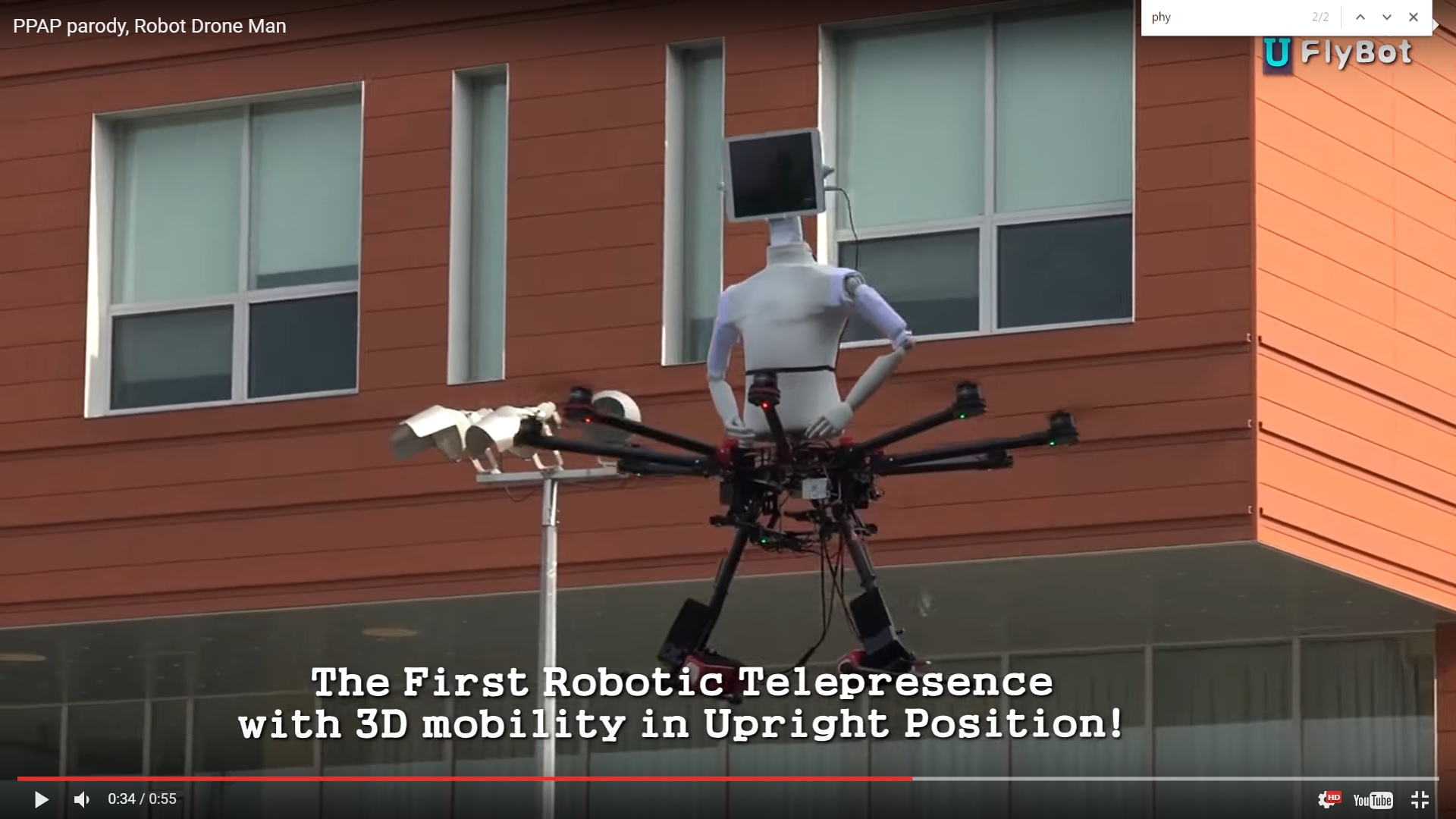
Research Professor Ilhan Bae of the Moon Soul Graduate School of Future Strategy at KAIST created a life-size humanoid robot on a drone platform, which gives users the experience of virtual flight and an opportunity to interact with people at remote locations. Professor Bae calls his new creation a "telepresence robot."
This avatar drone is a new application of drone and robotics technology, which extends the reach of human presence and mobility, Professor Bae explained his research.
“As a futurist, I forecast that drone technology will soon evolve to become another body for humans, and I wanted to demonstrate this potential application of drones. Avatar drones are especially useful for people who need to meet or manage other people face to face in remote locations,” he said.
For example, if elderly people with physical disabilities want to engage in social gatherings, this avatar drone is designed to help them do just that.
For more details, please see the link below:
Behind the Music: How Robot Drone Man Built His Flying Avatar
IEEE Spectrum, November 7, 2016
-
research KAIST Develops New Catalyst Design Technology to Improve Battery and Hydrogen Fuel Cell Performance
<(From Left) Professor Seung Jun Hwang, Professor Jaeyune Ryu> Korean researchers have developed a new catalyst design technology that can improve the performance of batteries and hydrogen fuel cells while reducing energy loss. KAISTannounced on the 1st of June that a research team led by Professor Seung Jun Hwang of the Department of Chemistry, through joint research with Professor Jaeyune Ryu’s team from the Department of Chemical and Biological Engineering at Seoul National
2026-06-01 -
research KAIST Produces Eco-Friendly Core Nylon Precursors Used from Clothing to Automobiles with Microbes
<(From Left) Dr. Da-Hee Ahn, Distinguished Professor Sang Yup Lee> Nylon is a representative plastic material used throughout our daily lives, from clothing to automobiles. However, most of its raw materials have been produced through petrochemical processes, resulting in large carbon emissions. KAIST researchers have developed a technology that can produce key nylon precursors in an eco-friendly way using microbes. KAIST (President Kwang Hyung Lee) announced on the 31st of May that a
2026-06-01 -
research "Development of 'ADvisor', an AI that Predicts Instagram Advertising Performance in Advance"
<(Bottom from left) M.S candidate Gyurim Hwang, M.S candidate Yeongho Kim, Ph.D. candidate Kyungho Kim, Ph.D.candidate Jongha Lee, M.S candidate Yeonje Choi (Top from left) Undergraduate student Sejin Chung, Researcher Hongseok Lee, Researcher Myeong Ho Song, Ph.D. candidate Sunwoo Kim, M.S candidate Juyeon Kim, Professor Kijung Shin> Social media advertising usually requires running multiple ad drafts in practice before determining which ad is effective. Because of this, testing adver
2026-06-01 -
research Development of a Virtual AI Testbed Capable of Performance Verification Before Building Massive AI Servers
< From left: Professor Jongse Park , M.S candidate Jaehong Cho, M.S candidate Hyunmin Choi, Professor Brandon Reagen ISPASS > Operating Large Language Model (LLM) services like ChatGPT requires a server infrastructure on the scale of tens of thousands of units. However, constructing actual equipment every time a new AI semiconductor or system architecture needs to be verified incurs massive costs and time. A research team at our university has developed a ‘virtual testbed’
2026-05-29 -
research Clearing the Expressway for Bubble Blockages to Achieve High-Efficiency Green Hydrogen Production
< (From left) Ph.D candidate Jaeho Byeon, Ph.D candidate Minkyeong Ban, Professor Jinwoo Lee, Dr. Sungjun Kim, Professor Jang Yong Lee> As the global transition toward carbon neutrality accelerates, "water electrolysis"—a technology that splits water electrically to produce clean hydrogen—is drawing significant attention. However, a major limitation has been the decline in efficiency caused by bubbles formed during the electrolysis process that block the pathways. A domestic
2026-05-28