people
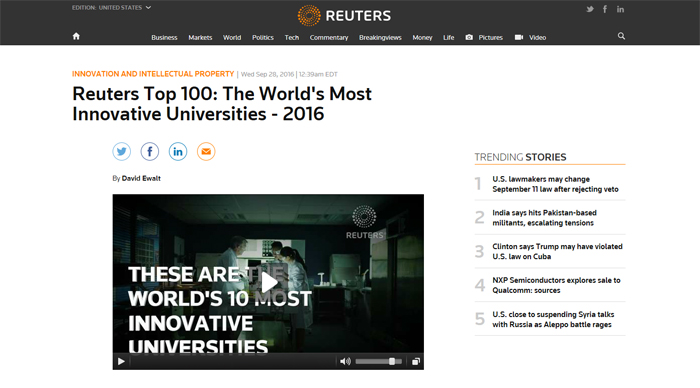
KAIST took sixth place in the list of “The World’s Top 100 Most Innovative Universities.” Thomson Reuters released the list on September 28, 2016, which was based on the data compiled by its division of Intellectual Property & Science such as patent filings, number of research papers and their citations, and industry collaboration. American universities took ranks from first to fifth; KAIST was the only non-American university that ranked highest in the list. Stressing the importance of linking basic research with commercializing efforts, Thomson Reuters said, the listed universities were “doing the most to advance science, invent new technologies and help drive the global economy.”
For details, go to the link below:
Reuters Top 100: The World’s Most Innovative Universities-2016
September 28, 2016
http://www.reuters.com/article/amers-reuters-ranking-innovative-univers-idUSL2N1C406D
-
research KAIST Develops New Catalyst Design Technology to Improve Battery and Hydrogen Fuel Cell Performance
<(From Left) Professor Seung Jun Hwang, Professor Jaeyune Ryu> Korean researchers have developed a new catalyst design technology that can improve the performance of batteries and hydrogen fuel cells while reducing energy loss. KAISTannounced on the 1st of June that a research team led by Professor Seung Jun Hwang of the Department of Chemistry, through joint research with Professor Jaeyune Ryu’s team from the Department of Chemical and Biological Engineering at Seoul National
2026-06-01 -
research KAIST Produces Eco-Friendly Core Nylon Precursors Used from Clothing to Automobiles with Microbes
<(From Left) Dr. Da-Hee Ahn, Distinguished Professor Sang Yup Lee> Nylon is a representative plastic material used throughout our daily lives, from clothing to automobiles. However, most of its raw materials have been produced through petrochemical processes, resulting in large carbon emissions. KAIST researchers have developed a technology that can produce key nylon precursors in an eco-friendly way using microbes. KAIST (President Kwang Hyung Lee) announced on the 31st of May that a
2026-06-01 -
research "Development of 'ADvisor', an AI that Predicts Instagram Advertising Performance in Advance"
<(Bottom from left) M.S candidate Gyurim Hwang, M.S candidate Yeongho Kim, Ph.D. candidate Kyungho Kim, Ph.D.candidate Jongha Lee, M.S candidate Yeonje Choi (Top from left) Undergraduate student Sejin Chung, Researcher Hongseok Lee, Researcher Myeong Ho Song, Ph.D. candidate Sunwoo Kim, M.S candidate Juyeon Kim, Professor Kijung Shin> Social media advertising usually requires running multiple ad drafts in practice before determining which ad is effective. Because of this, testing adver
2026-06-01 -
research Development of a Virtual AI Testbed Capable of Performance Verification Before Building Massive AI Servers
< From left: Professor Jongse Park , M.S candidate Jaehong Cho, M.S candidate Hyunmin Choi, Professor Brandon Reagen ISPASS > Operating Large Language Model (LLM) services like ChatGPT requires a server infrastructure on the scale of tens of thousands of units. However, constructing actual equipment every time a new AI semiconductor or system architecture needs to be verified incurs massive costs and time. A research team at our university has developed a ‘virtual testbed’
2026-05-29 -
research Clearing the Expressway for Bubble Blockages to Achieve High-Efficiency Green Hydrogen Production
< (From left) Ph.D candidate Jaeho Byeon, Ph.D candidate Minkyeong Ban, Professor Jinwoo Lee, Dr. Sungjun Kim, Professor Jang Yong Lee> As the global transition toward carbon neutrality accelerates, "water electrolysis"—a technology that splits water electrically to produce clean hydrogen—is drawing significant attention. However, a major limitation has been the decline in efficiency caused by bubbles formed during the electrolysis process that block the pathways. A domestic
2026-05-28