%72%65%73%65%61%72%63%68%65%72%73
-
 KAIST–National Intelligence Service Successfully Hold the 4th University Research Security Education Council Workshop
KAIST (President Kwang Hyung Lee) announced on the 22nd of August that, together with the National Intelligence Service, it held the “4th University Research Security Education Council Workshop” at the Academic Cultural Complex on KAIST’s main campus in Daejeon on the 21st.
This 4th workshop was held under the theme of “Global Research Security,” based on the recognition that technology leakage can have serious impacts not only on the national economy and security but on international exchanges in science and technology. Accordingly, national policies and outstanding cases from institutions to enhance the level of university research security management were shared, and practical security enhancement measures applicable in the field were discussed.
In the presentation sessions, △ the Ministry of Science and ICT presented the government’s policy direction for strengthening research security, △ the National Institute for International Education and Training (KIRD) gave a presentation on settlement and career support programs for foreign researchers in science and engineering, △ the Korea Strategic Trade Institute (KOSTI) introduced the Authorized Economic Operator (AEO/CP) system for universities’ dual-use items and technology export control measures, and △ the Korea Institute of S&T Evaluation and Planning (KISTEP) conducted a special lecture on research security field manuals.
In the university case presentations, KAIST shared achievements in promoting global research security, while Yong In University introduced its newly launched program this year for fostering security professionals.
This event was attended by more than 130 participants from approximately 70 universities nationwide, including Seoul National University and Ewha Womans University, as well as officials from the Ministry of Science and ICT, the National Intelligence Service, KIRD, KISTEP, and KOSTI.
An NIS official stated, “With the rapid changes in the university research environment due to the expansion of international joint research and the increase in international students, the establishment of a research security culture has become more important than ever. Based on the excellent cases shared at the workshop, we will actively reflect the opinions of host institutions to spread security awareness and continue preparing effective countermeasures.”
Cheol Seong Jang, President of the National University Council of Research & Industry Cooperation and Research Directors (Professor at Kangwon National University), emphasized, “If the ideas and cases discussed at the workshop are applied in university settings, they will greatly contribute to Korea leading the establishment of a trusted global research ecosystem.”
Byung-Kwan Cho, Director of Research at KAIST, said, “KAIST will not hesitate to introduce and spread leading research security systems so that our efforts to strengthen research security become a benchmark for other universities. By applying the principle of open science — ‘as open as possible, as closed as necessary’ — we will ensure that research security and global exchanges achieve harmony.”
The University Research Security Education Council was launched in June 2022 with joint supervision by KAIST and the National Intelligence Service and cooperation from KIRD. This year’s workshop was co-hosted by KAIST, the National Intelligence Service, and Kangwon National University.
2025.08.22 View 2560
KAIST–National Intelligence Service Successfully Hold the 4th University Research Security Education Council Workshop
KAIST (President Kwang Hyung Lee) announced on the 22nd of August that, together with the National Intelligence Service, it held the “4th University Research Security Education Council Workshop” at the Academic Cultural Complex on KAIST’s main campus in Daejeon on the 21st.
This 4th workshop was held under the theme of “Global Research Security,” based on the recognition that technology leakage can have serious impacts not only on the national economy and security but on international exchanges in science and technology. Accordingly, national policies and outstanding cases from institutions to enhance the level of university research security management were shared, and practical security enhancement measures applicable in the field were discussed.
In the presentation sessions, △ the Ministry of Science and ICT presented the government’s policy direction for strengthening research security, △ the National Institute for International Education and Training (KIRD) gave a presentation on settlement and career support programs for foreign researchers in science and engineering, △ the Korea Strategic Trade Institute (KOSTI) introduced the Authorized Economic Operator (AEO/CP) system for universities’ dual-use items and technology export control measures, and △ the Korea Institute of S&T Evaluation and Planning (KISTEP) conducted a special lecture on research security field manuals.
In the university case presentations, KAIST shared achievements in promoting global research security, while Yong In University introduced its newly launched program this year for fostering security professionals.
This event was attended by more than 130 participants from approximately 70 universities nationwide, including Seoul National University and Ewha Womans University, as well as officials from the Ministry of Science and ICT, the National Intelligence Service, KIRD, KISTEP, and KOSTI.
An NIS official stated, “With the rapid changes in the university research environment due to the expansion of international joint research and the increase in international students, the establishment of a research security culture has become more important than ever. Based on the excellent cases shared at the workshop, we will actively reflect the opinions of host institutions to spread security awareness and continue preparing effective countermeasures.”
Cheol Seong Jang, President of the National University Council of Research & Industry Cooperation and Research Directors (Professor at Kangwon National University), emphasized, “If the ideas and cases discussed at the workshop are applied in university settings, they will greatly contribute to Korea leading the establishment of a trusted global research ecosystem.”
Byung-Kwan Cho, Director of Research at KAIST, said, “KAIST will not hesitate to introduce and spread leading research security systems so that our efforts to strengthen research security become a benchmark for other universities. By applying the principle of open science — ‘as open as possible, as closed as necessary’ — we will ensure that research security and global exchanges achieve harmony.”
The University Research Security Education Council was launched in June 2022 with joint supervision by KAIST and the National Intelligence Service and cooperation from KIRD. This year’s workshop was co-hosted by KAIST, the National Intelligence Service, and Kangwon National University.
2025.08.22 View 2560 -
 KAIST to Host the ‘6th Emerging Materials Symposium’
KAIST (President Kwang Hyung Lee) announced on the 22nd of August that it will host the 6th KAIST Emerging Materials Symposium on the 26th in the Meta Convergence Hall (W13) on its main Daejeon campus, to explore the latest research trends in next-generation promising nanomaterials and discuss future visions.
Launched in 2020, this symposium marks its sixth year and has established itself as KAIST’s flagship academic event by inviting world-renowned scholars on next-generation materials to share groundbreaking achievements.
The event will feature six speakers from four prestigious overseas universities—the Massachusetts Institute of Technology (MIT), Yale University, UCLA, and Drexel University—providing an overview of cutting-edge global research trends in emerging materials, while also showcasing KAIST’s representative achievements.
Notably, Professor Yury Gogotsi of Drexel University, who gained global recognition for the pioneering development of MXene—an emerging material attracting attention for its high electrical conductivity and electromagnetic shielding capability—will deliver a lecture titled “The Future of MXene.”
In the session “Global Frontier in MIT,” three MIT professors will present the institute’s leading research: ▴Professor Ju Li, an authority on AI-robotics-based materials synthesis, ▴Professor Martin Z. Bazant, an expert in the fields of electrochemistry and electronic transport dynamics, and ▴Professor Jeehwan Kim, a leading researcher tackling the limitations of silicon wafer-based semiconductor manufacturing.
In the session “Emerging Materials and New Possibilities,” ▴Professor Yury Gogotsi of Drexel University, ▴Professor Liangbing Hu of Yale University, a pioneer in nanoparticle synthesis through rapid high-temperature thermal processing, and ▴Professor Jun Chen of UCLA, a key researcher in bioelectronic materials using multifunctional flexible materials, will present the development of core emerging materials and future directions.
Additionally, six professors from KAIST’s Department of Materials Science and Engineering will lead the session “KAIST’s MSE Entrepreneurial Spirit” where they will share the process of founding startups based on KAIST’s advanced materials technologies and how nanomaterials have taken root as foundational industries.
The session will include: ▴Professor Il-Doo Kim, founder of the nanofiber and colorimetric gas sensor company IDKLAB; ▴Professor Kibeom Kang, CEO of TDS Innovation, a company specializing in precursors and equipment for 2D material synthesis; ▴Professor Yeonsik Jeong, co-founder of Pico Foundry, a company producing SERS chips; ▴Professor Sang Wook Kim, founder of Materials Creation, which develops products based on high-quality graphene oxide; ▴Professor Jaebeom Jang, founder of Flashomic Inc., a leader in the commercialization of high-speed multiplexed protein imaging technology; and ▴Professor Steve Park, co-CEO of Aldaver, a company developing artificial cadavers (practice organs) that fully replicate the human body. They will each share their entrepreneurial cases, offering vivid lectures on the journey of scientific technologies into the marketplace.
The symposium will also feature a tour of the automated research lab at the Top-Tier KAIST-MIT Future Energy Initiative Research Center, jointly established by KAIST and MIT. The center, designed to build an AI-robotics-based autonomous research laboratory for the rapid development and application of advanced energy materials to help solve the global climate crisis, will operate for ten years. Overseas scholars will also be given an inside look at research and development using automated infrastructure, with discussions to follow on upcoming international collaborations.
Professor Il-Doo Kim of KAIST’s Department of Materials Science and Engineering, who organized the event, emphasized, “This symposium, featuring six global scholars and six KAIST entrepreneurial professors, will be a valuable opportunity to instill an international perspective and entrepreneurial mindset in students. It will also mark a turning point in KAIST’s innovative materials research and international collaborative research network.”
As part of the program, on Wednesday the 27th, KAIST will hold academic exchange sessions with overseas scholars. These will include discussions on international joint research, as well as sessions where KAIST students and early-career researchers can present their work and interact, opening opportunities for future collaborations.
The 6th KAIST Emerging Materials Symposium is open free of charge to all researchers interested in the latest research trends in chemistry, physics, biology, and materials science-related engineering fields.
Participation on the 26th will be available through on-site registration without prior application. Further details are available on the KAIST Department of Materials Science and Engineering EMS website (https://mse.kaist.ac.kr/index.php?mid=MSE_EMS).
2025.08.22 View 3884
KAIST to Host the ‘6th Emerging Materials Symposium’
KAIST (President Kwang Hyung Lee) announced on the 22nd of August that it will host the 6th KAIST Emerging Materials Symposium on the 26th in the Meta Convergence Hall (W13) on its main Daejeon campus, to explore the latest research trends in next-generation promising nanomaterials and discuss future visions.
Launched in 2020, this symposium marks its sixth year and has established itself as KAIST’s flagship academic event by inviting world-renowned scholars on next-generation materials to share groundbreaking achievements.
The event will feature six speakers from four prestigious overseas universities—the Massachusetts Institute of Technology (MIT), Yale University, UCLA, and Drexel University—providing an overview of cutting-edge global research trends in emerging materials, while also showcasing KAIST’s representative achievements.
Notably, Professor Yury Gogotsi of Drexel University, who gained global recognition for the pioneering development of MXene—an emerging material attracting attention for its high electrical conductivity and electromagnetic shielding capability—will deliver a lecture titled “The Future of MXene.”
In the session “Global Frontier in MIT,” three MIT professors will present the institute’s leading research: ▴Professor Ju Li, an authority on AI-robotics-based materials synthesis, ▴Professor Martin Z. Bazant, an expert in the fields of electrochemistry and electronic transport dynamics, and ▴Professor Jeehwan Kim, a leading researcher tackling the limitations of silicon wafer-based semiconductor manufacturing.
In the session “Emerging Materials and New Possibilities,” ▴Professor Yury Gogotsi of Drexel University, ▴Professor Liangbing Hu of Yale University, a pioneer in nanoparticle synthesis through rapid high-temperature thermal processing, and ▴Professor Jun Chen of UCLA, a key researcher in bioelectronic materials using multifunctional flexible materials, will present the development of core emerging materials and future directions.
Additionally, six professors from KAIST’s Department of Materials Science and Engineering will lead the session “KAIST’s MSE Entrepreneurial Spirit” where they will share the process of founding startups based on KAIST’s advanced materials technologies and how nanomaterials have taken root as foundational industries.
The session will include: ▴Professor Il-Doo Kim, founder of the nanofiber and colorimetric gas sensor company IDKLAB; ▴Professor Kibeom Kang, CEO of TDS Innovation, a company specializing in precursors and equipment for 2D material synthesis; ▴Professor Yeonsik Jeong, co-founder of Pico Foundry, a company producing SERS chips; ▴Professor Sang Wook Kim, founder of Materials Creation, which develops products based on high-quality graphene oxide; ▴Professor Jaebeom Jang, founder of Flashomic Inc., a leader in the commercialization of high-speed multiplexed protein imaging technology; and ▴Professor Steve Park, co-CEO of Aldaver, a company developing artificial cadavers (practice organs) that fully replicate the human body. They will each share their entrepreneurial cases, offering vivid lectures on the journey of scientific technologies into the marketplace.
The symposium will also feature a tour of the automated research lab at the Top-Tier KAIST-MIT Future Energy Initiative Research Center, jointly established by KAIST and MIT. The center, designed to build an AI-robotics-based autonomous research laboratory for the rapid development and application of advanced energy materials to help solve the global climate crisis, will operate for ten years. Overseas scholars will also be given an inside look at research and development using automated infrastructure, with discussions to follow on upcoming international collaborations.
Professor Il-Doo Kim of KAIST’s Department of Materials Science and Engineering, who organized the event, emphasized, “This symposium, featuring six global scholars and six KAIST entrepreneurial professors, will be a valuable opportunity to instill an international perspective and entrepreneurial mindset in students. It will also mark a turning point in KAIST’s innovative materials research and international collaborative research network.”
As part of the program, on Wednesday the 27th, KAIST will hold academic exchange sessions with overseas scholars. These will include discussions on international joint research, as well as sessions where KAIST students and early-career researchers can present their work and interact, opening opportunities for future collaborations.
The 6th KAIST Emerging Materials Symposium is open free of charge to all researchers interested in the latest research trends in chemistry, physics, biology, and materials science-related engineering fields.
Participation on the 26th will be available through on-site registration without prior application. Further details are available on the KAIST Department of Materials Science and Engineering EMS website (https://mse.kaist.ac.kr/index.php?mid=MSE_EMS).
2025.08.22 View 3884 -
 In KAIST, Robots Now Untie Rubber Bands and Insert Wires Like Humans
The technology that allows robots to handle deformable objects such as wires, clothing, and rubber bands has long been regarded as a key task in the automation of manufacturing and service industries. However, since such deformable objects do not have a fixed shape and their movements are difficult to predict, robots have faced great difficulties in accurately recognizing and manipulating them. KAIST researchers have developed a robot technology that can precisely grasp the state of deformable objects and handle them skillfully, even with incomplete visual information. This achievement is expected to contribute to intelligent automation in various industrial and service fields, including cable and wire assembly, manufacturing that handles soft components, and clothing organization and packaging.
KAIST (President Kwang Hyung Lee) announced on the 21st of August that the research team led by Professor Daehyung Park of the School of Computing developed an artificial intelligence technology called “INR-DOM (Implicit Neural-Representation for Deformable Object Manipulation),” which enables robots to skillfully handle objects whose shape continuously changes like elastic bands and which are visually difficult to distinguish.
Professor Park’s research team developed a technology that allows robots to completely reconstruct the overall shape of a deformable object from partially observed three-dimensional information and to learn manipulation strategies based on it. Additionally, the team introduced a new two-stage learning framework that combines reinforcement learning and contrastive learning so that robots can efficiently learn specific tasks. The trained controller achieved significantly higher task success rates compared to existing technologies in a simulation environment, and in real robot experiments, it demonstrated a high level of manipulation capability, such as untying complicatedly entangled rubber bands, thereby greatly expanding the applicability of robots in handling deformable objects.
Deformable Object Manipulation (DOM) is one of the long-standing challenges in robotics. This is because deformable objects have infinite degrees of freedom, making their movements difficult to predict, and the phenomenon of self-occlusion, in which the object hides parts of itself, makes it difficult for robots to grasp their overall state.
To solve these problems, representation methods of deformable object states and control technologies based on reinforcement learning have been widely studied. However, existing representation methods could not accurately represent continuously deforming surfaces or complex three-dimensional structures of deformable objects, and since state representation and reinforcement learning were separated, there was a limitation in constructing a suitable state representation space needed for object manipulation.
To overcome these limitations, the research team utilized “Implicit Neural Representation.” This technology receives partial three-dimensional information (point cloud*) observed by the robot and reconstructs the overall shape of the object, including unseen parts, as a continuous surface (signed distance function, SDF). This enables robots to imagine and understand the overall shape of the object just like humans.
*Point cloud 3D information: a method of representing the three-dimensional shape of an object as a “set of points” on its surface.
Furthermore, the research team introduced a two-stage learning framework. In the first stage of pre-training, a model is trained to reconstruct the complete shape from incomplete point cloud data, securing a state representation module that is robust to occlusion and capable of well representing the surfaces of stretching objects. In the second stage of fine-tuning, reinforcement learning and contrastive learning are used together to optimize the control policy and state representation module so that the robot can clearly distinguish subtle differences between the current state and the goal state and efficiently find the optimal action required for task execution.
When the INR-DOM technology developed by the research team was mounted on a robot and tested, it showed overwhelmingly higher success rates than the best existing technologies in three complex tasks in a simulation environment: inserting a rubber ring into a groove (sealing), installing an O-ring onto a part (installation), and untying tangled rubber bands (disentanglement). In particular, in the most challenging task, disentanglement, the success rate reached 75%, which was about 49% higher than the best existing technology (ACID, 26%).
The research team also verified that INR-DOM technology is applicable in real environments by combining sample-efficient robotic reinforcement learning with INR-DOM and performing reinforcement learning in a real-world environment.
As a result, in actual environments, the robot performed insertion, installation, and disentanglement tasks with a success rate of over 90%, and in particular, in the visually difficult bidirectional disentanglement task, it achieved a 25% higher success rate compared to existing image-based reinforcement learning methods, proving that robust manipulation is possible despite visual ambiguity.
Minseok Song, a master’s student and first author of this research, stated that “this research has shown the possibility that robots can understand the overall shape of deformable objects even with incomplete information and perform complex manipulation based on that understanding.” He added, “It will greatly contribute to the advancement of robot technology that performs sophisticated tasks in cooperation with humans or in place of humans in various fields such as manufacturing, logistics, and medicine.”
This study, with KAIST School of Computing master’s student Minseok Song as first author, was presented at the top international robotics conference, Robotics: Science and Systems (RSS) 2025, held June 21–25 at USC in Los Angeles.
※ Paper title: “Implicit Neural-Representation Learning for Elastic Deformable-Object Manipulations”
※ DOI: https://www.roboticsproceedings.org/ (to be released), currently https://arxiv.org/abs/2505.00500
This research was supported by the Ministry of Science and ICT through the Institute of Information & Communications Technology Planning & Evaluation (IITP)’s projects “Core Software Technology Development for Complex-Intelligence Autonomous Agents” (RS-2024-00336738; Development of Mission Execution Procedure Generation Technology for Autonomous Agents’ Complex Task Autonomy), “Core Technology Development for Human-Centered Artificial Intelligence” (RS-2022-II220311; Goal-Oriented Reinforcement Learning Technology for Multi-Contact Robot Manipulation of Everyday Objects), “Core Computing Technology” (RS-2024-00509279; Global AI Frontier Lab), as well as support from Samsung Electronics. More details can be found at https://inr-dom.github.io.
2025.08.21 View 4194
In KAIST, Robots Now Untie Rubber Bands and Insert Wires Like Humans
The technology that allows robots to handle deformable objects such as wires, clothing, and rubber bands has long been regarded as a key task in the automation of manufacturing and service industries. However, since such deformable objects do not have a fixed shape and their movements are difficult to predict, robots have faced great difficulties in accurately recognizing and manipulating them. KAIST researchers have developed a robot technology that can precisely grasp the state of deformable objects and handle them skillfully, even with incomplete visual information. This achievement is expected to contribute to intelligent automation in various industrial and service fields, including cable and wire assembly, manufacturing that handles soft components, and clothing organization and packaging.
KAIST (President Kwang Hyung Lee) announced on the 21st of August that the research team led by Professor Daehyung Park of the School of Computing developed an artificial intelligence technology called “INR-DOM (Implicit Neural-Representation for Deformable Object Manipulation),” which enables robots to skillfully handle objects whose shape continuously changes like elastic bands and which are visually difficult to distinguish.
Professor Park’s research team developed a technology that allows robots to completely reconstruct the overall shape of a deformable object from partially observed three-dimensional information and to learn manipulation strategies based on it. Additionally, the team introduced a new two-stage learning framework that combines reinforcement learning and contrastive learning so that robots can efficiently learn specific tasks. The trained controller achieved significantly higher task success rates compared to existing technologies in a simulation environment, and in real robot experiments, it demonstrated a high level of manipulation capability, such as untying complicatedly entangled rubber bands, thereby greatly expanding the applicability of robots in handling deformable objects.
Deformable Object Manipulation (DOM) is one of the long-standing challenges in robotics. This is because deformable objects have infinite degrees of freedom, making their movements difficult to predict, and the phenomenon of self-occlusion, in which the object hides parts of itself, makes it difficult for robots to grasp their overall state.
To solve these problems, representation methods of deformable object states and control technologies based on reinforcement learning have been widely studied. However, existing representation methods could not accurately represent continuously deforming surfaces or complex three-dimensional structures of deformable objects, and since state representation and reinforcement learning were separated, there was a limitation in constructing a suitable state representation space needed for object manipulation.
To overcome these limitations, the research team utilized “Implicit Neural Representation.” This technology receives partial three-dimensional information (point cloud*) observed by the robot and reconstructs the overall shape of the object, including unseen parts, as a continuous surface (signed distance function, SDF). This enables robots to imagine and understand the overall shape of the object just like humans.
*Point cloud 3D information: a method of representing the three-dimensional shape of an object as a “set of points” on its surface.
Furthermore, the research team introduced a two-stage learning framework. In the first stage of pre-training, a model is trained to reconstruct the complete shape from incomplete point cloud data, securing a state representation module that is robust to occlusion and capable of well representing the surfaces of stretching objects. In the second stage of fine-tuning, reinforcement learning and contrastive learning are used together to optimize the control policy and state representation module so that the robot can clearly distinguish subtle differences between the current state and the goal state and efficiently find the optimal action required for task execution.
When the INR-DOM technology developed by the research team was mounted on a robot and tested, it showed overwhelmingly higher success rates than the best existing technologies in three complex tasks in a simulation environment: inserting a rubber ring into a groove (sealing), installing an O-ring onto a part (installation), and untying tangled rubber bands (disentanglement). In particular, in the most challenging task, disentanglement, the success rate reached 75%, which was about 49% higher than the best existing technology (ACID, 26%).
The research team also verified that INR-DOM technology is applicable in real environments by combining sample-efficient robotic reinforcement learning with INR-DOM and performing reinforcement learning in a real-world environment.
As a result, in actual environments, the robot performed insertion, installation, and disentanglement tasks with a success rate of over 90%, and in particular, in the visually difficult bidirectional disentanglement task, it achieved a 25% higher success rate compared to existing image-based reinforcement learning methods, proving that robust manipulation is possible despite visual ambiguity.
Minseok Song, a master’s student and first author of this research, stated that “this research has shown the possibility that robots can understand the overall shape of deformable objects even with incomplete information and perform complex manipulation based on that understanding.” He added, “It will greatly contribute to the advancement of robot technology that performs sophisticated tasks in cooperation with humans or in place of humans in various fields such as manufacturing, logistics, and medicine.”
This study, with KAIST School of Computing master’s student Minseok Song as first author, was presented at the top international robotics conference, Robotics: Science and Systems (RSS) 2025, held June 21–25 at USC in Los Angeles.
※ Paper title: “Implicit Neural-Representation Learning for Elastic Deformable-Object Manipulations”
※ DOI: https://www.roboticsproceedings.org/ (to be released), currently https://arxiv.org/abs/2505.00500
This research was supported by the Ministry of Science and ICT through the Institute of Information & Communications Technology Planning & Evaluation (IITP)’s projects “Core Software Technology Development for Complex-Intelligence Autonomous Agents” (RS-2024-00336738; Development of Mission Execution Procedure Generation Technology for Autonomous Agents’ Complex Task Autonomy), “Core Technology Development for Human-Centered Artificial Intelligence” (RS-2022-II220311; Goal-Oriented Reinforcement Learning Technology for Multi-Contact Robot Manipulation of Everyday Objects), “Core Computing Technology” (RS-2024-00509279; Global AI Frontier Lab), as well as support from Samsung Electronics. More details can be found at https://inr-dom.github.io.
2025.08.21 View 4194 -
 KAIST Leading the International Standardization of Next-Generation Random Number Generators
In computer security, random numbers are crucial values that must be unpredictable—such as secret keys or initialization vectors (IVs)—forming the foundation of security systems. To achieve this, deterministic random bit generators (DRBGs) are used, which produce numbers that appear random. However, existing DRBGs had limitations in both security (unpredictability against hacking) and output speed. KAIST researchers have developed a DRBG that theoretically achieves the highest possible level of security through a new proof technique, while maximizing speed by parallelizing its structure. This enables safe and ultra-fast random number generation applicable from IoT devices to large-scale servers.
KAIST (President Kwang Hyung Lee) announced on the 20th of August that a research team led by Professor Jooyoung Lee from the School of Computing has established a new theoretical framework for analyzing the security of permutation*-based deterministic random bit generators (DRBG, Deterministic Random Bits Generator) and has designed a DRBG that achieves optimal efficiency.
*Permutation: The process of shuffling bits or bytes by changing their order, allowing bidirectional conversion (the shuffled data can be restored to its original state).
Deterministic random bit generators create unpredictable random numbers from entropy sources (random data obtained from the environment) using basic cryptographic operations such as block ciphers*, hash functions**, and permutations.
*Block cipher: A method of transforming plaintext into ciphertext of the same length.
**Hash function: A function that converts input into a fixed-length digest by mixing input data to produce an unpredictable value.
The random numbers generated are used in most cryptographic algorithms determine the fundamental security of the entire system that relies on them. Therefore, DRBGs form the basis of cryptography, and improving their efficiency and security is a highly important research task.
Permutation functions, as fundamental components of cryptographic algorithms that allow bidirectional computation, have attracted significant attention for their excellent security and efficiency, especially since being adopted in the U.S. standard SHA-3 hash function.
However, the sponge construction* adopted in SHA-3 has been criticized for its limited output efficiency relative to permutation size. Since all existing permutation-based DRBGs used sponge constructions in their output functions, they too suffered from output efficiency limitations.
*Sponge construction (Sponge construction): A structure resembling a sponge’s process of absorbing and squeezing out water. It sequentially absorbs input data and then squeezes out as much output as desired. Since the output length is not fixed, it can generate very long random numbers or hashes when needed.
In addition, existing permutation-based DRBGs used a technique called game hopping to prove security. However, this method had the limitation of yielding lower security guarantees than theoretically possible.
For example, when a permutation’s capacity (c) is 256 bits, the theoretical expectation is min{c/2, λ}, i.e., 128-bit security. But under the conventional proof method, the guarantee was only min{c/3, λ}, about 85 bits. (λ refers to the entropy threshold, and min indicates taking the smaller of the two values.)
Game hopping defines the situation between the random number generator and the adversary as a “game,” splits it into many small steps (mini-games), and calculates the adversary’s success probability at each stage to combine them. However, because the process excessively subdivides the stages, the resulting security level turned out lower than the actual one.
Professor Jooyoung Lee’s research team at KAIST noted that the conventional game-hopping technique divided the overall game into too many steps and proposed a new proof method simplifying it into just two stages. As a result, they demonstrated that the security level of permutation-based DRBGs actually corresponds to min{c/2, λ} bits— an improvement of approximately 50% compared to existing proofs. They also proved that this value is the theoretical maximum achievable.
The research team also designed POSDRBG (Parallel Output Sponge-based DRBG) to address the output efficiency limitation of the existing sponge structure caused by its serial (single-line) processing. The newly proposed parallel structure processes multiple streams simultaneously, thereby achieving the maximum efficiency possible for permutation-based DRBGs.
Professor Jooyoung Lee stated, “POSDRBG is a new deterministic random bit generator that improves both random number generation speed and security, making it applicable from small IoT devices to large-scale servers. This research is expected to positively influence the ongoing revision of the international DRBG standard SP800-90A*, leading to the formal inclusion of permutation-based DRBGs.”
*SP800-90A: An international standard document established by the U.S. NIST (National Institute of Standards and Technology), defining the design and operational criteria for DRBGs used in cryptographic systems. Until now, permutation-based DRBGs have not been included in the standard.
This research, with Woohyuk Chung (KAIST, first author), Seongha Hwang (KAIST), Hwigyeom Kim (Samsung Electronics), and Jooyoung Lee (KAIST, corresponding author), will be presented in August at CRYPTO (the Annual International Cryptology Conference), the world’s top academic conference in cryptology.
Article title: “Enhancing Provable Security and Efficiency of Permutation-Based DRBGs“
DOI: https://doi.org/10.1007/978-3-032-01901-1_15
This research was supported by the Institute for Information & Communications Technology Planning & Evaluation (IITP).
The random number output function of the existing Sponge-DRBG uses a sponge structure that directly connects the permutation P. For reference, all existing permutation-function-based DRBGs have this sponge structure. In the sponge structure, among the n-bit inputs of P, only the upper r bits are used as the output Z. Therefore, the output efficiency is always limited to r/n.
In this study, the random number output function of POSDRBG was designed to allow parallel computation, and all n-bit outputs of the permutation function P become random numbers Z. Therefore, it has an output efficiency of 1.
2025.08.20 View 2061
KAIST Leading the International Standardization of Next-Generation Random Number Generators
In computer security, random numbers are crucial values that must be unpredictable—such as secret keys or initialization vectors (IVs)—forming the foundation of security systems. To achieve this, deterministic random bit generators (DRBGs) are used, which produce numbers that appear random. However, existing DRBGs had limitations in both security (unpredictability against hacking) and output speed. KAIST researchers have developed a DRBG that theoretically achieves the highest possible level of security through a new proof technique, while maximizing speed by parallelizing its structure. This enables safe and ultra-fast random number generation applicable from IoT devices to large-scale servers.
KAIST (President Kwang Hyung Lee) announced on the 20th of August that a research team led by Professor Jooyoung Lee from the School of Computing has established a new theoretical framework for analyzing the security of permutation*-based deterministic random bit generators (DRBG, Deterministic Random Bits Generator) and has designed a DRBG that achieves optimal efficiency.
*Permutation: The process of shuffling bits or bytes by changing their order, allowing bidirectional conversion (the shuffled data can be restored to its original state).
Deterministic random bit generators create unpredictable random numbers from entropy sources (random data obtained from the environment) using basic cryptographic operations such as block ciphers*, hash functions**, and permutations.
*Block cipher: A method of transforming plaintext into ciphertext of the same length.
**Hash function: A function that converts input into a fixed-length digest by mixing input data to produce an unpredictable value.
The random numbers generated are used in most cryptographic algorithms determine the fundamental security of the entire system that relies on them. Therefore, DRBGs form the basis of cryptography, and improving their efficiency and security is a highly important research task.
Permutation functions, as fundamental components of cryptographic algorithms that allow bidirectional computation, have attracted significant attention for their excellent security and efficiency, especially since being adopted in the U.S. standard SHA-3 hash function.
However, the sponge construction* adopted in SHA-3 has been criticized for its limited output efficiency relative to permutation size. Since all existing permutation-based DRBGs used sponge constructions in their output functions, they too suffered from output efficiency limitations.
*Sponge construction (Sponge construction): A structure resembling a sponge’s process of absorbing and squeezing out water. It sequentially absorbs input data and then squeezes out as much output as desired. Since the output length is not fixed, it can generate very long random numbers or hashes when needed.
In addition, existing permutation-based DRBGs used a technique called game hopping to prove security. However, this method had the limitation of yielding lower security guarantees than theoretically possible.
For example, when a permutation’s capacity (c) is 256 bits, the theoretical expectation is min{c/2, λ}, i.e., 128-bit security. But under the conventional proof method, the guarantee was only min{c/3, λ}, about 85 bits. (λ refers to the entropy threshold, and min indicates taking the smaller of the two values.)
Game hopping defines the situation between the random number generator and the adversary as a “game,” splits it into many small steps (mini-games), and calculates the adversary’s success probability at each stage to combine them. However, because the process excessively subdivides the stages, the resulting security level turned out lower than the actual one.
Professor Jooyoung Lee’s research team at KAIST noted that the conventional game-hopping technique divided the overall game into too many steps and proposed a new proof method simplifying it into just two stages. As a result, they demonstrated that the security level of permutation-based DRBGs actually corresponds to min{c/2, λ} bits— an improvement of approximately 50% compared to existing proofs. They also proved that this value is the theoretical maximum achievable.
The research team also designed POSDRBG (Parallel Output Sponge-based DRBG) to address the output efficiency limitation of the existing sponge structure caused by its serial (single-line) processing. The newly proposed parallel structure processes multiple streams simultaneously, thereby achieving the maximum efficiency possible for permutation-based DRBGs.
Professor Jooyoung Lee stated, “POSDRBG is a new deterministic random bit generator that improves both random number generation speed and security, making it applicable from small IoT devices to large-scale servers. This research is expected to positively influence the ongoing revision of the international DRBG standard SP800-90A*, leading to the formal inclusion of permutation-based DRBGs.”
*SP800-90A: An international standard document established by the U.S. NIST (National Institute of Standards and Technology), defining the design and operational criteria for DRBGs used in cryptographic systems. Until now, permutation-based DRBGs have not been included in the standard.
This research, with Woohyuk Chung (KAIST, first author), Seongha Hwang (KAIST), Hwigyeom Kim (Samsung Electronics), and Jooyoung Lee (KAIST, corresponding author), will be presented in August at CRYPTO (the Annual International Cryptology Conference), the world’s top academic conference in cryptology.
Article title: “Enhancing Provable Security and Efficiency of Permutation-Based DRBGs“
DOI: https://doi.org/10.1007/978-3-032-01901-1_15
This research was supported by the Institute for Information & Communications Technology Planning & Evaluation (IITP).
The random number output function of the existing Sponge-DRBG uses a sponge structure that directly connects the permutation P. For reference, all existing permutation-function-based DRBGs have this sponge structure. In the sponge structure, among the n-bit inputs of P, only the upper r bits are used as the output Z. Therefore, the output efficiency is always limited to r/n.
In this study, the random number output function of POSDRBG was designed to allow parallel computation, and all n-bit outputs of the permutation function P become random numbers Z. Therefore, it has an output efficiency of 1.
2025.08.20 View 2061 -
 “Why are we depressed?” KAIST is identifying the cause of depression and uncovering clues for treatment
Major depressive disorder (MDD) is one of the most common psychiatric illnesses worldwide, but its molecular causes* have still not been clearly identified. A domestic research team has discovered that depression may not simply be caused by neuronal damage, but can also arise from the dysregulation of specific neural signaling pathways. In particular, they identified the molecular reason why elderly patients with depression do not respond to conventional antidepressants. This study suggests the possibility of therapeutic approaches using optogenetic technology to regulate neural signaling, and it provides clues for the development of new treatment strategies targeting the protein ‘Numb’ protein for elderly patients with depression.
*Molecular causes: explanations for the origin of a disease at the level of molecules, proteins, or genes in the brain.
KAIST (President Kwang Hyung Lee) announced on the 19th of August that a research team led by Distinguished Professor Won Do Heo of the Department of Biological Sciences at KAIST, in collaboration with forensic pathologist Minju Lee of the National Forensic Service (Director Bong Woo Lee) and Professor Seokhwi Kim of the Department of Pathology at Ajou University Medical Center (Director Sangwook Han), identified a new molecular mechanism for depression through RNA sequencing and the immunohistochemical analysis of brain tissue from patients who had committed suicide. Furthermore, they demonstrated in animal models that antidepressant effects can be restored by regulating the signaling pathway that induces neural recovery using optogenetic technology.
The research team focused on the hippocampus, the brain region responsible for memory and emotion, and in particular on the dentate gyrus (DG). The DG is the entry point of information into the hippocampus, playing a role in new memory formation, neurogenesis, and emotional regulation, and is closely linked with depression.
Using two representative mouse models for depression (the corticosterone stress model and the chronic unpredictable stress model), the team found that stress induced a striking increase in the signaling receptor FGFR1 (Fibroblast Growth Factor Receptor 1) in the DG. FGFR1 receives growth factor (FGF) signals and transmits growth and differentiation commands within cells.
Subsequently, using conditional knockout (cKO) mice in which the FGFR1 gene was deleted, the researchers revealed that the absence of FGFR1 made mice more vulnerable to stress and led them to exhibit depressive symptoms more quickly. This indicates that FGFR1 plays a critical role in proper neural regulation and stress resistance.
The team then developed an ‘optoFGFR1 system’ using optogenetics, enabling FGFR1 —essential for stress resistance—to be activated by light. They observed that activating FGFR1 in depression mouse models lacking FGFR1 restored antidepressant effects. In other words, they experimentally demonstrated that the activation of FGFR1 signaling alone could improve depressive behavior.
Surprisingly, however, in aged depression mouse models, the activation of FGFR1 signaling through the optoFGFR1 system did not yield antidepressant effects. Investigating further, the researchers found that in the aged brains, a protein called ‘Numb’ was excessively expressed and interfered with FGFR1 signaling.
Indeed, analysis of postmortem human brain tissue also showed the specific overexpression of Numb protein only in elderly patients with depression. When the researchers suppressed Numb using a gene regulatory tool (shRNA) while simultaneously activating FGFR1 signaling in mouse models, neurogenesis and behavior—previously unrecoverable—returned to normal even in aged depression models. This shows that the Numb protein acts as a “blocker” of FGFR1 signaling and is a key factor preventing the hippocampus from executing antidepressant mechanisms.
Distinguished Professor Won Do Heo of KAIST said, “This study is meaningful in that it revealed that depression may not only result from simple neuronal damage, but can also arise from the dysregulation of specific neural signaling pathways. In particular, we identified the molecular reason why antidepressants are less effective in elderly patients, and we expect this to provide a clue for the development of new therapeutic strategies targeting the Numb protein.”
He added, “Moreover, this interdisciplinary study, which combined KAIST’s expertise in neuroscience with the National Forensic Service’s forensic brain analysis technologies, is expected to serve as a bridge between basic research on psychiatric disorders and clinical applications.”
This study, led by first author Jongpil Shin, a PhD student in the Department of Biological Sciences at KAIST, was published on August 15, 2025, in the international journal Experimental & Molecular Medicine.
Paper title: “Dysregulation of FGFR1 signaling in the hippocampus facilitates depressive disorder”
DOI: https://doi.org/10.1038/s12276-025-01519-9
This research was supported by the Ministry of Science and ICT’s National Research Foundation of Korea through the ASTRA program and the Bio-Medical Technology Development project.
2025.08.19 View 3556
“Why are we depressed?” KAIST is identifying the cause of depression and uncovering clues for treatment
Major depressive disorder (MDD) is one of the most common psychiatric illnesses worldwide, but its molecular causes* have still not been clearly identified. A domestic research team has discovered that depression may not simply be caused by neuronal damage, but can also arise from the dysregulation of specific neural signaling pathways. In particular, they identified the molecular reason why elderly patients with depression do not respond to conventional antidepressants. This study suggests the possibility of therapeutic approaches using optogenetic technology to regulate neural signaling, and it provides clues for the development of new treatment strategies targeting the protein ‘Numb’ protein for elderly patients with depression.
*Molecular causes: explanations for the origin of a disease at the level of molecules, proteins, or genes in the brain.
KAIST (President Kwang Hyung Lee) announced on the 19th of August that a research team led by Distinguished Professor Won Do Heo of the Department of Biological Sciences at KAIST, in collaboration with forensic pathologist Minju Lee of the National Forensic Service (Director Bong Woo Lee) and Professor Seokhwi Kim of the Department of Pathology at Ajou University Medical Center (Director Sangwook Han), identified a new molecular mechanism for depression through RNA sequencing and the immunohistochemical analysis of brain tissue from patients who had committed suicide. Furthermore, they demonstrated in animal models that antidepressant effects can be restored by regulating the signaling pathway that induces neural recovery using optogenetic technology.
The research team focused on the hippocampus, the brain region responsible for memory and emotion, and in particular on the dentate gyrus (DG). The DG is the entry point of information into the hippocampus, playing a role in new memory formation, neurogenesis, and emotional regulation, and is closely linked with depression.
Using two representative mouse models for depression (the corticosterone stress model and the chronic unpredictable stress model), the team found that stress induced a striking increase in the signaling receptor FGFR1 (Fibroblast Growth Factor Receptor 1) in the DG. FGFR1 receives growth factor (FGF) signals and transmits growth and differentiation commands within cells.
Subsequently, using conditional knockout (cKO) mice in which the FGFR1 gene was deleted, the researchers revealed that the absence of FGFR1 made mice more vulnerable to stress and led them to exhibit depressive symptoms more quickly. This indicates that FGFR1 plays a critical role in proper neural regulation and stress resistance.
The team then developed an ‘optoFGFR1 system’ using optogenetics, enabling FGFR1 —essential for stress resistance—to be activated by light. They observed that activating FGFR1 in depression mouse models lacking FGFR1 restored antidepressant effects. In other words, they experimentally demonstrated that the activation of FGFR1 signaling alone could improve depressive behavior.
Surprisingly, however, in aged depression mouse models, the activation of FGFR1 signaling through the optoFGFR1 system did not yield antidepressant effects. Investigating further, the researchers found that in the aged brains, a protein called ‘Numb’ was excessively expressed and interfered with FGFR1 signaling.
Indeed, analysis of postmortem human brain tissue also showed the specific overexpression of Numb protein only in elderly patients with depression. When the researchers suppressed Numb using a gene regulatory tool (shRNA) while simultaneously activating FGFR1 signaling in mouse models, neurogenesis and behavior—previously unrecoverable—returned to normal even in aged depression models. This shows that the Numb protein acts as a “blocker” of FGFR1 signaling and is a key factor preventing the hippocampus from executing antidepressant mechanisms.
Distinguished Professor Won Do Heo of KAIST said, “This study is meaningful in that it revealed that depression may not only result from simple neuronal damage, but can also arise from the dysregulation of specific neural signaling pathways. In particular, we identified the molecular reason why antidepressants are less effective in elderly patients, and we expect this to provide a clue for the development of new therapeutic strategies targeting the Numb protein.”
He added, “Moreover, this interdisciplinary study, which combined KAIST’s expertise in neuroscience with the National Forensic Service’s forensic brain analysis technologies, is expected to serve as a bridge between basic research on psychiatric disorders and clinical applications.”
This study, led by first author Jongpil Shin, a PhD student in the Department of Biological Sciences at KAIST, was published on August 15, 2025, in the international journal Experimental & Molecular Medicine.
Paper title: “Dysregulation of FGFR1 signaling in the hippocampus facilitates depressive disorder”
DOI: https://doi.org/10.1038/s12276-025-01519-9
This research was supported by the Ministry of Science and ICT’s National Research Foundation of Korea through the ASTRA program and the Bio-Medical Technology Development project.
2025.08.19 View 3556 -
 KAIST Identifies Key to Slowing Aging via RNA Regulation... Unlocks Mechanism for Longevity
As aging progresses, the quality of DNA and proteins inside cells declines, known to be the cause of various degenerative diseases. However, the connection between aging and RNA has remained largely unexplored. Now, a Korean research team has discovered that a ribosome-associated quality control factor—PELOTA, a protein essential for eliminating abnormal mRNA—plays a central role in slowing aging and promoting longevity. This breakthrough is expected to provide a new direction for future therapeutic strategies targeting human aging and neurodegenerative diseases.
KAIST (President Kwang Hyung Lee) announced that a joint research team—led by Professor Seung-Jae V. Lee of the Department of Biological Sciences at KAIST and the Research Center for RNA-mediated Healthy Longevity, Professor Jinsoo Seo of Yonsei University (President Dong-Sup Yoon), and Professor Kwang-Pyo Lee of the Korea Research Institute of Bioscience and Biotechnology (KRIBB, President Suk Yoon Kwon) under the National Research Council of Science & Technology (NST, Chairman Yeung-Shik Kim—has discovered that the protein ‘PELOTA*’, which plays a key role in ribosome-associated quality control, regulates the pace of aging.
*PELOTA: A key protein in maintaining cellular translational homeostasis, responsible for detecting and resolving errors during mRNA translation by ribosomes.
Until now, RNA—particularly mRNA—has generally been regarded as a transient intermediary in protein synthesis. Its instability made it difficult to study quantitatively or track over time, leaving its physiological and functional roles relatively understudied compared to DNA.
Using C. elegans (a nematode widely used in aging research due to its short lifespan), the researchers first discovered that the ribosome-associated quality control factor PELOTA is essential for longevity. In particular, when PELOTA was overexpressed in normal nematodes, their lifespan was extended, suggesting that ribosome-associated quality control mechanisms involved in removing abnormal mRNA are necessary for promoting longevity.
The study also revealed that the ribosome-associated quality control system simultaneously regulates both the mTOR signaling pathway—which senses nutrient status or growth signals to control cell growth, protein synthesis, and autophagy, and plays a key role in aging and energy metabolism—and the autophagy pathway, the cellular cleanup and recycling system through which cells break down and reuse unnecessary or damaged components.
When PELOTA was deficient, the mTOR pathway became abnormally activated, and autophagy was suppressed—accelerating aging. Conversely, activation of PELOTA inhibited mTOR and induced autophagy, thereby maintaining cellular homeostasis and extending lifespan.
Notably, this mechanism was found to be conserved in both mice and humans. The study also showed that the loss of PELOTA could contribute to muscle aging and Alzheimer’s disease, suggesting its relevance to age-related disorders.
These findings indicate that the study of PELOTA and ribosome-associated quality control could play an important role in developing therapeutic strategies for human aging and neurodegenerative diseases.
Professor Seung-Jae V. Lee of KAIST, who led the research, stated, “While the connection between quality control and aging has been well established at the DNA and protein levels, molecular evidence showing that RNA quality control also functionally contributes to lifespan regulation has been very limited.” He emphasized that the “study provides strong evidence that the removal of abnormal RNA is a central axis in the aging regulatory network.”
The study was published on August 5th in the prestigious journal PNAS (Proceedings of the National Academy of Sciences), with Dr. Jongsun Lee and Dr. Eun Ji Kim of KAIST, Dr. Bora Lee of KRIBB, and Dr. Hyein Lee of Yonsei University as co-first authors.
※ Title: Pelota-mediated ribosome-associated quality control counteracts aging and age-associated pathologies across species ※ DOI: https://doi.org/10.1073/pnas.2505217122
This research was supported by the Global Leader Research Project of the National Research Foundation of Korea.
2025.08.18 View 4658
KAIST Identifies Key to Slowing Aging via RNA Regulation... Unlocks Mechanism for Longevity
As aging progresses, the quality of DNA and proteins inside cells declines, known to be the cause of various degenerative diseases. However, the connection between aging and RNA has remained largely unexplored. Now, a Korean research team has discovered that a ribosome-associated quality control factor—PELOTA, a protein essential for eliminating abnormal mRNA—plays a central role in slowing aging and promoting longevity. This breakthrough is expected to provide a new direction for future therapeutic strategies targeting human aging and neurodegenerative diseases.
KAIST (President Kwang Hyung Lee) announced that a joint research team—led by Professor Seung-Jae V. Lee of the Department of Biological Sciences at KAIST and the Research Center for RNA-mediated Healthy Longevity, Professor Jinsoo Seo of Yonsei University (President Dong-Sup Yoon), and Professor Kwang-Pyo Lee of the Korea Research Institute of Bioscience and Biotechnology (KRIBB, President Suk Yoon Kwon) under the National Research Council of Science & Technology (NST, Chairman Yeung-Shik Kim—has discovered that the protein ‘PELOTA*’, which plays a key role in ribosome-associated quality control, regulates the pace of aging.
*PELOTA: A key protein in maintaining cellular translational homeostasis, responsible for detecting and resolving errors during mRNA translation by ribosomes.
Until now, RNA—particularly mRNA—has generally been regarded as a transient intermediary in protein synthesis. Its instability made it difficult to study quantitatively or track over time, leaving its physiological and functional roles relatively understudied compared to DNA.
Using C. elegans (a nematode widely used in aging research due to its short lifespan), the researchers first discovered that the ribosome-associated quality control factor PELOTA is essential for longevity. In particular, when PELOTA was overexpressed in normal nematodes, their lifespan was extended, suggesting that ribosome-associated quality control mechanisms involved in removing abnormal mRNA are necessary for promoting longevity.
The study also revealed that the ribosome-associated quality control system simultaneously regulates both the mTOR signaling pathway—which senses nutrient status or growth signals to control cell growth, protein synthesis, and autophagy, and plays a key role in aging and energy metabolism—and the autophagy pathway, the cellular cleanup and recycling system through which cells break down and reuse unnecessary or damaged components.
When PELOTA was deficient, the mTOR pathway became abnormally activated, and autophagy was suppressed—accelerating aging. Conversely, activation of PELOTA inhibited mTOR and induced autophagy, thereby maintaining cellular homeostasis and extending lifespan.
Notably, this mechanism was found to be conserved in both mice and humans. The study also showed that the loss of PELOTA could contribute to muscle aging and Alzheimer’s disease, suggesting its relevance to age-related disorders.
These findings indicate that the study of PELOTA and ribosome-associated quality control could play an important role in developing therapeutic strategies for human aging and neurodegenerative diseases.
Professor Seung-Jae V. Lee of KAIST, who led the research, stated, “While the connection between quality control and aging has been well established at the DNA and protein levels, molecular evidence showing that RNA quality control also functionally contributes to lifespan regulation has been very limited.” He emphasized that the “study provides strong evidence that the removal of abnormal RNA is a central axis in the aging regulatory network.”
The study was published on August 5th in the prestigious journal PNAS (Proceedings of the National Academy of Sciences), with Dr. Jongsun Lee and Dr. Eun Ji Kim of KAIST, Dr. Bora Lee of KRIBB, and Dr. Hyein Lee of Yonsei University as co-first authors.
※ Title: Pelota-mediated ribosome-associated quality control counteracts aging and age-associated pathologies across species ※ DOI: https://doi.org/10.1073/pnas.2505217122
This research was supported by the Global Leader Research Project of the National Research Foundation of Korea.
2025.08.18 View 4658 -
 KAIST Takes the Lead in Developing Core Technologies for Generative AI National R&D Project
KAIST announced on the 15th of August that Professor Sanghoo Park of the Department of Nuclear and Quantum Engineering has won two consecutive awards for early-career researchers at two of the world's most prestigious plasma academic conferences.
Professor Park was selected as a recipient of the Early Career Award (ECA) at the Gaseous Electronics Conference (GEC), hosted by the American Physical Society, on August 4. He was also honored with the Young Investigator Award, presented by the International Plasma Chemistry Society (IPCS), on June 19.
The American Physical Society's GEC Early Career Award is given to only one person worldwide every two years, based on a comprehensive evaluation of research excellence, academic influence, and contributions to the field of plasma. The award will be presented at GEC 2025, which will be held at COEX in Seoul from October 13 to 17.
Established in 1948, the GEC is a leading academic conference in the plasma field with a 77-year history of showcasing key research achievements in all areas of plasma, including physics, chemistry, diagnostics, and application technologies. Recently, advanced application research such as eco-friendly chemical processes, next-generation semiconductors, and atomic layer and ultra-low-temperature etching technology for HBM processes have been gaining attention.
To commemorate the award, Professor Park will give an invited lecture at GEC 2025 on the topic of "Deep-Learning-Based Spectroscopic Data Analysis for Advancing Plasma Spectroscopy." In his lecture, he will use case studies to demonstrate a method that allows even non-specialists to easily and quickly perform spectroscopic data analysis—which is essential for spectroscopy, a key analytical method in modern science including plasma diagnostics—by using deep learning technology.
Professor Park also won the Young Investigator Award from the IPCS at the 26th International Symposium on Plasma Chemistry (ISPC 26), which was held in Minneapolis, USA, from June 15 to 20.
First held in 1973, the ISPC (International Symposium on Plasma Chemistry) is a representative international conference in the field of plasma chemistry, held biennially. It covers a wide range of topics, from basic plasma chemical reaction principles to applications in semiconductor processes, green energy, environmental science, and biotechnology. Researchers from industry, academia, and research institutions worldwide share their latest findings at each event. The Young Investigator Award is given to a scientist who has obtained their doctorate within the last 10 years and has demonstrated outstanding achievements in the field.
Professor Park was recognized for his leading research achievements in using plasma-liquid interactions and real-time optical diagnostic technology to environmentally fix nitrogen from the air and precisely control the quantity and types of reactive chemical species that are beneficial to the human body and the environment.
Professor Sanghoo Park stated, "It is very meaningful to receive the Young Investigator Award representing Korea at the GEC event, which is being held in Korea for the first time in its history." He added, "I am happy that my consistent interest in and achievements in fundamental plasma science have been recognized, and it is even more significant that the efforts of the KAIST research team have been acknowledged by the world's top conferences."
2025.08.16 View 3979
KAIST Takes the Lead in Developing Core Technologies for Generative AI National R&D Project
KAIST announced on the 15th of August that Professor Sanghoo Park of the Department of Nuclear and Quantum Engineering has won two consecutive awards for early-career researchers at two of the world's most prestigious plasma academic conferences.
Professor Park was selected as a recipient of the Early Career Award (ECA) at the Gaseous Electronics Conference (GEC), hosted by the American Physical Society, on August 4. He was also honored with the Young Investigator Award, presented by the International Plasma Chemistry Society (IPCS), on June 19.
The American Physical Society's GEC Early Career Award is given to only one person worldwide every two years, based on a comprehensive evaluation of research excellence, academic influence, and contributions to the field of plasma. The award will be presented at GEC 2025, which will be held at COEX in Seoul from October 13 to 17.
Established in 1948, the GEC is a leading academic conference in the plasma field with a 77-year history of showcasing key research achievements in all areas of plasma, including physics, chemistry, diagnostics, and application technologies. Recently, advanced application research such as eco-friendly chemical processes, next-generation semiconductors, and atomic layer and ultra-low-temperature etching technology for HBM processes have been gaining attention.
To commemorate the award, Professor Park will give an invited lecture at GEC 2025 on the topic of "Deep-Learning-Based Spectroscopic Data Analysis for Advancing Plasma Spectroscopy." In his lecture, he will use case studies to demonstrate a method that allows even non-specialists to easily and quickly perform spectroscopic data analysis—which is essential for spectroscopy, a key analytical method in modern science including plasma diagnostics—by using deep learning technology.
Professor Park also won the Young Investigator Award from the IPCS at the 26th International Symposium on Plasma Chemistry (ISPC 26), which was held in Minneapolis, USA, from June 15 to 20.
First held in 1973, the ISPC (International Symposium on Plasma Chemistry) is a representative international conference in the field of plasma chemistry, held biennially. It covers a wide range of topics, from basic plasma chemical reaction principles to applications in semiconductor processes, green energy, environmental science, and biotechnology. Researchers from industry, academia, and research institutions worldwide share their latest findings at each event. The Young Investigator Award is given to a scientist who has obtained their doctorate within the last 10 years and has demonstrated outstanding achievements in the field.
Professor Park was recognized for his leading research achievements in using plasma-liquid interactions and real-time optical diagnostic technology to environmentally fix nitrogen from the air and precisely control the quantity and types of reactive chemical species that are beneficial to the human body and the environment.
Professor Sanghoo Park stated, "It is very meaningful to receive the Young Investigator Award representing Korea at the GEC event, which is being held in Korea for the first time in its history." He added, "I am happy that my consistent interest in and achievements in fundamental plasma science have been recognized, and it is even more significant that the efforts of the KAIST research team have been acknowledged by the world's top conferences."
2025.08.16 View 3979 -
 KAIST Takes the Lead in Developing Core Technologies for Generative AI National R&D Project
KAIST (President Kwang Hyung Lee) is leading the transition to AI Transformation (AX) by advancing research topics based on the practical technological demands of industries, fostering AI talent, and demonstrating research outcomes in industrial settings. In this context, KAIST announced on the 13th of August that it is at the forefront of strengthening the nation's AI technology competitiveness by developing core AI technologies via national R&D projects for generative AI led by the Ministry of Science and ICT.
In the 'Generative AI Leading Talent Cultivation Project,' KAIST was selected as a joint research institution for all three projects—two led by industry partners and one by a research institution—and will thus be tasked with the dual challenge of developing core generative AI technologies and cultivating practical, core talent through industry-academia collaborations.
Moreover, in the 'Development of a Proprietary AI Foundation Model' project, KAIST faculty members are participating as key researchers in four out of five consortia, establishing the university as a central hub for domestic generative AI research.
Each project in the Generative AI Leading Talent Cultivation Project will receive 6.7 billion won, while each consortium in the proprietary AI foundation model development project will receive a total of 200 billion won in government support, including GPU infrastructure.
As part of the 'Generative AI Leading Talent Cultivation Project,' which runs until the end of 2028, KAIST is collaborating with LG AI Research. Professor Noseong Park from the School of Computing will participate as the principal investigator for KAIST, conducting research in the field of physics-based generative AI (Physical AI). This project focuses on developing image and video generation technologies based on physical laws and developing a 'World Model.'
In particular, research being conducted by Professor Noseong Park's team and Professor Sung-Eui Yoon's team proposes a model structure designed to help AI learn the real-world rules of the physical world more precisely. This is considered a core technology for Physical AI.
Professors Noseong Park, Jae-gil Lee, Jiyoung Hwang, Sung-Eui Yoon, and Hyun-Woo Kim from the School of Computing, who have been globally recognized for their achievements in the AI field, are jointly participating in this project. This year, they have presented work at top AI conferences such as ICLR, ICRA, ICCV, and ICML, including: ▲ Research on physics-based Ollivier Ricci-flow (ICLR 2025, Prof. Noseong Park) ▲ Technology to improve the navigation efficiency of quadruped robots (ICRA 2025, Prof. Sung-Eui Yoon) ▲ A multimodal large language model for text-video retrieval (ICCV 2025, Prof. Hyun-Woo Kim) ▲ Structured representation learning for knowledge generation (ICML 2025, Prof. Jiyoung Whang).
In the collaboration with NC AI, Professor Tae-Kyun Kim from the School of Computing is participating as the principal investigator to develop multimodal AI agent technology. The research will explore technologies applicable to the entire gaming industry, such as 3D modeling, animation, avatar expression generation, and character AI. It is expected to contribute to training practical AI talents by giving them hands-on experience in the industrial field and making the game production pipeline more efficient.
As the principal investigator, Professor Tae-Kyun Kim, a renowned scholar in 3D computer vision and generative AI, is developing key technologies for creating immersive avatars in the virtual and gaming industries. He will apply a first-person full-body motion diffusion model, which he developed through a joint research project with Meta, to VR and AR environments.
Professor Tae-Kyun Kim, Minhyeok Seong, and Tae-Hyun Oh from the School of Computing, and Professors Sung-Hee Lee, Woon-Tack Woo, Jun-Yong Noh, and Kyung-Tae Lim from the Graduate School of Culture Technology, are participating in the NC AI project. They have presented globally recognized work at CVPR 2025 and ICLR 2025, including: ▲ A first-person full-body motion diffusion model (CVPR 2025, Prof. Tae-Kyun Kim) ▲ Stochastic diffusion synchronization technology for image generation (ICLR 2025, Prof. Minhyeok Seong) ▲ The creation of a large-scale 3D facial mesh video dataset (ICLR 2025, Prof. Tae-Hyun Oh) ▲ Object-adaptive agent motion generation technology, InterFaceRays (Eurographics 2025, Prof. Sung-Hee Lee) ▲ 3D neural face editing technology (CVPR 2025, Prof. Jun-Yong Noh) ▲ Research on selective search augmentation for multilingual vision-language models (COLING 2025, Prof. Kyung-Tae Lim).
In the project led by the Korea Electronics Technology Institute (KETI), Professor Seungryong Kim from the Kim Jae-chul Graduate School of AI is participating in generative AI technology development. His team recently developed new technology for extracting robust point-tracking information from video data in collaboration with Adobe Research and Google DeepMind, proposing a key technology for clearly understanding and generating videos.
Each industry partner will open joint courses with KAIST and provide their generative AI foundation models for education and research. Selected outstanding students will be dispatched to these companies to conduct practical research, and KAIST faculty will also serve as adjunct professors at the in-house AI graduate school established by LG AI Research.
Meanwhile, KAIST showed an unrivaled presence by participating in four consortia for the Ministry of Science and ICT's 'Proprietary AI Foundation Model Development' project.
In the NC AI Consortium, Professors Tae-Kyun Kim, Sung-Eui Yoon, Noseong Park, Jiyoung Hwang, and Minhyeok Seong from the School of Computing are participating, focusing on the development of multimodal foundation models (LMMs) and robot-based models. They are particularly concentrating on developing LMMs that learn common sense about space, physics, and time. They have formed a research team optimized for developing next-generation, multimodal AI models that can understand and interact with the physical world, equipped with an 'all-purpose AI brain' capable of simultaneously understanding and processing diverse information such as text, images, video, and sound.
In the Upstage Consortium, Professors Jae-gil Lee and Hyeon-eon Oh from the School of Computing, both renowned scholars in data AI and NLP (natural language processing), along with Professor Kyung-Tae Lim from the Graduate School of Culture Technology, an LLM expert, are responsible for developing vertical models for industries such as finance, law, and manufacturing. The KAIST researchers will concentrate on developing practical AI models that are directly applicable to industrial settings and tailored to each specific industry.
The Naver Consortium includes Professor Tae-Hyun Oh from the School of Computing, who has developed key technology for multimodal learning and compositional language-vision models, Professor Hyun-Woo Kim, who has proposed video reasoning and generation methods using language models, and faculty from the Kim Jae-chul Graduate School of AI and the Department of Electrical Engineering.
In the SKT Consortium, Professor Ki-min Lee from the Kim Jae-chul Graduate School of AI, who has achieved outstanding results in text-to-image generation, human preference modeling, and visual robotic manipulation technology development, is participating. This technology is expected to play a key role in developing personalized services and customized AI solutions for telecommunications companies.
This outcome is considered a successful culmination of KAIST's strategy for developing AI technology based on industry demand and centered on on-site demonstrations.
KAIST President Kwang Hyung Lee said, "For AI technology to go beyond academic achievements and be connected to and practical for industry, continuous government support, research, and education centered on industry-academia collaboration are essential. KAIST will continue to strive to solve problems in industrial settings and make a real contribution to enhancing the competitiveness of the AI ecosystem."
He added that while the project led by Professor Sung-Ju Hwang from the Kim Jae-chul Graduate School of AI, which had applied as a lead institution for the proprietary foundation model development project, was unfortunately not selected, it was a meaningful challenge that stood out for its original approach and bold attempts. President Lee further commented, "Regardless of whether it was selected or not, such attempts will accumulate and make the Korean AI ecosystem even richer."
2025.08.13 View 4949
KAIST Takes the Lead in Developing Core Technologies for Generative AI National R&D Project
KAIST (President Kwang Hyung Lee) is leading the transition to AI Transformation (AX) by advancing research topics based on the practical technological demands of industries, fostering AI talent, and demonstrating research outcomes in industrial settings. In this context, KAIST announced on the 13th of August that it is at the forefront of strengthening the nation's AI technology competitiveness by developing core AI technologies via national R&D projects for generative AI led by the Ministry of Science and ICT.
In the 'Generative AI Leading Talent Cultivation Project,' KAIST was selected as a joint research institution for all three projects—two led by industry partners and one by a research institution—and will thus be tasked with the dual challenge of developing core generative AI technologies and cultivating practical, core talent through industry-academia collaborations.
Moreover, in the 'Development of a Proprietary AI Foundation Model' project, KAIST faculty members are participating as key researchers in four out of five consortia, establishing the university as a central hub for domestic generative AI research.
Each project in the Generative AI Leading Talent Cultivation Project will receive 6.7 billion won, while each consortium in the proprietary AI foundation model development project will receive a total of 200 billion won in government support, including GPU infrastructure.
As part of the 'Generative AI Leading Talent Cultivation Project,' which runs until the end of 2028, KAIST is collaborating with LG AI Research. Professor Noseong Park from the School of Computing will participate as the principal investigator for KAIST, conducting research in the field of physics-based generative AI (Physical AI). This project focuses on developing image and video generation technologies based on physical laws and developing a 'World Model.'
In particular, research being conducted by Professor Noseong Park's team and Professor Sung-Eui Yoon's team proposes a model structure designed to help AI learn the real-world rules of the physical world more precisely. This is considered a core technology for Physical AI.
Professors Noseong Park, Jae-gil Lee, Jiyoung Hwang, Sung-Eui Yoon, and Hyun-Woo Kim from the School of Computing, who have been globally recognized for their achievements in the AI field, are jointly participating in this project. This year, they have presented work at top AI conferences such as ICLR, ICRA, ICCV, and ICML, including: ▲ Research on physics-based Ollivier Ricci-flow (ICLR 2025, Prof. Noseong Park) ▲ Technology to improve the navigation efficiency of quadruped robots (ICRA 2025, Prof. Sung-Eui Yoon) ▲ A multimodal large language model for text-video retrieval (ICCV 2025, Prof. Hyun-Woo Kim) ▲ Structured representation learning for knowledge generation (ICML 2025, Prof. Jiyoung Whang).
In the collaboration with NC AI, Professor Tae-Kyun Kim from the School of Computing is participating as the principal investigator to develop multimodal AI agent technology. The research will explore technologies applicable to the entire gaming industry, such as 3D modeling, animation, avatar expression generation, and character AI. It is expected to contribute to training practical AI talents by giving them hands-on experience in the industrial field and making the game production pipeline more efficient.
As the principal investigator, Professor Tae-Kyun Kim, a renowned scholar in 3D computer vision and generative AI, is developing key technologies for creating immersive avatars in the virtual and gaming industries. He will apply a first-person full-body motion diffusion model, which he developed through a joint research project with Meta, to VR and AR environments.
Professor Tae-Kyun Kim, Minhyeok Seong, and Tae-Hyun Oh from the School of Computing, and Professors Sung-Hee Lee, Woon-Tack Woo, Jun-Yong Noh, and Kyung-Tae Lim from the Graduate School of Culture Technology, are participating in the NC AI project. They have presented globally recognized work at CVPR 2025 and ICLR 2025, including: ▲ A first-person full-body motion diffusion model (CVPR 2025, Prof. Tae-Kyun Kim) ▲ Stochastic diffusion synchronization technology for image generation (ICLR 2025, Prof. Minhyeok Seong) ▲ The creation of a large-scale 3D facial mesh video dataset (ICLR 2025, Prof. Tae-Hyun Oh) ▲ Object-adaptive agent motion generation technology, InterFaceRays (Eurographics 2025, Prof. Sung-Hee Lee) ▲ 3D neural face editing technology (CVPR 2025, Prof. Jun-Yong Noh) ▲ Research on selective search augmentation for multilingual vision-language models (COLING 2025, Prof. Kyung-Tae Lim).
In the project led by the Korea Electronics Technology Institute (KETI), Professor Seungryong Kim from the Kim Jae-chul Graduate School of AI is participating in generative AI technology development. His team recently developed new technology for extracting robust point-tracking information from video data in collaboration with Adobe Research and Google DeepMind, proposing a key technology for clearly understanding and generating videos.
Each industry partner will open joint courses with KAIST and provide their generative AI foundation models for education and research. Selected outstanding students will be dispatched to these companies to conduct practical research, and KAIST faculty will also serve as adjunct professors at the in-house AI graduate school established by LG AI Research.
Meanwhile, KAIST showed an unrivaled presence by participating in four consortia for the Ministry of Science and ICT's 'Proprietary AI Foundation Model Development' project.
In the NC AI Consortium, Professors Tae-Kyun Kim, Sung-Eui Yoon, Noseong Park, Jiyoung Hwang, and Minhyeok Seong from the School of Computing are participating, focusing on the development of multimodal foundation models (LMMs) and robot-based models. They are particularly concentrating on developing LMMs that learn common sense about space, physics, and time. They have formed a research team optimized for developing next-generation, multimodal AI models that can understand and interact with the physical world, equipped with an 'all-purpose AI brain' capable of simultaneously understanding and processing diverse information such as text, images, video, and sound.
In the Upstage Consortium, Professors Jae-gil Lee and Hyeon-eon Oh from the School of Computing, both renowned scholars in data AI and NLP (natural language processing), along with Professor Kyung-Tae Lim from the Graduate School of Culture Technology, an LLM expert, are responsible for developing vertical models for industries such as finance, law, and manufacturing. The KAIST researchers will concentrate on developing practical AI models that are directly applicable to industrial settings and tailored to each specific industry.
The Naver Consortium includes Professor Tae-Hyun Oh from the School of Computing, who has developed key technology for multimodal learning and compositional language-vision models, Professor Hyun-Woo Kim, who has proposed video reasoning and generation methods using language models, and faculty from the Kim Jae-chul Graduate School of AI and the Department of Electrical Engineering.
In the SKT Consortium, Professor Ki-min Lee from the Kim Jae-chul Graduate School of AI, who has achieved outstanding results in text-to-image generation, human preference modeling, and visual robotic manipulation technology development, is participating. This technology is expected to play a key role in developing personalized services and customized AI solutions for telecommunications companies.
This outcome is considered a successful culmination of KAIST's strategy for developing AI technology based on industry demand and centered on on-site demonstrations.
KAIST President Kwang Hyung Lee said, "For AI technology to go beyond academic achievements and be connected to and practical for industry, continuous government support, research, and education centered on industry-academia collaboration are essential. KAIST will continue to strive to solve problems in industrial settings and make a real contribution to enhancing the competitiveness of the AI ecosystem."
He added that while the project led by Professor Sung-Ju Hwang from the Kim Jae-chul Graduate School of AI, which had applied as a lead institution for the proprietary foundation model development project, was unfortunately not selected, it was a meaningful challenge that stood out for its original approach and bold attempts. President Lee further commented, "Regardless of whether it was selected or not, such attempts will accumulate and make the Korean AI ecosystem even richer."
2025.08.13 View 4949 -
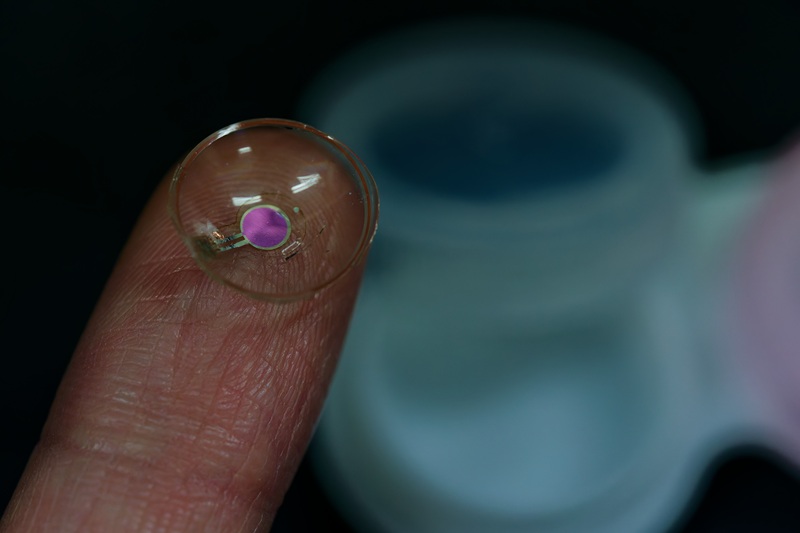 KAIST Develops World’s First Wireless OLED Contact Lens for Retinal Diagnostics
<ID-style photograph against a laboratory background featuring an OLED contact lens sample (center), flanked by the principal authors (left: Professor Seunghyup Yoo ; right: Dr. Jee Hoon Sim). Above them (from top to bottom) are: Professor Se Joon Woo, Professor Sei Kwang Hahn, Dr. Su-Bon Kim, and Dr. Hyeonwook Chae>
Electroretinography (ERG) is an ophthalmic diagnostic method used to determine whether the retina is functioning normally. It is widely employed for diagnosing hereditary retinal diseases or assessing retinal function decline.
A team of Korean researchers has developed a next-generation wireless ophthalmic diagnostic technology that replaces the existing stationary, darkroom-based retinal testing method by incorporating an “ultrathin OLED” into a contact lens. This breakthrough is expected to have applications in diverse fields such as myopia treatment, ocular biosignal analysis, augmented-reality (AR) visual information delivery, and light-based neurostimulation.
On the 12th, KAIST (President Kwang Hyung Lee) announced that a research team led by Professor Seunghyup Yoo from the School of Electrical Engineering, in collaboration with Professor Se Joon Woo of Seoul National University Bundang Hospital (Director Jeong-Han Song), Professor Sei Kwang Hahn of POSTECH (President Sung-Keun Kim) and CEO of PHI Biomed Co., and the Electronics and Telecommunications Research Institute (ETRI, President Seungchan Bang) under the National Research Council of Science & Technology (NST, Chairman Youngshik Kim), has developed the world’s first wireless contact lens-based wearable retinal diagnostic platform using organic light-emitting diodes (OLEDs).
<Figure 1. Schematic and photograph of the wireless OLED contact lens>
This technology enables ERG simply by wearing the lens, eliminating the need for large specialized light sources and dramatically simplifying the conventional, complex ophthalmic diagnostic environment.
Traditionally, ERG requires the use of a stationary Ganzfeld device in a dark room, where patients must keep their eyes open and remain still during the test. This setup imposes spatial constraints and can lead to patient fatigue and compliances challenges.
To overcome these limitations, the joint research team integrated an ultrathin flexible OLED —approximately 12.5 μm thick, or 6–8 times thinner than a human hair— into a contact lens electrode for ERG. They also equipped it with a wireless power receiving antenna and a control chip, completing a system capable of independent operation.
For power transmission, the team adopted a wireless power transfer method using a 433 MHz resonant frequency suitable for stable wireless communication. This was also demonstrated in the form of a wireless controller embedded in a sleep mask, which can be linked to a smartphone —further enhancing practical usability.
<Figure 2. Schematic of the electroretinography (ERG) testing system using a wireless OLED contact lens and an example of an actual test in progress>
While most smart contact lens–type light sources developed for ocular illumination have used inorganic LEDs, these rigid devices emit light almost from a single point, which can lead to excessive heat accumulation and thus usable light intensity. In contrast, OLEDs are areal light sources and were shown to induce retinal responses even under low luminance conditions. In this study, under a relatively low luminance* of 126 nits, the OLED contact lens successfully induced stable ERG signals, producing diagnostic results equivalent to those obtained with existing commercial light sources.
*Luminance: A value indicating how brightly a surface or screen emits light; for reference, the luminance of a smartphone screen is about 300–600 nits (can exceed 1000 nits at maximum).
Animal tests confirmed that the surface temperature of a rabbit’s eye wearing the OLED contact lens remained below 27°C, avoiding corneal heat damage, and that the light-emitting performance was maintained even in humid environments—demonstrating its effectiveness and safety as an ERG diagnostic tool in real clinical settings.
Professor Seunghyup Yoo stated that “integrating the flexibility and diffusive light characteristics of ultrathin OLEDs into a contact lens is a world-first attempt,” and that “this research can help expand smart contact lens technology into on-eye optical diagnostic and phototherapeutic platforms, contributing to the advancement of digital healthcare technology.”
< Wireless operation of the OLED contact lens >
Jee Hoon Sim, Hyeonwook Chae, and Su-Bon Kim, PhD researchers at KAIST, played a key role as co-first authors alongside Dr. Sangbaie Shin of PHI Biomed Co.. Corresponding authors are Professor Seunghyup Yoo (School of Electrical Engineering, KAIST), Professor Sei Kwang Hahn (Department of Materials Science and Engineering, POSTECH), and Professor Se Joon Woo (Seoul National University Bundang Hospital). The results were published online in the internationally renowned journal ACS Nano on May 1st.
● Paper title: Wireless Organic Light-Emitting Diode Contact Lenses for On-Eye Wearable Light Sources and Their Application to Personalized Health Monitoring
● DOI: https://doi.org/10.1021/acsnano.4c18563
● Related video clip: http://bit.ly/3UGg6R8
< Close-up of the OLED contact lens sample >
2025.08.12 View 5342
KAIST Develops World’s First Wireless OLED Contact Lens for Retinal Diagnostics
<ID-style photograph against a laboratory background featuring an OLED contact lens sample (center), flanked by the principal authors (left: Professor Seunghyup Yoo ; right: Dr. Jee Hoon Sim). Above them (from top to bottom) are: Professor Se Joon Woo, Professor Sei Kwang Hahn, Dr. Su-Bon Kim, and Dr. Hyeonwook Chae>
Electroretinography (ERG) is an ophthalmic diagnostic method used to determine whether the retina is functioning normally. It is widely employed for diagnosing hereditary retinal diseases or assessing retinal function decline.
A team of Korean researchers has developed a next-generation wireless ophthalmic diagnostic technology that replaces the existing stationary, darkroom-based retinal testing method by incorporating an “ultrathin OLED” into a contact lens. This breakthrough is expected to have applications in diverse fields such as myopia treatment, ocular biosignal analysis, augmented-reality (AR) visual information delivery, and light-based neurostimulation.
On the 12th, KAIST (President Kwang Hyung Lee) announced that a research team led by Professor Seunghyup Yoo from the School of Electrical Engineering, in collaboration with Professor Se Joon Woo of Seoul National University Bundang Hospital (Director Jeong-Han Song), Professor Sei Kwang Hahn of POSTECH (President Sung-Keun Kim) and CEO of PHI Biomed Co., and the Electronics and Telecommunications Research Institute (ETRI, President Seungchan Bang) under the National Research Council of Science & Technology (NST, Chairman Youngshik Kim), has developed the world’s first wireless contact lens-based wearable retinal diagnostic platform using organic light-emitting diodes (OLEDs).
<Figure 1. Schematic and photograph of the wireless OLED contact lens>
This technology enables ERG simply by wearing the lens, eliminating the need for large specialized light sources and dramatically simplifying the conventional, complex ophthalmic diagnostic environment.
Traditionally, ERG requires the use of a stationary Ganzfeld device in a dark room, where patients must keep their eyes open and remain still during the test. This setup imposes spatial constraints and can lead to patient fatigue and compliances challenges.
To overcome these limitations, the joint research team integrated an ultrathin flexible OLED —approximately 12.5 μm thick, or 6–8 times thinner than a human hair— into a contact lens electrode for ERG. They also equipped it with a wireless power receiving antenna and a control chip, completing a system capable of independent operation.
For power transmission, the team adopted a wireless power transfer method using a 433 MHz resonant frequency suitable for stable wireless communication. This was also demonstrated in the form of a wireless controller embedded in a sleep mask, which can be linked to a smartphone —further enhancing practical usability.
<Figure 2. Schematic of the electroretinography (ERG) testing system using a wireless OLED contact lens and an example of an actual test in progress>
While most smart contact lens–type light sources developed for ocular illumination have used inorganic LEDs, these rigid devices emit light almost from a single point, which can lead to excessive heat accumulation and thus usable light intensity. In contrast, OLEDs are areal light sources and were shown to induce retinal responses even under low luminance conditions. In this study, under a relatively low luminance* of 126 nits, the OLED contact lens successfully induced stable ERG signals, producing diagnostic results equivalent to those obtained with existing commercial light sources.
*Luminance: A value indicating how brightly a surface or screen emits light; for reference, the luminance of a smartphone screen is about 300–600 nits (can exceed 1000 nits at maximum).
Animal tests confirmed that the surface temperature of a rabbit’s eye wearing the OLED contact lens remained below 27°C, avoiding corneal heat damage, and that the light-emitting performance was maintained even in humid environments—demonstrating its effectiveness and safety as an ERG diagnostic tool in real clinical settings.
Professor Seunghyup Yoo stated that “integrating the flexibility and diffusive light characteristics of ultrathin OLEDs into a contact lens is a world-first attempt,” and that “this research can help expand smart contact lens technology into on-eye optical diagnostic and phototherapeutic platforms, contributing to the advancement of digital healthcare technology.”
< Wireless operation of the OLED contact lens >
Jee Hoon Sim, Hyeonwook Chae, and Su-Bon Kim, PhD researchers at KAIST, played a key role as co-first authors alongside Dr. Sangbaie Shin of PHI Biomed Co.. Corresponding authors are Professor Seunghyup Yoo (School of Electrical Engineering, KAIST), Professor Sei Kwang Hahn (Department of Materials Science and Engineering, POSTECH), and Professor Se Joon Woo (Seoul National University Bundang Hospital). The results were published online in the internationally renowned journal ACS Nano on May 1st.
● Paper title: Wireless Organic Light-Emitting Diode Contact Lenses for On-Eye Wearable Light Sources and Their Application to Personalized Health Monitoring
● DOI: https://doi.org/10.1021/acsnano.4c18563
● Related video clip: http://bit.ly/3UGg6R8
< Close-up of the OLED contact lens sample >
2025.08.12 View 5342 -
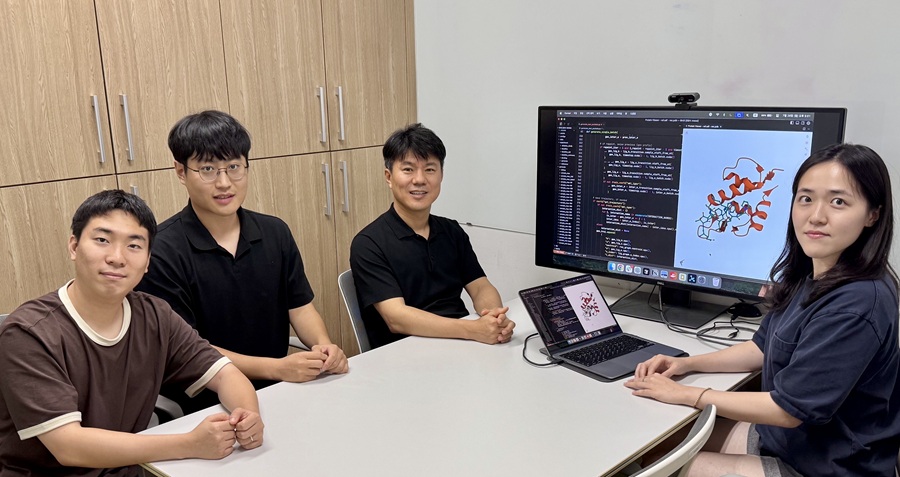 KAIST Develops AI That Automatically Designs Optimal Drug Candidates for Cancer-Targeting Mutations
< (From left) Ph.D candidate Wonho Zhung, Ph.D cadidate Joongwon Lee , Prof. Woo Young Kim , Ph.D candidate Jisu Seo >
Traditional drug development methods involve identifying a target protin (e.g., a cancer cell receptor) that causes disease, and then searching through countless molecular candidates (potential drugs) that could bind to that protein and block its function. This process is costly, time-consuming, and has a low success rate. KAIST researchers have developed an AI model that, using only information about the target protein, can design optimal drug candidates without any prior molecular data—opening up new possibilities for drug discovery.
KAIST (President Kwang Hyung Lee) announced on the 10th that a research team led by Professor Woo Youn Kim in the Department of Chemistry has developed an AI model named BInD (Bond and Interaction-generating Diffusion model), which can design and optimize drug candidate molecules tailored to a protein’s structure alone—without needing prior information about binding molecules. The model also predicts the binding mechanism (non-covalent interactions) between the drug and the target protein.
The core innovation of this technology lies in its “simultaneous design” approach. Previous AI models either focused on generating molecules or separately evaluating whether the generated molecule could bind to the target protein. In contrast, this new model considers the binding mechanism between the molecule and the protein during the generation process, enabling comprehensive design in one step. Since it pre-accounts for critical factors in protein-ligand binding, it has a much higher likelihood of generating effective and stable molecules. The generation process visually demonstrates how types and positions of atoms, covalent bonds, and interactions are created simultaneously to fit the protein’s binding site.
<Figure 1. Schematic of the diffusion model developed by the research team, which generates molecular structures and non-covalent interactions based on protein structures. Starting from a noise distribution, the model gradually removes noise (via reverse diffusion) to restore the atom positions, types, covalent bond types, and interaction types, thereby generating molecules. Interacting patterns are extracted from prior knowledge of known binding molecules or proteins, and through an inpainting technique, these patterns are kept fixed during the reverse diffusion process to guide the molecular generation.>
Moreover, this model is designed to meet multiple essential drug design criteria simultaneously—such as target binding affinity, drug-like properties, and structural stability. Traditional models often optimized for only one or two goals at the expense of others, but this new model balances various objectives, significantly enhancing its practical applicability.
The research team explained that the AI operates based on a “diffusion model”—a generative approach where a structure becomes increasingly refined from a random state. This is the same type of model used in AlphaFold 3, the 2024 Nobel Chemistry Prize-winning tool for protein-ligand structure generation, which has already demonstrated high efficiency.
Unlike AlphaFold 3, which provides spatial coordinates for atom positions, this study introduced a knowledge-based guide grounded in actual chemical laws—such as bond lengths and protein-ligand distances—enabling more chemically realistic structure generation.
<Figure 2. (Left) Target protein and the original bound molecule; (Right) Examples of molecules designed using the model developed in this study. The values for protein binding affinity (Vina), drug-likeness (QED), and synthetic accessibility (SA) are shown at the bottom.>
Additionally, the team applied an optimization strategy where outstanding binding patterns from prior results are reused. This allowed the model to generate even better drug candidates without additional training. Notably, the AI successfully produced molecules that selectively bind to the mutated residues of EGFR, a cancer-related target protein.
This study is also meaningful because it advances beyond the team’s previous research, which required prior input about the molecular conditions for the interaction pattern of protein binding.
Professor Woo Youn Kim commented that “the newly developed AI can learn and understand the key features required for strong binding to a target protein, and design optimal drug candidate molecules—even without any prior input. This could significantly shift the paradigm of drug development.” He added, “Since this technology generates molecular structures based on principles of chemical interactions, it is expected to enable faster and more reliable drug development.”
Joongwon Lee and Wonho Zhung, PhD students in the Department of Chemistry, participated as co-first authors of this study. The research results were published in the international journal Advanced Science (IF = 14.1) on July 11.
● Paper Title: BInD: Bond and Interaction-Generating Diffusion Model for Multi-Objective Structure-Based Drug Design
● DOI: 10.1002/advs.202502702
This research was supported by the National Research Foundation of Korea and the Ministry of Health and Welfare.
2025.08.12 View 5680
KAIST Develops AI That Automatically Designs Optimal Drug Candidates for Cancer-Targeting Mutations
< (From left) Ph.D candidate Wonho Zhung, Ph.D cadidate Joongwon Lee , Prof. Woo Young Kim , Ph.D candidate Jisu Seo >
Traditional drug development methods involve identifying a target protin (e.g., a cancer cell receptor) that causes disease, and then searching through countless molecular candidates (potential drugs) that could bind to that protein and block its function. This process is costly, time-consuming, and has a low success rate. KAIST researchers have developed an AI model that, using only information about the target protein, can design optimal drug candidates without any prior molecular data—opening up new possibilities for drug discovery.
KAIST (President Kwang Hyung Lee) announced on the 10th that a research team led by Professor Woo Youn Kim in the Department of Chemistry has developed an AI model named BInD (Bond and Interaction-generating Diffusion model), which can design and optimize drug candidate molecules tailored to a protein’s structure alone—without needing prior information about binding molecules. The model also predicts the binding mechanism (non-covalent interactions) between the drug and the target protein.
The core innovation of this technology lies in its “simultaneous design” approach. Previous AI models either focused on generating molecules or separately evaluating whether the generated molecule could bind to the target protein. In contrast, this new model considers the binding mechanism between the molecule and the protein during the generation process, enabling comprehensive design in one step. Since it pre-accounts for critical factors in protein-ligand binding, it has a much higher likelihood of generating effective and stable molecules. The generation process visually demonstrates how types and positions of atoms, covalent bonds, and interactions are created simultaneously to fit the protein’s binding site.
<Figure 1. Schematic of the diffusion model developed by the research team, which generates molecular structures and non-covalent interactions based on protein structures. Starting from a noise distribution, the model gradually removes noise (via reverse diffusion) to restore the atom positions, types, covalent bond types, and interaction types, thereby generating molecules. Interacting patterns are extracted from prior knowledge of known binding molecules or proteins, and through an inpainting technique, these patterns are kept fixed during the reverse diffusion process to guide the molecular generation.>
Moreover, this model is designed to meet multiple essential drug design criteria simultaneously—such as target binding affinity, drug-like properties, and structural stability. Traditional models often optimized for only one or two goals at the expense of others, but this new model balances various objectives, significantly enhancing its practical applicability.
The research team explained that the AI operates based on a “diffusion model”—a generative approach where a structure becomes increasingly refined from a random state. This is the same type of model used in AlphaFold 3, the 2024 Nobel Chemistry Prize-winning tool for protein-ligand structure generation, which has already demonstrated high efficiency.
Unlike AlphaFold 3, which provides spatial coordinates for atom positions, this study introduced a knowledge-based guide grounded in actual chemical laws—such as bond lengths and protein-ligand distances—enabling more chemically realistic structure generation.
<Figure 2. (Left) Target protein and the original bound molecule; (Right) Examples of molecules designed using the model developed in this study. The values for protein binding affinity (Vina), drug-likeness (QED), and synthetic accessibility (SA) are shown at the bottom.>
Additionally, the team applied an optimization strategy where outstanding binding patterns from prior results are reused. This allowed the model to generate even better drug candidates without additional training. Notably, the AI successfully produced molecules that selectively bind to the mutated residues of EGFR, a cancer-related target protein.
This study is also meaningful because it advances beyond the team’s previous research, which required prior input about the molecular conditions for the interaction pattern of protein binding.
Professor Woo Youn Kim commented that “the newly developed AI can learn and understand the key features required for strong binding to a target protein, and design optimal drug candidate molecules—even without any prior input. This could significantly shift the paradigm of drug development.” He added, “Since this technology generates molecular structures based on principles of chemical interactions, it is expected to enable faster and more reliable drug development.”
Joongwon Lee and Wonho Zhung, PhD students in the Department of Chemistry, participated as co-first authors of this study. The research results were published in the international journal Advanced Science (IF = 14.1) on July 11.
● Paper Title: BInD: Bond and Interaction-Generating Diffusion Model for Multi-Objective Structure-Based Drug Design
● DOI: 10.1002/advs.202502702
This research was supported by the National Research Foundation of Korea and the Ministry of Health and Welfare.
2025.08.12 View 5680 -
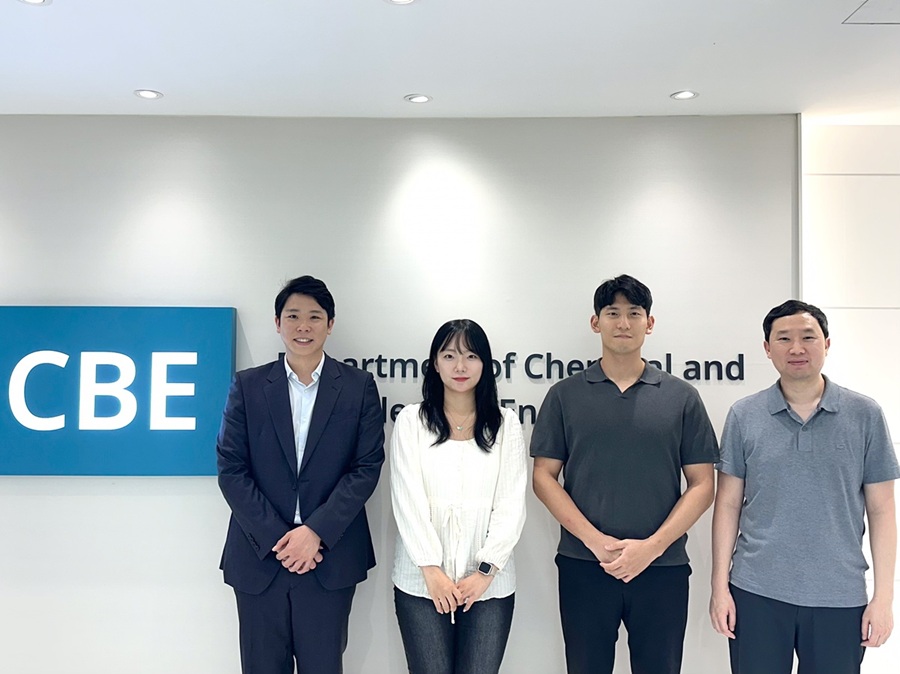 KAIST Develops Bioelectrosynthesis Platform for Switch-Like Precision Control of Cell Signaling
<(From left)Professor Jimin Park, Ph.D candidate Myeongeun Lee, Ph.D cadidate Jaewoong Lee,Professor Jihan Kim>
Cells use various signaling molecules to regulate the nervous, immune, and vascular systems. Among these, nitric oxide (NO) and ammonia (NH₃) play important roles, but their chemical instability and gaseous nature make them difficult to generate or control externally. A KAIST research team has developed a platform that generates specific signaling molecules in situ from a single precursor under an applied electrical signal, enabling switch-like, precise spatiotemporal control of cellular responses. This approach could provide a foundation for future medical technologies such as electroceuticals, electrogenetics, and personalized cell therapies.
KAIST (President Kwang Hyung Lee) announced on August 11 that a research team led by Professor Jimin Park from the Department of Chemical and Biomolecular Engineering, in collaboration with Professor Jihan Kim's group, has developed a 'Bioelectrosynthesis Platform' capable of producing either nitric oxide or ammonia on demand using only an electrical signal. The platform allows control over the timing, spatial range, and duration of cell responses.
Inspired by enzymes involved in nitrite reduction, the researchers implemented an electrochemical strategy that selectively produces nitric oxide or ammonia from a single precursor, nitrite (NO₂⁻). By changing the catalyst, the team generated ammonia or nitric oxide from nitrite using a copper-molybdenum-sulfur catalyst (Cu2MoS4) and an iron-incorporated catalyst (FeCuMS4), respectively.
Through electrochemical measurements and computer simulations, the team revealed that Fe sites in the FeCuMoS4 catalyst bind nitric oxide intermediates more strongly, shifting product selectivity toward nitric oxide. Under the same electrical conditions, the Fe-containing catalyst preferentially produces nitric oxide, whereas the Cu2MoS4 catalyst favors ammonia production.
<Figure 1. Schematic diagram of a bio-electrosynthesis platform that synthesizes a desired signaling substance with an electrical signal (left) and the results of precise cell control using it (right)>
The research team demonstrated biological functionality by using the platform to activate ion channels in human cells. Specifically, electrochemically produced nitric oxide activated TRPV1 channels (responsive to heat and chemical stimuli), while electrochemically produced ammonia induced intracellular alkalinization and activated OTOP1 proton channels. By tuning the applied voltage and electrolysis duration, the team modulated the onset time, spatial extent, and termination of cellular responses, which effectively turned cellular signaling on and off like a switch.
<Figure 2. Experimental results showing the change in the production ratio of nitric oxide and ammonia signaling substances according to the type of catalyst (left) and computational simulation results showing the strong bond between iron and nitric oxide (right)>
Professor Jimin Park said, "This work is significant because it enables precise cellular control by selectively producing signaling molecules with electricity. We believe it has strong potential for applications in electroceutical technologies targeting the nervous system or metabolic disorders."
Myeongeun Lee and Jaewoong Lee, Ph.D. students in the Department of Chemical and Biomolecular Engineering at KAIST, served as the co-first authors. Professor Jihan Kim is a co-author. The paper was published online in 'Angewandte Chemie International Edition' on July 8, 2025 (DOI: 10.1002/ange.202508192).
Reference: https://doi.org/10.1002/ange.202508192
Authors: Myeongeun Lee†, Jaewoong Lee†, Yongha Kim, Changho Lee, Sang Yeon Oh, Prof. Jihan Kim, Prof. Jimin Park*
†These authors contributed equally. *Corresponding author.
2025.08.12 View 4026
KAIST Develops Bioelectrosynthesis Platform for Switch-Like Precision Control of Cell Signaling
<(From left)Professor Jimin Park, Ph.D candidate Myeongeun Lee, Ph.D cadidate Jaewoong Lee,Professor Jihan Kim>
Cells use various signaling molecules to regulate the nervous, immune, and vascular systems. Among these, nitric oxide (NO) and ammonia (NH₃) play important roles, but their chemical instability and gaseous nature make them difficult to generate or control externally. A KAIST research team has developed a platform that generates specific signaling molecules in situ from a single precursor under an applied electrical signal, enabling switch-like, precise spatiotemporal control of cellular responses. This approach could provide a foundation for future medical technologies such as electroceuticals, electrogenetics, and personalized cell therapies.
KAIST (President Kwang Hyung Lee) announced on August 11 that a research team led by Professor Jimin Park from the Department of Chemical and Biomolecular Engineering, in collaboration with Professor Jihan Kim's group, has developed a 'Bioelectrosynthesis Platform' capable of producing either nitric oxide or ammonia on demand using only an electrical signal. The platform allows control over the timing, spatial range, and duration of cell responses.
Inspired by enzymes involved in nitrite reduction, the researchers implemented an electrochemical strategy that selectively produces nitric oxide or ammonia from a single precursor, nitrite (NO₂⁻). By changing the catalyst, the team generated ammonia or nitric oxide from nitrite using a copper-molybdenum-sulfur catalyst (Cu2MoS4) and an iron-incorporated catalyst (FeCuMS4), respectively.
Through electrochemical measurements and computer simulations, the team revealed that Fe sites in the FeCuMoS4 catalyst bind nitric oxide intermediates more strongly, shifting product selectivity toward nitric oxide. Under the same electrical conditions, the Fe-containing catalyst preferentially produces nitric oxide, whereas the Cu2MoS4 catalyst favors ammonia production.
<Figure 1. Schematic diagram of a bio-electrosynthesis platform that synthesizes a desired signaling substance with an electrical signal (left) and the results of precise cell control using it (right)>
The research team demonstrated biological functionality by using the platform to activate ion channels in human cells. Specifically, electrochemically produced nitric oxide activated TRPV1 channels (responsive to heat and chemical stimuli), while electrochemically produced ammonia induced intracellular alkalinization and activated OTOP1 proton channels. By tuning the applied voltage and electrolysis duration, the team modulated the onset time, spatial extent, and termination of cellular responses, which effectively turned cellular signaling on and off like a switch.
<Figure 2. Experimental results showing the change in the production ratio of nitric oxide and ammonia signaling substances according to the type of catalyst (left) and computational simulation results showing the strong bond between iron and nitric oxide (right)>
Professor Jimin Park said, "This work is significant because it enables precise cellular control by selectively producing signaling molecules with electricity. We believe it has strong potential for applications in electroceutical technologies targeting the nervous system or metabolic disorders."
Myeongeun Lee and Jaewoong Lee, Ph.D. students in the Department of Chemical and Biomolecular Engineering at KAIST, served as the co-first authors. Professor Jihan Kim is a co-author. The paper was published online in 'Angewandte Chemie International Edition' on July 8, 2025 (DOI: 10.1002/ange.202508192).
Reference: https://doi.org/10.1002/ange.202508192
Authors: Myeongeun Lee†, Jaewoong Lee†, Yongha Kim, Changho Lee, Sang Yeon Oh, Prof. Jihan Kim, Prof. Jimin Park*
†These authors contributed equally. *Corresponding author.
2025.08.12 View 4026 -
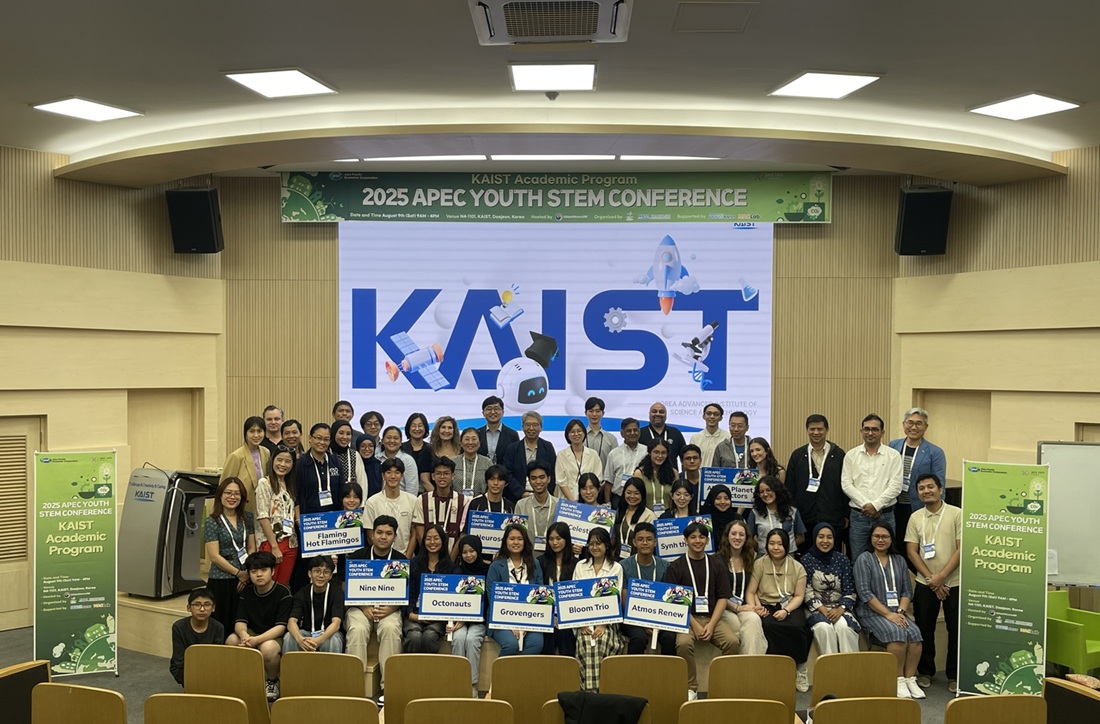 2025 APEC Youth STEM Science Exchange Program Successfully Completed
<Photo1. Group photo at the end of the program>
KAIST (President Kwang Hyung Lee) announced on the 11thof August that it successfully hosted the 'APEC Youth STEM Conference KAIST Academic Program,' a global science exchange program for 28 youth researchers from 10 countries and over 30 experts who participated in the '2025 APEC Youth STEM* Collaborative Research and Competition.' The event was held at the main campus in Daejeon on Saturday, August 9.
STEM (Science, Technology, Engineering, Math) refers to the fields of science and engineering.
The competition was hosted by the Ministry of Science and ICT and organized by the APEC Science Gifted Mentoring Center. It took place from Wednesday, August 6, to Saturday, August 9, 2025, at KAIST in Daejeon and the Korea Science Academy of KAIST in Busan. The KAIST program was organized by the APEC Science Gifted Mentoring Center and supported by the KAIST Institute for the Gifted and Talented in Science Education.
Participants had the opportunity to experience Korea's cutting-edge research infrastructure firsthand, broaden their horizons in science and technology, and collaborate and exchange ideas with future science talents from the APEC region.
As the 2025 APEC chair, Korea is promoting various international collaborations to discover and nurture the next generation of talent in the STEM fields. The KAIST academic exchange program was particularly meaningful as it was designed with the international goal of revitalizing science gifted exchanges and expanding the basis for cooperation among APEC member countries. It moved beyond the traditional online-centric research collaboration model to focus on hands-on, on-site, and convergence research experiences.
The global science exchange program at KAIST introduced participants to KAIST's world-class educational and research environment and provided various academic content to allow them to experience real-world examples of convergence technology-based research.
<Photo2. Program Activities>
First, the KAIST Admissions Office participated, introducing KAIST's admissions system and its educational and research environment to outstanding international students, providing an opportunity to attract global talent. Following this, Dr. Tae-kyun Kwon of the Music and Audio Computing Lab at the Graduate School of Culture Technology presented a convergence art project based on musical artificial intelligence data, including a research demonstration in an anechoic chamber.
<Photo3. Participation in a music AI research demonstration>
Furthermore, a Climate Talk Concert program was organized under the leadership of the Graduate School of Green Growth and Sustainability, in connection with the theme of the APEC Youth STEM Collaborative Research: 'Youth-led STEM Solutions: Enhancing Climate Resilience.'
The program was planned and hosted by Dean Jiyong Eom. It provided a platform for young people to explore creative and practical STEM-based solutions to the climate crisis and seek opportunities for international cooperation.
<Photo4. Participation in Music AI Research Demonstration >
The program was a meaningful time for APEC youth researchers, offering practical support for their research through special lectures and Q&A sessions on:
Interdisciplinary Research and Education in the Era of Climate Crisis (Dean Jiyong Eom)
Energy Transition Technology in the Carbon Neutral Era (Professor Jeongrak Son)
Policies for Energy System Change (Professor Jihyo Kim)
Carbon Neutral Bio-technology (Professor Gyeongrok Choi)
After the afternoon talk concert, Lee Jing Jing, a student from Brunei, shared her thoughts, saying, "The lectures by the four professors were very meaningful and insightful. I was able to think about energy transition plans to solve climate change from various perspectives."
Si-jong Kwak, Director of the KAIST Global Institute for Talented Education, stated, "I hope that young people from all over the world will directly experience KAIST's research areas and environment, expand their interest in KAIST, and continue to grow as outstanding talents in the fields of science and engineering."
KAIST President Kwang Hyung Lee said, "KAIST will be at the center of science and technology-based international cooperation and will spare no effort to support future talents in developing creative and practical problem-solving skills. I hope this event served as an opportunity for young people to understand the value of global cooperation and grow into future science leaders."
2025.08.11 View 5533
2025 APEC Youth STEM Science Exchange Program Successfully Completed
<Photo1. Group photo at the end of the program>
KAIST (President Kwang Hyung Lee) announced on the 11thof August that it successfully hosted the 'APEC Youth STEM Conference KAIST Academic Program,' a global science exchange program for 28 youth researchers from 10 countries and over 30 experts who participated in the '2025 APEC Youth STEM* Collaborative Research and Competition.' The event was held at the main campus in Daejeon on Saturday, August 9.
STEM (Science, Technology, Engineering, Math) refers to the fields of science and engineering.
The competition was hosted by the Ministry of Science and ICT and organized by the APEC Science Gifted Mentoring Center. It took place from Wednesday, August 6, to Saturday, August 9, 2025, at KAIST in Daejeon and the Korea Science Academy of KAIST in Busan. The KAIST program was organized by the APEC Science Gifted Mentoring Center and supported by the KAIST Institute for the Gifted and Talented in Science Education.
Participants had the opportunity to experience Korea's cutting-edge research infrastructure firsthand, broaden their horizons in science and technology, and collaborate and exchange ideas with future science talents from the APEC region.
As the 2025 APEC chair, Korea is promoting various international collaborations to discover and nurture the next generation of talent in the STEM fields. The KAIST academic exchange program was particularly meaningful as it was designed with the international goal of revitalizing science gifted exchanges and expanding the basis for cooperation among APEC member countries. It moved beyond the traditional online-centric research collaboration model to focus on hands-on, on-site, and convergence research experiences.
The global science exchange program at KAIST introduced participants to KAIST's world-class educational and research environment and provided various academic content to allow them to experience real-world examples of convergence technology-based research.
<Photo2. Program Activities>
First, the KAIST Admissions Office participated, introducing KAIST's admissions system and its educational and research environment to outstanding international students, providing an opportunity to attract global talent. Following this, Dr. Tae-kyun Kwon of the Music and Audio Computing Lab at the Graduate School of Culture Technology presented a convergence art project based on musical artificial intelligence data, including a research demonstration in an anechoic chamber.
<Photo3. Participation in a music AI research demonstration>
Furthermore, a Climate Talk Concert program was organized under the leadership of the Graduate School of Green Growth and Sustainability, in connection with the theme of the APEC Youth STEM Collaborative Research: 'Youth-led STEM Solutions: Enhancing Climate Resilience.'
The program was planned and hosted by Dean Jiyong Eom. It provided a platform for young people to explore creative and practical STEM-based solutions to the climate crisis and seek opportunities for international cooperation.
<Photo4. Participation in Music AI Research Demonstration >
The program was a meaningful time for APEC youth researchers, offering practical support for their research through special lectures and Q&A sessions on:
Interdisciplinary Research and Education in the Era of Climate Crisis (Dean Jiyong Eom)
Energy Transition Technology in the Carbon Neutral Era (Professor Jeongrak Son)
Policies for Energy System Change (Professor Jihyo Kim)
Carbon Neutral Bio-technology (Professor Gyeongrok Choi)
After the afternoon talk concert, Lee Jing Jing, a student from Brunei, shared her thoughts, saying, "The lectures by the four professors were very meaningful and insightful. I was able to think about energy transition plans to solve climate change from various perspectives."
Si-jong Kwak, Director of the KAIST Global Institute for Talented Education, stated, "I hope that young people from all over the world will directly experience KAIST's research areas and environment, expand their interest in KAIST, and continue to grow as outstanding talents in the fields of science and engineering."
KAIST President Kwang Hyung Lee said, "KAIST will be at the center of science and technology-based international cooperation and will spare no effort to support future talents in developing creative and practical problem-solving skills. I hope this event served as an opportunity for young people to understand the value of global cooperation and grow into future science leaders."
2025.08.11 View 5533